

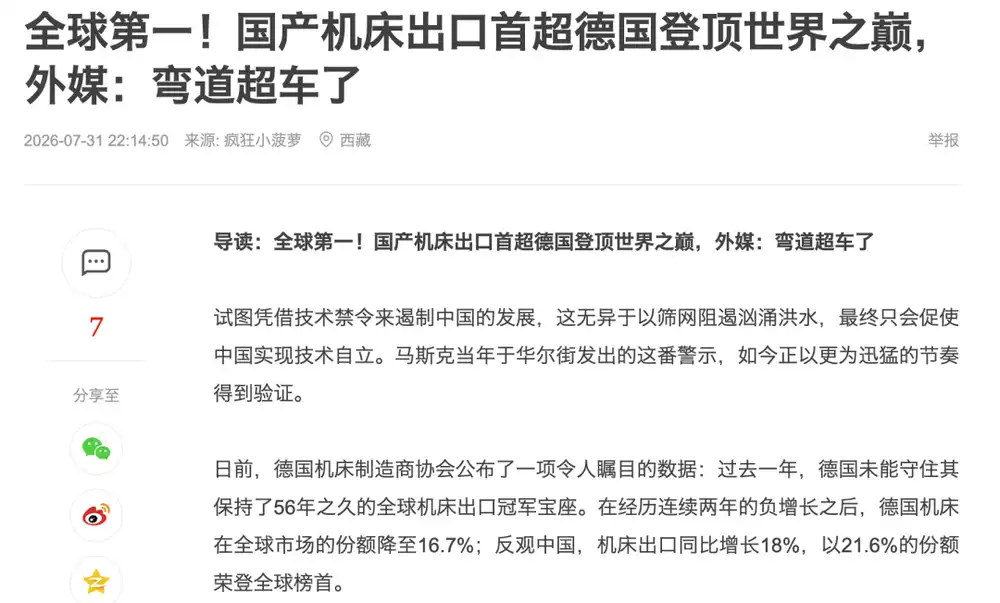
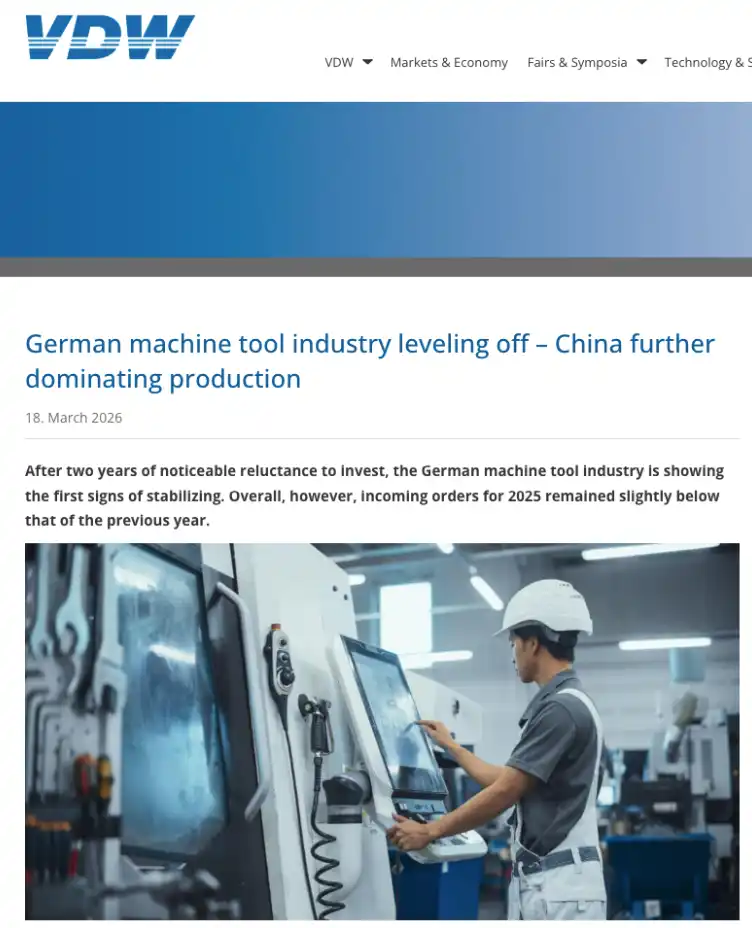
China’s machine tool exports reached 8.6 billion euros in 2025, or about 21% of the global total, according to the German Machine Tool Builders’ Association, or VDW. That put China ahead of Germany’s 7.1 billion euros for the first time, ending Germany’s long hold on the top spot.
The result runs against a familiar perception. For years, Chinese manufacturers were often seen as buyers of expensive equipment from Germany and Japan, with limited alternatives and heavy dependence on imported high-end tools. The article cites DMG MORI as an example, saying the company installs GPS displacement detection devices on machines exported worldwide. The installation site is registered at delivery, and unauthorized relocation can cause the machine to lock and stop. The piece notes that this is part of a global export compliance mechanism meant to prevent resale for weapons manufacturing.
Why high-end machine tools are hard to build
A machine tool’s basic job sounds simple: cut, grind, or press metal into the required shape. But high-end models work at micron-level precision. The report gives a rough comparison of 1 micron as about one-sixtieth the diameter of a human hair.
The harder part is not hitting that precision once at the factory. It is keeping it over long operating periods. The article breaks the problem into three forces that happen at the same time and compound each other: heat, vibration, and wear.
Heat comes first. Motors, bearings, and cutting points all generate heat during operation. Metal expands and contracts with temperature, and even a few degrees can change dimensions by several microns. Uneven heating can also shift axes that were aligned at the start. High-end tools need a thermal compensation system that corrects in real time, and the report says that calls for optimization across the full machine structure, material choices, and control algorithms, not just an isolated sensor fix.
Then comes vibration. At high cutting speeds, the tool strikes metal with significant reactive force, which can trigger self-excited vibration, or chatter. Once chatter appears, the machined surface can fill with ripples and burrs, and parts may be scrapped. Suppressing it depends on structural rigidity, damping design, cutting parameters, and dynamic compensation inside the CNC system.
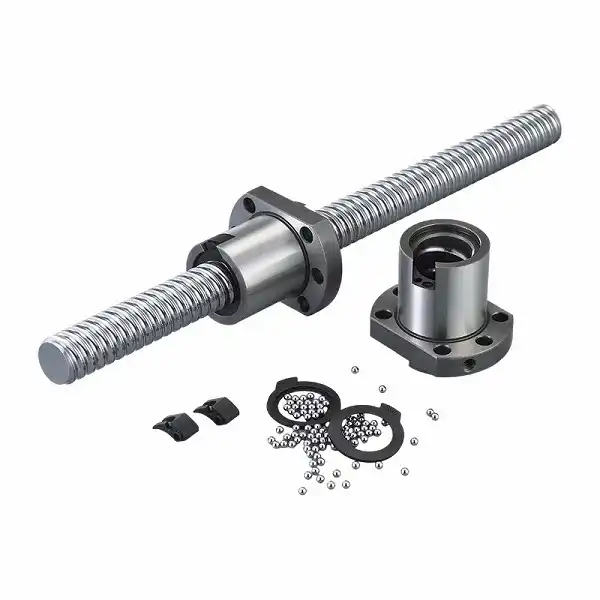
Wear is the third issue. After a spindle rotates hundreds of millions of times at high speed, bearings wear down. Guideways wear down. Ball screws wear down. The article says many domestic machine tools can leave the factory with acceptable precision, but drift after a period of use. In the industry, that is often framed as a question of precision retention.
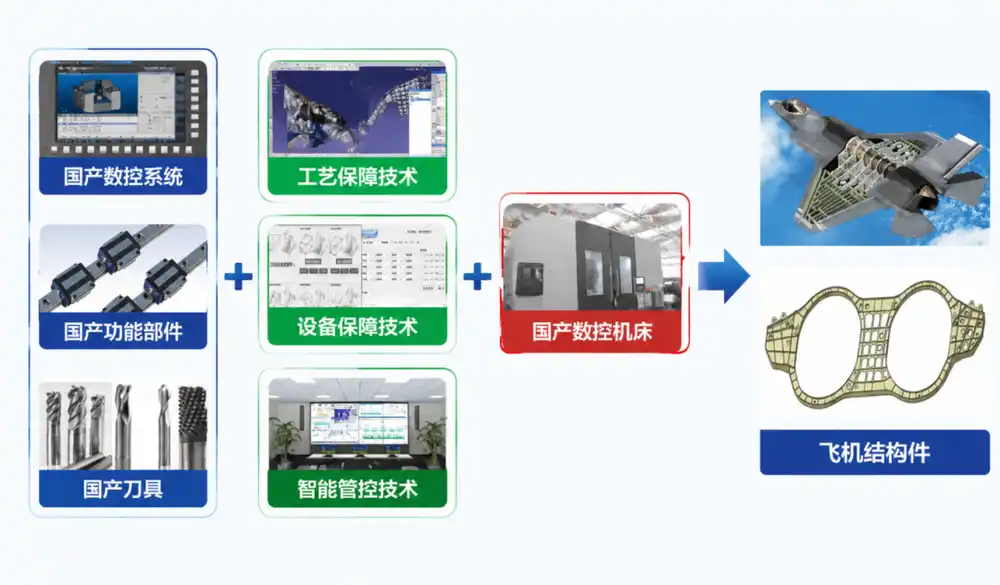
Those physical limits sit in a small set of core components. The spindle acts as the machine’s heart, shaping cutting power and rotational precision. Ball screws and guideways form the skeleton, determining motion accuracy and smoothness. The CNC system serves as the brain, coordinating multiple axes and handling compensation and computation. The article also points to the sector’s classic chicken-and-egg problem: producing precision spindles and screws requires precision grinding machines, which means a country needs good machine tools before it can make better ones.
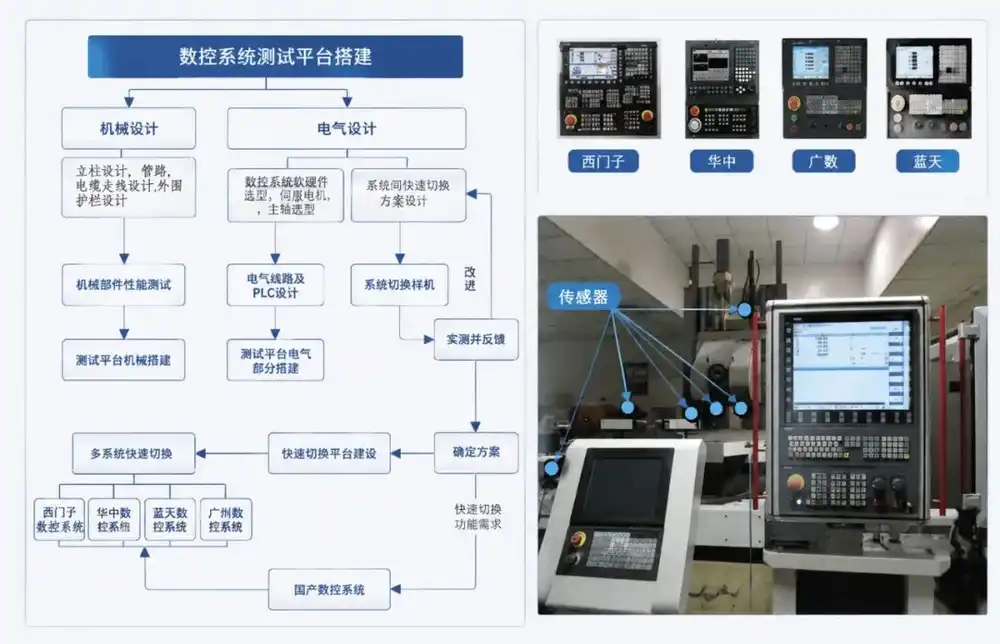
That is where China’s bottlenecks sat for years. Based on an assessment cited in the report, as of 2020 about 90% of high-end CNC systems and servo systems used for precise motion execution still relied on imports. More than 90% of high-end functional components such as spindles, ball screws, and guideways also came from outside suppliers. Another professional review published in 2025 said the average mean time between failures, or MTBF, for foreign high-end CNC systems was above 50,000 hours, compared with about 30,000 hours for domestic systems.
The “04 Special Project” raised the floor
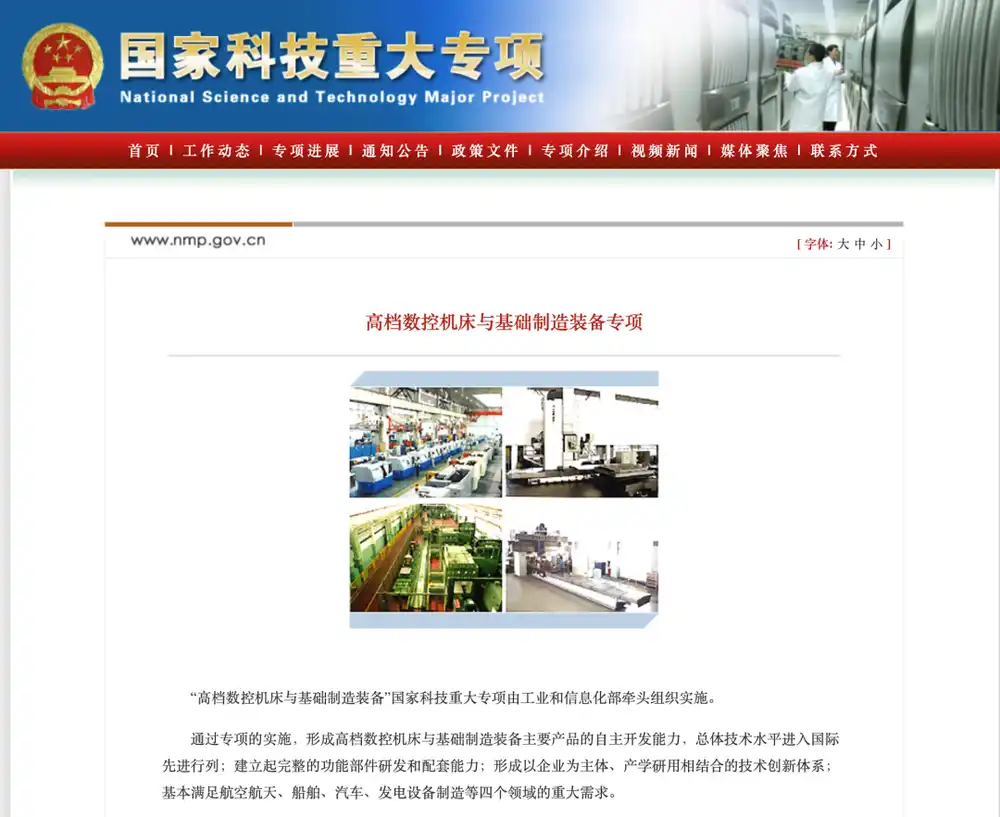
The article traces one turning point to China’s national major special project for high-end CNC machine tools and basic manufacturing equipment, known in the industry as the “04 Special Project.”
Before that program began, domestic high-end CNC systems accounted for less than 1% of the market inside Chinese-made machine tools, and complete high-end CNC machine tools had an MTBF of only about 600 hours. The report converts that into roughly one month between failures on an automotive production line running 20 hours a day.
The project started in 2009 and ran through 2020. Over those 11 years, the article says it delivered two measurable changes:
- the localization rate for high-end CNC systems rose from less than 1% to 31.9%;
- MTBF for complete high-end CNC machine tools improved from 600 hours to more than 2,000 hours.
That did not close the gap with the global first tier. Still, it moved Chinese suppliers into the game. The report’s point is that the project solved the question of whether the country had these capabilities at all. The tougher question of whether they were good enough at scale was left to the next force.
EV manufacturing changed what needed to be machined
That next force was the market, and specifically the speed and size of China’s industrial demand. The article uses new energy vehicles as the clearest example. The impact on machine tools was not only a jump in orders. It changed the parts being processed and the methods needed to process them.
In traditional internal combustion vehicles, manufacturers had to machine engine blocks and multi-speed transmission housings. In battery electric vehicles, those parts give way to integrated die-cast bodies, battery housings, and electric drive housings. That shift reshaped both the work and the equipment mix.
The report says those needs led to a new batch of domestic equipment and complete production-line solutions built around EV manufacturing. Integrated die-cast components are far larger than traditional parts, which pushes demand for gantry machining centers with very large travel. Battery housings are thin-walled, prone to vibration, and subject to strict sealing requirements, making generic setups difficult to apply without dedicated tooling and tailored processing schemes.
Integrated die-casting is the most vivid example in the article. To turn the rear body of the Model Y from more than 70 stamped and welded parts into a single cast component, Tesla needed a 6,000-ton-class ultra-large die-casting machine, and only a small number of companies worldwide could build equipment at that scale.
The article goes further and describes 16,000 tons of clamping force as the pressure used to hold the two halves of a mold together during die-casting, comparing it to stacking more than ten thousand passenger cars downward to shape a full body section within seconds. After Tesla, the process spread quickly to NIO, XPeng, and more Chinese automakers. The article’s framing is that China became the main arena where this manufacturing method was defined, scaled, and diffused.
That mattered because in newer fields such as integrated die-casting, battery housings, and electric drive housings, Chinese companies started closer to German and Japanese peers. These were new questions for everyone. Chinese manufacturers also had a location advantage: the world’s largest EV market was next door, customers were nearby, and local feedback could move into product iterations faster through domestic supply chains.
Even so, the article does not present the EV wave as a complete reset. It says the localization rate for high-end machine tools in the automotive sector is still below 10%, and for high-precision internal and external cylindrical grinders and precision high-speed gear grinding machines used in shaft and gear parts, localization remains below 5%.
Customer validation took years
Machine tools are heavy industrial assets, and the article stresses a rule that slows every transition: equipment selection takes a long time, and switching suppliers takes even longer.
Once an automotive production line starts running, it may stay in service for 10 years or more. Replacing a supplier means more than paying for new hardware. It often requires process revalidation, fresh yield verification, and worker retraining. Car companies may spend years evaluating an equipment vendor, but once a supplier is approved and installed, they are reluctant to switch.
That is why specification sheets alone do not win market share. Real adoption comes only when a customer is willing to put an operating production line on a company’s equipment. The article mentions a story stretching from 2004 to 2016, a 12-year span used to show that China’s catch-up did not happen at a single turning point. It came through three lines moving together: technology progress, market demand, and user validation.
China passed Germany on exports, step by step
The article says the reversal in exports was not sudden. The machine tool industry posted its first trade surplus in 2019. By 2023, it had moved into surplus across all categories. In 2025, exports formally moved ahead of Germany.
Overseas markets have now shifted from a supplemental channel to the main source of incremental growth. In 2025, exports contributed 63.6% of growth in total industry revenue, according to the report.
Still, this No. 1 ranking reflects leadership in scale and breadth rather than across-the-board technical leadership. The largest export category is special processing machine tools, meaning equipment that uses electrical discharge, lasers, and similar methods rather than conventional cutting tools.
The top five export destinations are Vietnam, Russia, India, Thailand, and the United States, showing an export center of gravity tilted toward Asian manufacturing markets. VDW also noted that the total includes machines produced in China by international companies from Germany, Japan, Switzerland, and other countries and then exported from China, though it did not disclose the share.
From being controlled as a buyer to managing exports as a seller
The article argues that the bigger shift is not the ranking itself but China’s changing role in the industry. In the past, foreign export control lists largely shaped what levels of precision Chinese buyers could access. Now China’s machine tool sector has entered a stage where it must identify and manage exports of sensitive equipment itself.
It cites a policy change dated June 30, 2026, saying customs further required exporters of related equipment to declare technical parameters and indicate whether the products fall under controlled items. In the article’s framing, the industry has moved from being tightly managed on the buying side to becoming more finely regulated on the selling side.
The next test is service, support, and precision over time
The report ends on a quieter point. Selling a machine tool abroad is only the start. What follows can span 10 or 20 years of installation, commissioning, fault response, spare parts supply, and precision assurance. Export revenue can turn quickly. An overseas service network cannot.
At the 2026 China CNC Machine Tool Fair, the article describes a Turkish buyer who traveled nearly 9,000 kilometers to find Chinese equipment. The repeated question was simple: after the purchase, will there be someone local to repair it, and how fast can the supplier arrive when something goes wrong?
Years ago, Chinese buyers of German machine tools worried about long-term operating stability and about use restrictions tied to GPS displacement detection. Today, overseas buyers focus more on after-sales response. The specific issue has changed. The underlying question has not. Can this kind of expensive equipment be trusted for long-term use after it is installed?
The article’s answer is that getting machines across the border clears only the first hurdle. Installing them well, tuning them accurately, fixing failures in time, and keeping precision intact over 10 years is what will decide whether China can truly hold the global top spot.
The piece was compiled and edited by Coollabs and first published on the WeChat public account Coollabs (ID: coollabs).