
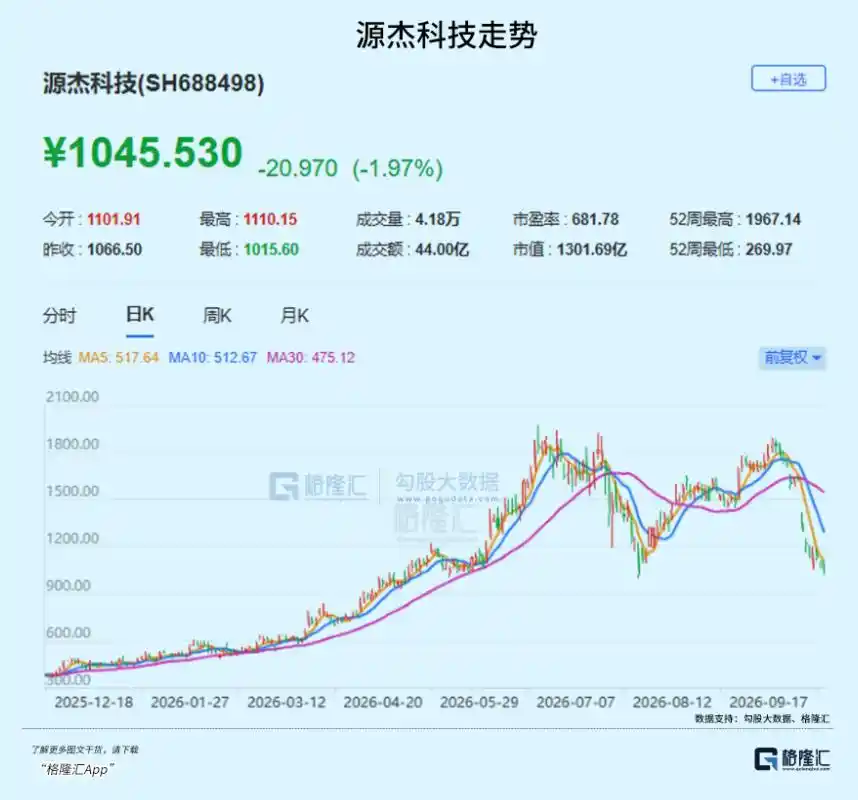
Chinese optical communication stocks, especially upstream component makers, have traded weakly in recent sessions. Since the market reopened after the Oct. 8 holiday break, shares including Yuanjie Technology, Changguang Huaxin and Shijia Photons have come under repeated pressure as investor sentiment turned cautious.
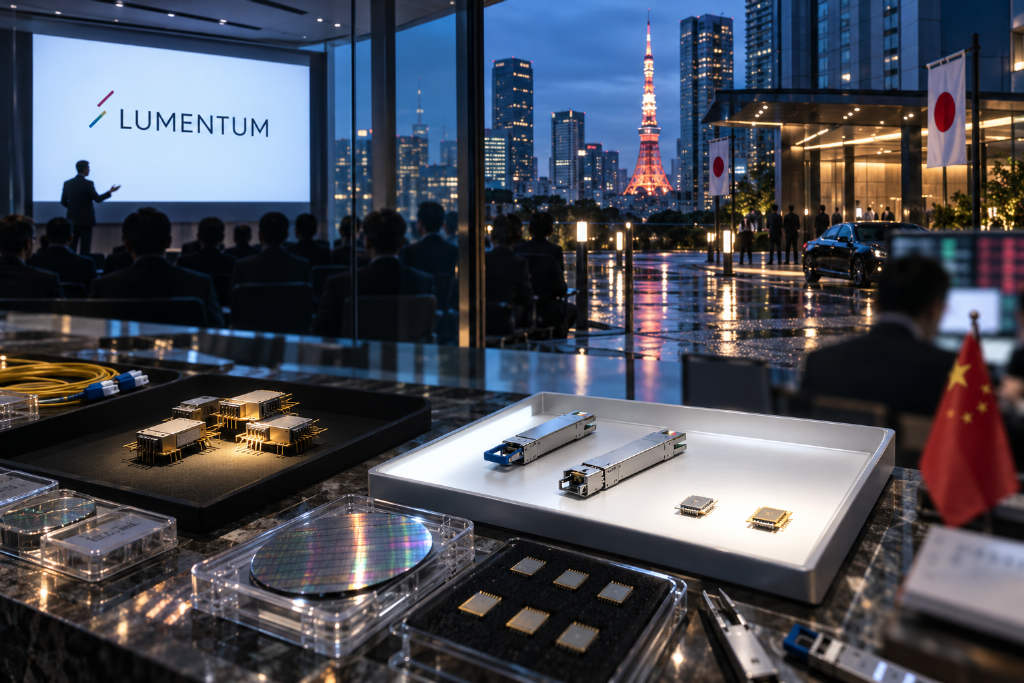
The contrast highlighted in the article is striking. While the domestic market has been rattled by rumors about price pressure on 1.6T optical chips and talk of tighter overseas policy constraints, optical component giant Lumentum said in Tokyo that its capacity is booked out to early 2029, with supply-demand gaps on some products reaching as much as 70%.
That leaves the market with a basic question. If overseas leaders are still selling into a shortage, why have Chinese suppliers been marked down first instead of being treated as replacement beneficiaries.
Lumentum says shortages are still broad
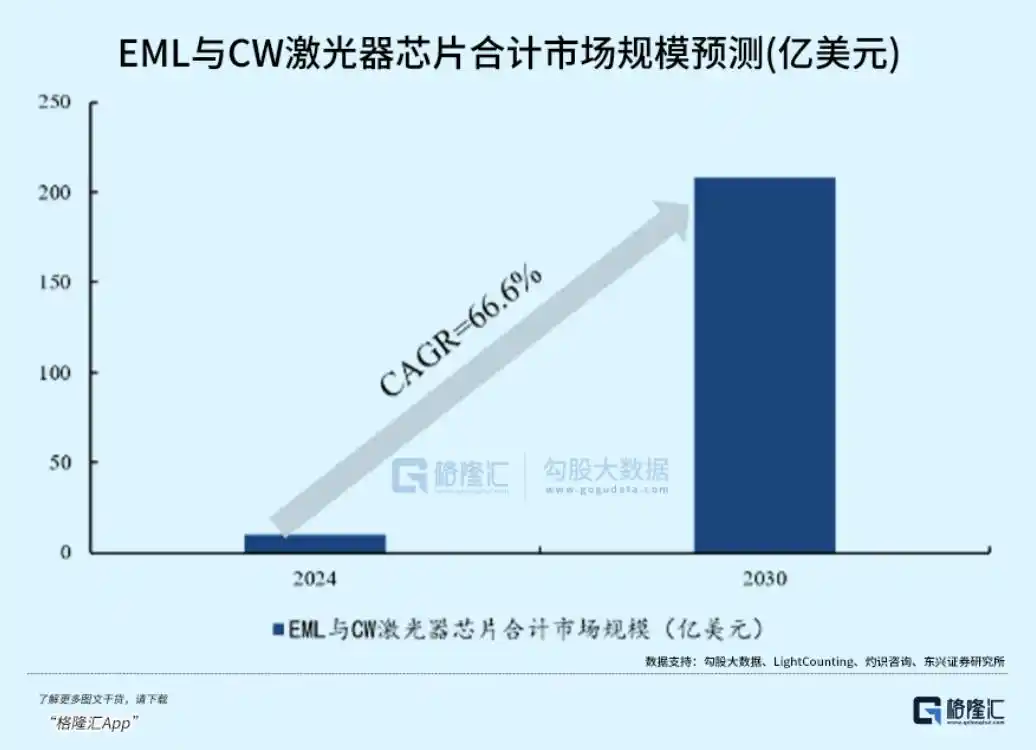
The article quotes Lumentum as saying, 「we are still short everywhere」. In that account, EML is short, CW is short, and the imbalance may not ease even by 2027. Once optical links are used more broadly for GPU scale-up interconnects in 2028, demand could expand another three to four times.
On capacity, the company said its wafer fab near Tokyo expanded output 12-fold over two years. It is also investing at least $350 million with nearby facilities, yet building a new unit of capacity still takes three to five years.
That shifts attention to a narrower point: which 1.6T optical chips are actually being discussed when the market talks about price cuts.
Two chip types sit behind 1.6T deployments
The article breaks the mainstream datacenter laser chips into two groups.
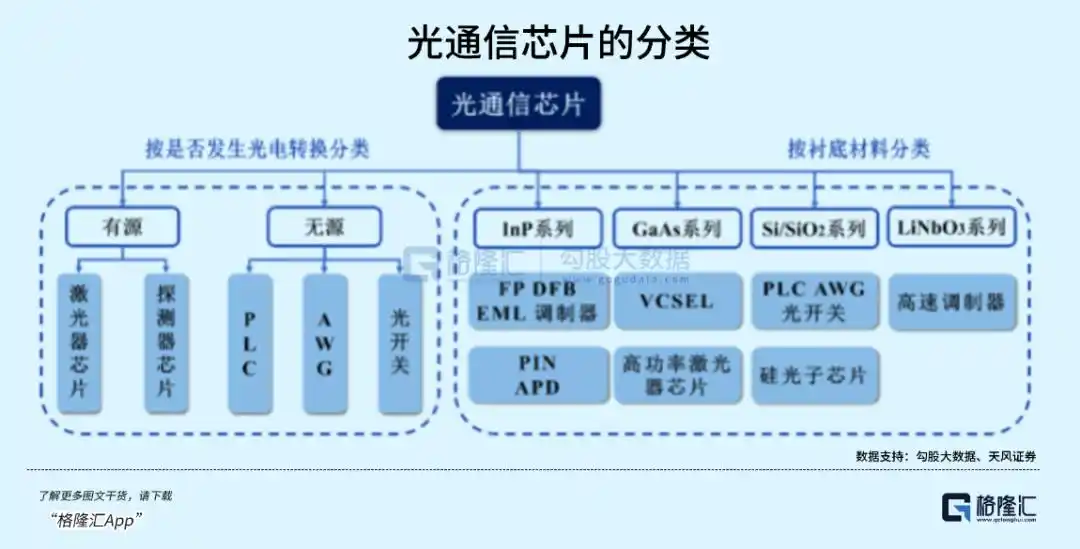
One is EML, or electro-absorption modulated laser, where the laser and modulator are integrated on the same chip. The chip emits light and loads the signal itself. As data rates double, modulator bandwidth also needs to double, and yield becomes the main bottleneck.
The other is CW, or continuous-wave laser. Silicon does not emit light on its own, so silicon photonics designs need an indium phosphide laser placed alongside the silicon chip as a stable light source. These products are divided by power level, and the engineering challenge rises with power.
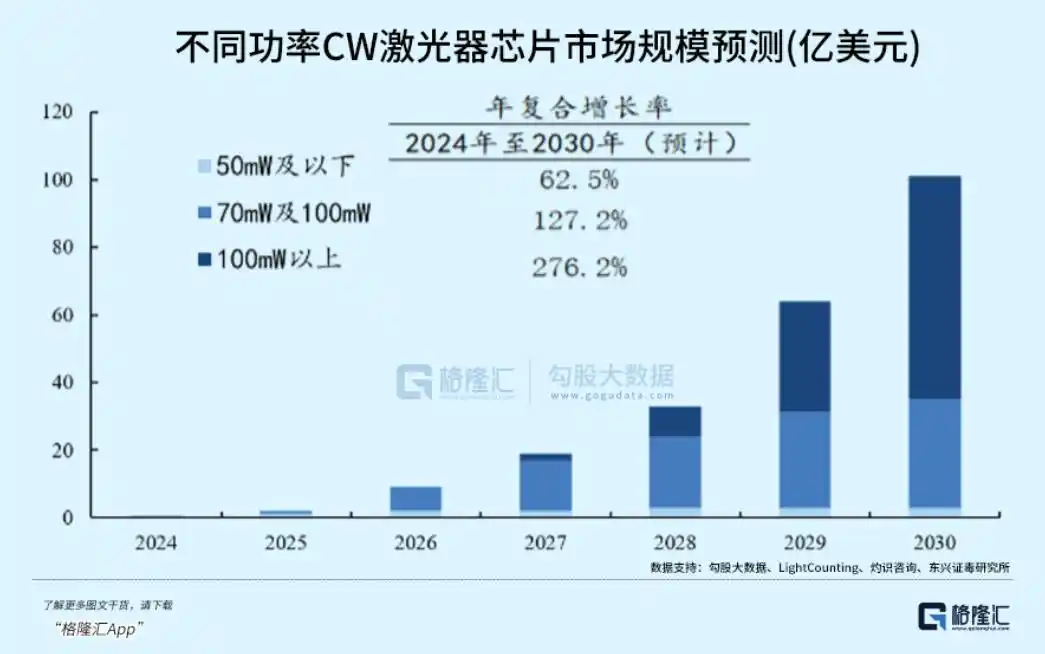
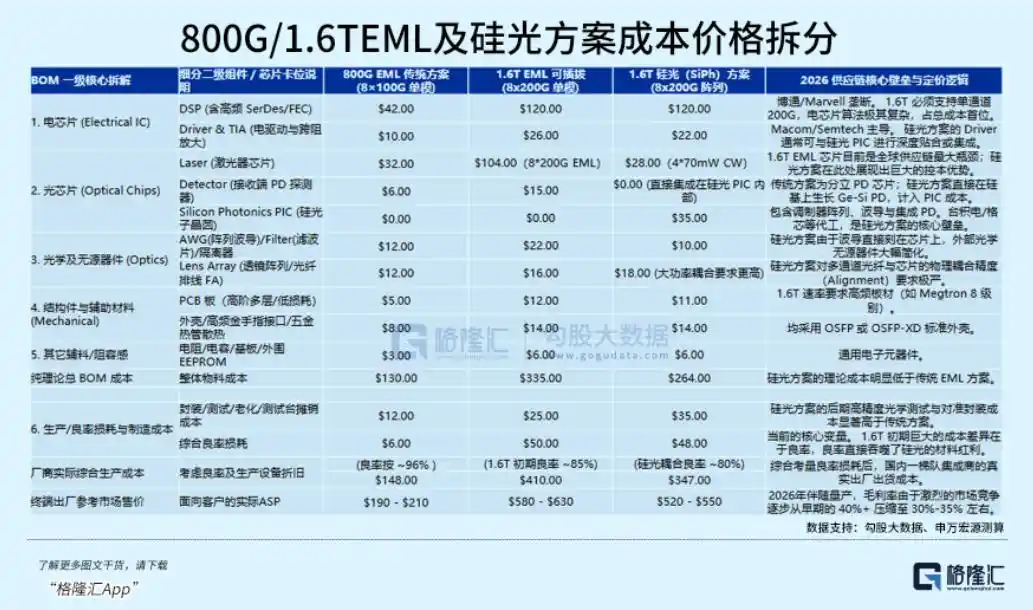
In the framework laid out in the piece, speed and power define the product tier. A 1.6T EML solution uses eight 200G EML chips. A silicon photonics approach typically uses 70mW to 100mW CW lasers.
The rumor appears to point mainly to 70/100mW CW
The article says 200G EML is one of Lumentum’s main areas of focus. More than one-quarter of its EML revenue already comes from 200G EML, and the company expects that product to become the volume driver by mid-2027.
Within Lumentum’s competitive set, the piece names Coherent as the only clear rival. Chinese suppliers, by comparison, are described as either still in development or in customer qualification for this segment. The only domestic producer already in mass production, Source Photonics, mainly uses its optical chips in its own modules and sells externally only in a limited way.
Under that logic, the part of the market most likely to be hit by the current pricing rumor is 70/100mW CW.
That also happens to be the segment where Chinese suppliers already have volume shipments and are still expanding output, while moving into higher power bands over time.
Capacity plans and shipments already show up in company data
On the capacity side, Shijia Photons in September saw the Shanghai Stock Exchange accept its private placement plan, which proposes RMB 1.4 billion for a CW laser chip and COC industrialization project. Yuanjie Technology is putting about RMB 1 billion into the second phase of its domestic project, mainly to prepare capacity for 2027. The main plant structure and clean room are complete, and equipment has begun moving in.
Shipment progress is also listed company by company. Yuanjie has already moved into batch shipments, and those products have become the main line in its datacenter business. Changguang Huaxin has reached mass-production shipment levels. Shijia has also entered batch shipments. Dingxin Optoelectronics, under Yongding, has landed mass production, and in July it received two orders worth more than RMB 1 billion combined.
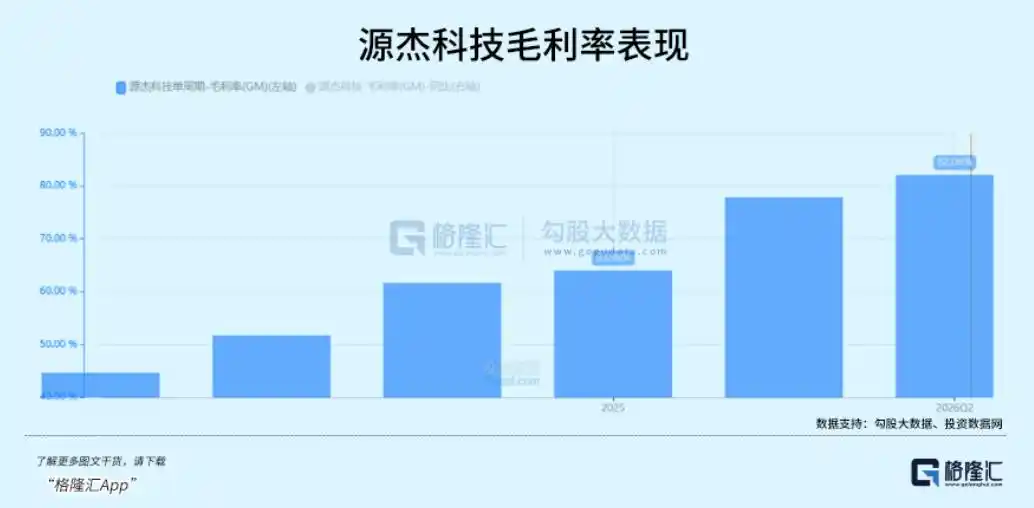
The article points to financial results as evidence that volume deliveries are already happening. Yuanjie reported first-half 2026 revenue of RMB 925 million, up 351% year over year. Revenue from its datacenter business was RMB 774 million, up 640%. Gross margin was 80.42%, up 31.62 percentage points from a year earlier. Second-quarter gross margin alone was 82.06%, and the datacenter business posted a gross margin of 84.0%.
The piece sums that up this way: the current domestic profit pool is being driven mainly by 70/100mW CW and 100G EML. With demand clearly there and supply expanding quickly, the foundation for pricing-war concerns is also there.
Lumentum’s comments are used as a cross-check
The article says that at an investor meeting in late August, a Lumentum executive was asked what would happen when Chinese CW makers entered the market. His answer, as described in the piece, was that domestic CW suppliers would eventually make it.
That supports a more segmented reading of the industry. Chinese producers could become the main force filling the demand gap in 70/100mW CW over the next several years. Lumentum, meanwhile, would keep its advantage in 200G EML and higher-power lasers, where it can still command a premium.
In other words, the rumored price decline for 1.6T supporting optical chips may have a much narrower real scope than headline trading implies. The pressure would be concentrated in 70/100mW CW, the part shared by silicon photonics and 800G deployments. That segment faces the familiar risk of rising volume and tighter margins at the same time, while 200G EML and higher-power lasers are still operating in a seller’s market.
The sell-off may be about valuation assumptions, not a confirmed price cut
The article argues that the deeper issue is not whether prices can ever fall. It is how much investors are paying for the expected combination of price and volume growth in optical chips.
In the short term, it says, there is little factual support for an immediate broad price cut. Over a longer horizon, however, companies themselves have not ruled out weaker pricing. At a Sept. 30 half-year results meeting, executives at Changguang Huaxin said overall optical chip prices are currently stable because supply and demand remain tight. Over the long run, they said, prices could decline as yields improve, capacity expands and new entrants come in.
That is why the article sees the pullback as a valuation adjustment first. The real market debate is less 「will prices ever decline」 and more 「how much are investors willing to pay for this margin and volume story」.
High-margin assumptions are doing a lot of work
Yuanjie is used as the clearest example. The company posted a gross margin of 80.42%, a second-quarter gross margin of 82.06%, a datacenter business gross margin of 84.0%, and a net margin attributable to shareholders of 65.62%. The article says those are exceptionally high levels for a manufacturing business.
Margins that high amplify earnings on the way up. They also increase sensitivity on the way down. If 70/100mW products move into price competition, even modest changes at the margin can have a large effect on profitability.
Valuation itself also embeds the idea that these margins can last. Based on one institutional forecast cited in the article, Yuanjie’s net profit attributable to shareholders is projected at RMB 935 million in 2026, RMB 1.486 billion in 2027 and RMB 2.292 billion in 2028, implying price-to-earnings multiples of 144.73x, 91.08x and 59.05x respectively.
If the high-margin assumption weakens, earnings downgrades and multiple compression can arrive together. The company’s June 30 risk disclosure also listed large swings in optical chip demand and prices, intensifying competition, and high customer concentration as factors that could affect both operating results and the sustainability of current gross margins.
From that perspective, the article says the present adjustment is better explained not by a price cut that has already happened, but by a market beginning to price in the possibility that today’s gross margins will not last indefinitely.
Policy rumors are a longer-dated variable
Another source of pressure has been market talk about potential U.S. policy restrictions on optical modules. The article says the core logic here is not a traditional ban on high-end technology exports. It is closer to supply-chain exclusion based on the value share of U.S.-origin materials in a module.
Citing Morgan Stanley, the piece says any restriction would likely be linked to the value share of U.S. content in the module. DSPs and lasers carry the highest value share and are mostly supplied by U.S. vendors. It also says implementation would more likely be phased in starting with the 3.2T generation.
For now, though, the article stresses that this remains at the level of institutional scenario analysis. It is aimed at next-generation products and does not amount to a fundamental hit to the current 1.6T market.
Even if such rules were implemented, the direct issue would not be whether Chinese companies can manufacture high-end chips. The issue would be whether those chips, once built into modules sold into the U.S. market, can still qualify for market access. In that framework, the affected portion would be the Chinese chips used in modules sold to the United States, while the chip tier itself would not be the decisive variable.
What matters next is where supply can actually break through
As an investment question, the article says this geopolitical concern is mostly affecting sentiment and valuation in the near term. If access rules for the 3.2T era are eventually formalized, the commercial runway for Chinese suppliers moving into higher-power CPO and NPO products could end up narrower, potentially limited to non-U.S. markets.
Over a longer cycle, that would constrain the ceiling for domestic upgrading. The valuation hit would be most direct for suppliers that mainly support export-oriented modules and have not yet secured a position in higher-end tiers.
The article closes by saying Chinese optical chip valuations are now boxed in by three lines of pressure after this year’s sharp run-up: price competition in lower-end products, a capacity gap in higher-end products, and a longer-term market-access game around the 3.2T era.
In the years ahead, the margin defense in lower-end CW and the mass-production push in higher-end EML and high-power products may unfold at the same time. Sector divergence, in that view, will depend less on whether a company is in optical chips at all and more on the supply-demand structure of the power and speed tiers where it competes.
The article points to several markers for the next stage: Changguang Huaxin’s fourth-quarter progress in 200G EML mass-production deliveries; whether Yuanjie’s 200G EML can move from 「customer qualification progressing steadily」 to 「qualification passed」 or even 「batch shipments」; and the timing of domestic high-power CW sources entering CPO and NPO supply chains, with particular attention on the high-power source needed for NPO architecture.
That brings the discussion back to the opening questions. What exactly is falling in price, and which tier is still short. The article’s answer is that the key to judging the sector lies in knowing which tier is short and who can fill it. Localization in 70/100mW CW is seen as likely. The bigger value divide may come down to whether 200G EML and CW light sources above 100mW can move from qualification to large-scale shipments before 2027.
The article carries a note that the views are those of the original author and do not represent Gelonghui’s position. It also says the content is for reference only and does not constitute investment advice. The piece is attributed to the WeChat public account Gelonghui APP, ID hkguruclub, and authored by Freddy.