
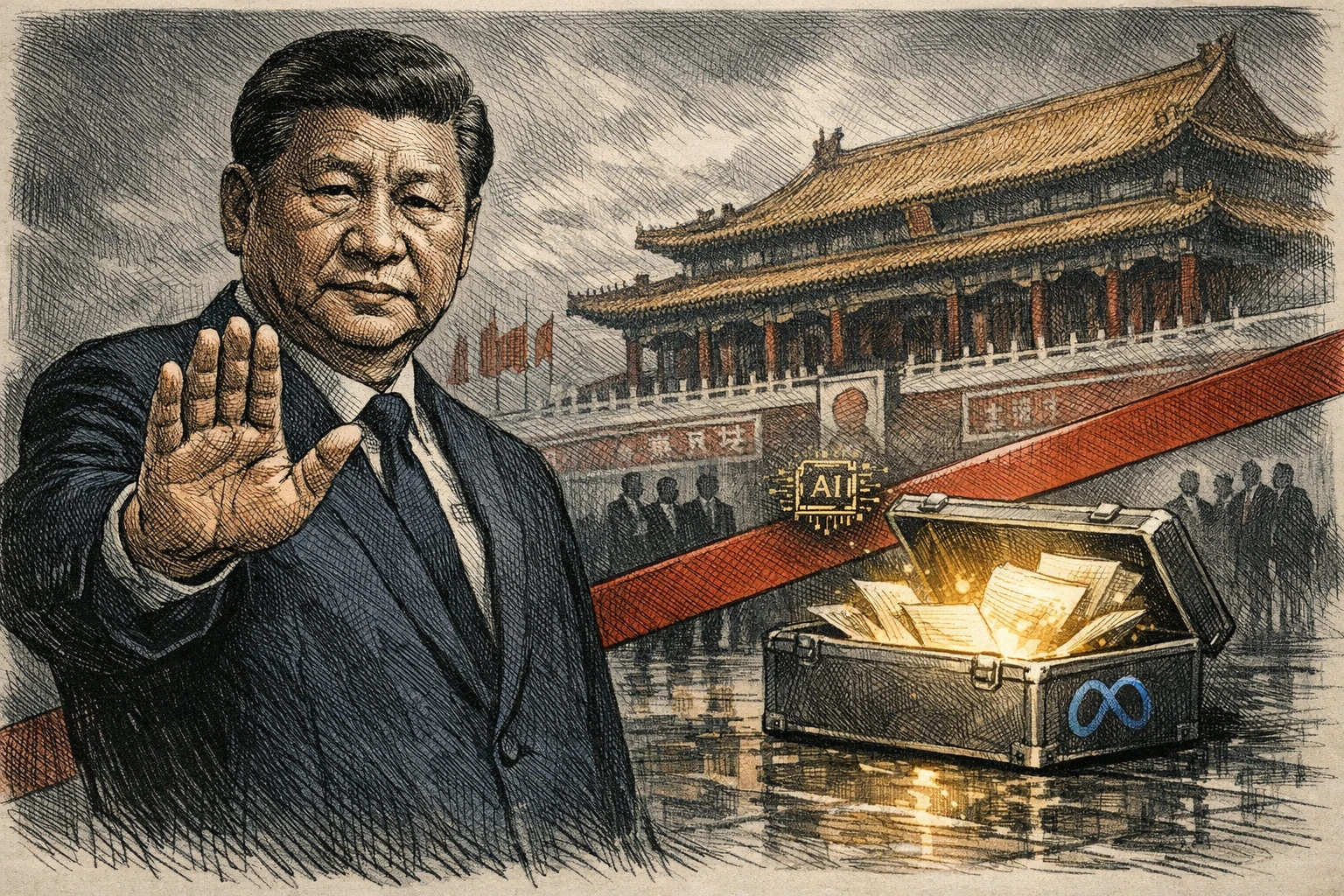
On April 28, China’s National Development and Reform Commission (NDRC) ordered Meta to unwind its $2 billion acquisition of AI startup Manus, marking the first time Beijing has publicly invoked a foreign investment security review mechanism that had sat dormant for 15 years, according to Bloomberg.
What makes the order striking is that the deal closed more than four months ago. Manus employees already work out of Meta’s Singapore office, and the startup’s founder has joined Meta’s core AI team. The code has been delivered and integrated into Meta services. Investors — including Tencent Holdings, ZhenFund, and Sequoia China — have all received full refunds. U.S. venture firm Benchmark, which led Manus’s $75 million funding round last year, has even begun distributing returns to its limited partners, a step that typically signals a fully settled deal.
Code Integrated, Employees Onboard: Beijing Acts Four Months Post-Closing
Beijing has forced deal reversals before — most notably when it ordered Didi Global to delist from the NYSE in 2021. But Manus presents a far more complex challenge. Didi’s delisting merely removed shares from U.S. exchanges. Manus, by contrast, is being asked to “return to pre-acquisition status” — a nearly impossible technical task given that its code is already embedded in Meta’s systems and its staff already employed by the U.S. company.
Meta’s public response was cautious and vague. The company said it has “fully complied with relevant laws” and looks forward to a proper resolution, without elaborating further.
Beijing’s Real Leverage: Controlling Founder Cross-Border Freedom
“The Manus ruling is largely symbolic. Unwinding the deal at this point is not feasible; capital and technology transfer have already been completed,” said Laila Khawaja, research director at Gezhi Technology. She noted that Beijing has limited leverage over Meta itself — Facebook and Instagram are already banned in China, and the company has almost no physical presence there. “What leverage Beijing retains is controlling the cross-border mobility of Manus executives and potentially forcing them to resign from Meta,” she said.
Analysts were blunt about the practical impossibility of enforcement. Forcing the founders and investors to return Meta’s money would leave the U.S. company with Manus’s key AI technology for free.
Warning Signal: AI Startups Must Not Copy the “Going Abroad” Template
The real impact of this case, Bloomberg reports, is not on Meta or Manus but on the broader Chinese AI startup ecosystem. Many Chinese AI startups have been evaluating the “Singapore template”: moving their registered company, intellectual property, and core talent outside mainland China to gain overseas fundraising access while loosening the grip of domestic regulation. Manus was once the most successful example of this approach.
Liu Xu, a researcher at Tsinghua University’s National Strategy Institute, said this is the first time the government has publicly used this foreign investment review mechanism. Future acquisitions in high-tech fields, especially AI, and cases involving high valuations or overseas relocation will face strict scrutiny. Deals that “could lead to core patents or key technologies falling into foreign hands” will be especially targeted, he emphasized.
The NDRC is also pressuring other AI startups. Bloomberg reported last week that Moonshot AI and Stepfun have been told they cannot accept U.S. investment without explicit approval. ByteDance, China’s most valuable startup, faces similar restrictions.
The orders come ahead of a scheduled summit between Trump and Xi in the coming weeks, with discussions expected to cover investment, technology access, AI, and trade. It remains unclear whether the Meta-Manus case will make it onto the agenda. But the message to any Chinese startup or talent considering a “de-China” relocation strategy is unmistakable: Beijing is watching, and it can still act.