
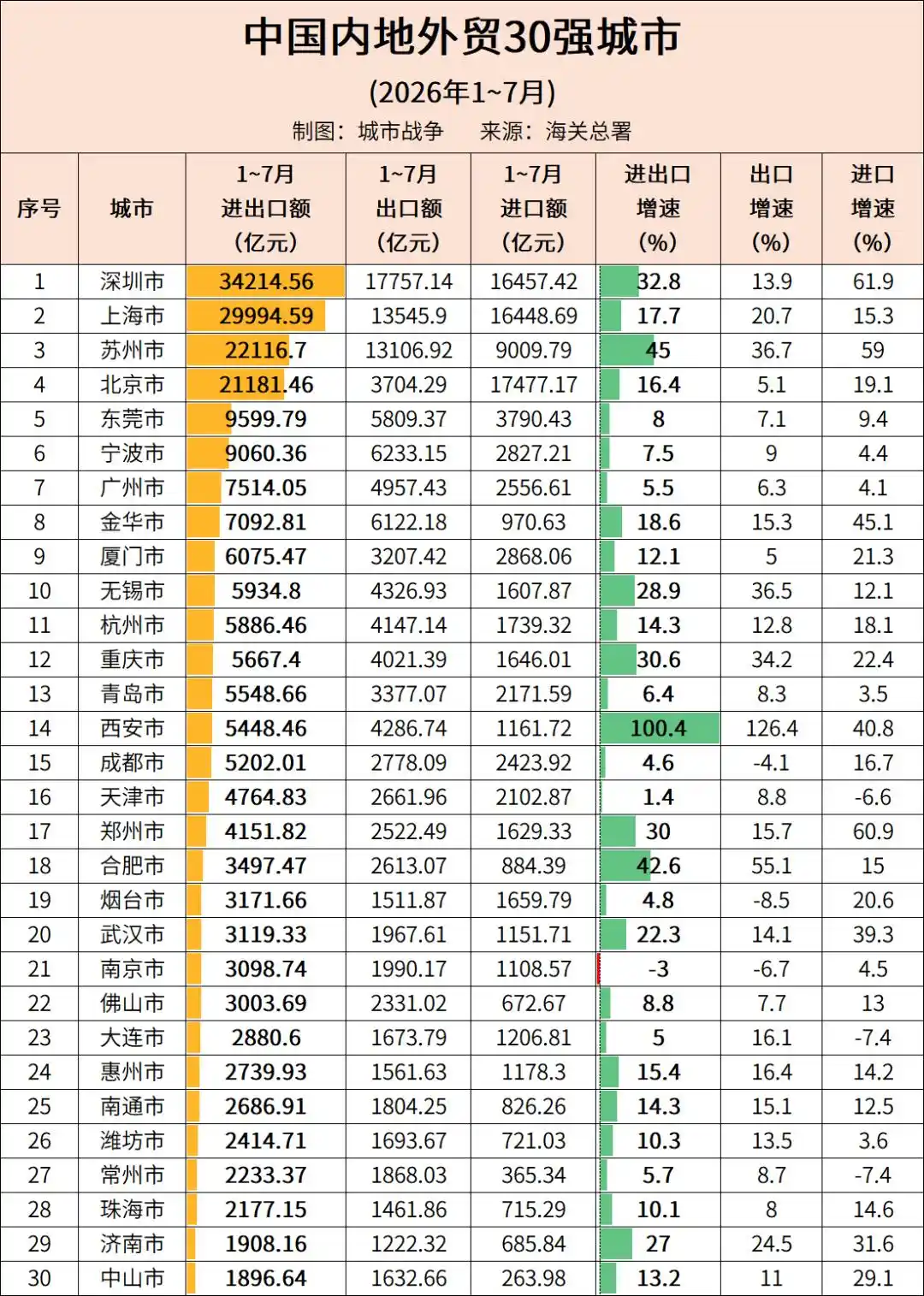
China’s foreign trade map changed again in the first seven months of 2026, with several major cities moving up or down the national rankings. Shenzhen held onto the top spot and opened a wider gap over Shanghai. Suzhou moved past Beijing to rank third. Wuxi entered the top 10, while Qingdao dropped out. Xi’an was the fastest-growing city among the leading group, with foreign trade up 100.4%.
Data released by the General Administration of Customs showed that China’s total goods imports and exports reached 30.13 trillion yuan in the first seven months, up 17.3% from a year earlier. Exports came in at 17.44 trillion yuan, rising 14%. Imports reached 12.69 trillion yuan, up 22%, compared with a 1.6% decline in the same period last year.
The figures show imports growing faster than exports. The source article said that many imports are intermediate goods, including chips, steel, and chemical raw materials, which are processed or assembled in China and then exported, linking import growth with export capacity.
Shenzhen stays on top as imports overtake Shanghai for the first time
Shenzhen recorded 3.42 trillion yuan in total trade in the first seven months, up 32.8% year on year. That put it 422 billion yuan ahead of Shanghai. For comparison, Shenzhen finished all of 2025 only 43.05 billion yuan ahead of Shanghai, which means the gap widened sharply within a year.
Imports were the main driver. Shenzhen’s imports reached 1.65 trillion yuan in the period, surging 61.9% from a year earlier. Based on the detailed numbers cited in the source, Shenzhen imported 1.6457 trillion yuan, slightly above Shanghai’s 1.6449 trillion yuan. The article described this as the first time in history that Shenzhen’s import scale had exceeded Shanghai’s.
The shift looks even more pronounced against last year’s base. In the same period of 2025, Shenzhen’s imports stood at 1.02 trillion yuan, with growth of only 9.4%. After this jump, Shenzhen’s trade structure also changed, with imports now nearly matching exports instead of trailing them by a wide margin.
The article also noted that Beijing and Shanghai differ from most other cities in trade structure, with imports exceeding exports in both cases. Imports account for 55% of Shanghai’s total trade and 82.5% of Beijing’s.
Suzhou rises to third and Wuxi breaks into the top 10
The ranking of China’s top 30 trade cities saw multiple changes from 2025.
- Suzhou overtook Beijing for the first time, moving from fourth to third nationwide.
- Wuxi climbed from 14th to 10th, entering the national top 10.
- Chongqing rose from 15th to 12th.
- Xi’an jumped five places, from 19th to 14th.
- Hefei moved from 21st to 18th.
- Wuhan advanced from 22nd to 20th.
- Huizhou moved from 25th to 24th.
- Jinan rose from 30th to 29th.
- Zhongshan climbed from 32nd to 30th, entering the top 30.
Several cities moved the other way.
- Qingdao fell from 10th to 13th, dropping out of the top 10.
- Chengdu slipped from 12th to 15th.
- Tianjin moved down from 13th to 16th.
- Nanjing fell from 17th to 21st.
- Foshan dropped from 20th to 22nd.
Manufacturing and electronics shaped the reshuffle
According to the source article, one of the clearest features of this year’s reshuffle is that manufacturing-heavy and export-oriented cities moved forward as a group, especially those with stronger foundations in chips and AI hardware.
The article highlighted Xi’an, Suzhou, Hefei, and Shenzhen, with growth rates of 100.4%, 45%, 42.6%, and 32.8%, respectively.
Xi’an was described as the biggest dark horse. Its total trade surged 100.4% in the first seven months. The source said Samsung operates its largest global NAND flash production base in Xi’an, accounting for 40% of Samsung’s total capacity. Micron also has a presence there, while local chip companies are expanding. In the first seven months, Xi’an’s exports of mechanical and electrical products rose 143.8%, accounting for more than 95% of total exports.
Suzhou’s gains were tied to electronic information products and AI computing hardware. In July alone, Suzhou’s foreign trade grew 67.8%. Trade in Suzhou Industrial Park in the first seven months already exceeded the full-year level of last year, and AI computing hardware products accounted for more than half of exports.
Hefei’s momentum came from ChangXin Memory Technologies and the local memory chip industry. Shenzhen remained active in AI servers and consumer electronics trade, backed by its manufacturing base. Wuxi, a major integrated circuit hub with a relatively complete semiconductor supply chain, also benefited.
Most top 30 cities still trailed the national average growth rate
Despite the sharp reshuffle, not every city kept pace. The source article said 19 of the top 30 foreign trade cities posted growth rates below the national average of 17.3%.
The article was originally published on the WeChat public account City Wars, written by Tinghai Moyu, and carried by MarsBit.