
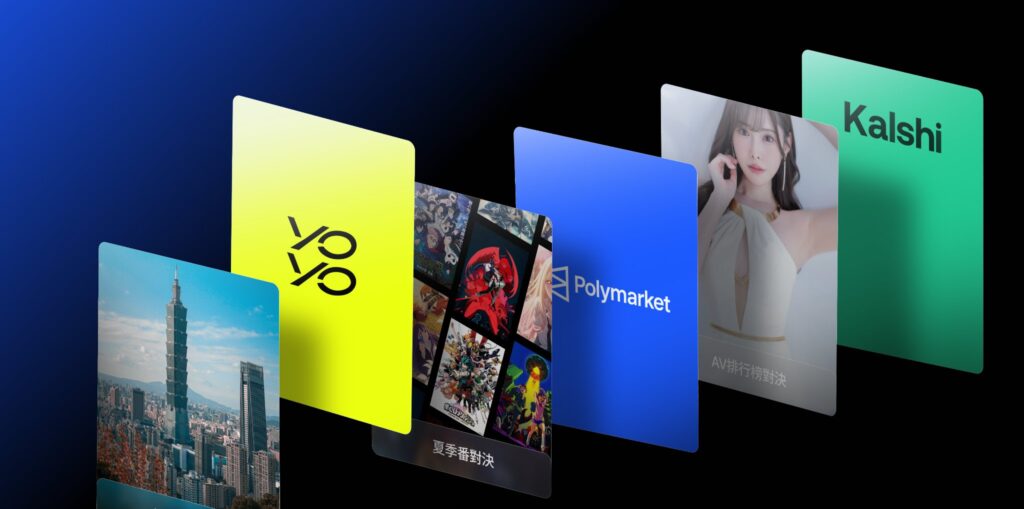
Prediction markets drew global attention during the 2024 U.S. election, when traders on Polymarket pushed Donald Trump’s odds to 60% before the final result broadly matched the signal. In BlockTempo’s telling, that night gave the sector a public demonstration of what it can do: when people put real money behind a view, the market can produce a probability signal that looks sharper than a poll.
But that experience does not translate cleanly for Chinese-speaking users. Open Polymarket, the report says, and the screen is filled with the Federal Reserve, U.S. elections, American football and Hollywood awards. Very little is built around the questions Asian users actually follow day to day, even though Asia accounts for more than 4 billion people.
Prediction markets as probability sensors
BlockTempo describes a prediction market as a place where prices aggregate information. Users buy and sell contracts tied to whether a future event will happen, and the contract price works as a market-implied probability. The article cites a16z economist Scott Duke Kominers, who has described the model as a “probability sensor.” A contract trading at $0.50 implies a 50% chance, and traders who believe the real odds are higher buy and move the price upward.
The report says a16z has highlighted four advantages over traditional polling: live probability readings, rapid updates as new information arrives, financial incentives that push participants to do real research, and the ability to list niche questions. That makes prediction markets useful well beyond wagering. In the article’s examples, companies can use them to estimate product launch timing, researchers can use them to gauge the likelihood of experimental success, and media organizations can extract signals from collective judgment.
BlockTempo also argues the sector’s growth is no longer easy to dismiss as a short-lived crypto trend. It says the market cooled after the 2024 U.S. election, then accelerated again in the second half of 2025 on sports, geopolitical and macroeconomic topics. By April 2026, total monthly trading volume across the sector had reached about $24 billion. Bernstein projects that annual volume could climb to $1 trillion by 2030, and gambling research firm Eilers & Krejcik is said to hold the same view. On the capital side, Kalshi’s valuation rose to about $22 billion within a year, while Polymarket reached about $15 billion after receiving investment from Intercontinental Exchange, the parent company of the New York Stock Exchange.
The article’s broader point is that prediction markets are moving from a crypto niche into infrastructure for dealing with uncertainty.
Polymarket and Kalshi lead the sector, but both revolve around the U.S.
BlockTempo places the two biggest platforms on separate tracks: Polymarket as the crypto-native version, Kalshi as the regulated one.
Polymarket is described as the world’s largest decentralized prediction market. It runs on Polygon, settles in USDC and uses UMA as its oracle layer. The report says its Trump-versus-Harris market during the 2024 U.S. election generated more than $3.3 billion in volume. For full-year 2024, the platform posted about $9 billion in trading volume and roughly 314,000 active traders. In October 2025, monthly volume passed $3 billion, above its election peak. The article also says Polymarket acquired QCEX, an exchange with a Commodity Futures Trading Commission license, in 2025 and returned to the U.S. through a compliance route, while securing an investment commitment from ICE of up to $2 billion.
Kalshi, by contrast, is presented as a CFTC-regulated designated contract market. It accepts fiat deposits and uses a central limit order book, or CLOB, more like a traditional exchange. The report says about 80% of Kalshi’s trading volume comes from sports markets and notes that its partnership with Robinhood has helped bring in retail flow. Its valuation, according to the article, has climbed to about $22 billion.
Despite their scale, BlockTempo says the two platforms share the same blind spot: their markets and their user bases are still centered on the United States.
Why Asia needs its own prediction market
The report lays out three reasons.
First, it points to a mismatch between population and market focus. Asia-Pacific has more than 4 billion people, or over 60% of the world’s population, yet Polymarket’s headline markets are U.S. elections and Kalshi’s most visible contracts focus on Fed rates and the NFL. For Chinese-speaking users, the article argues, trading those topics often means competing against participants who are structurally closer to the information flow in the U.S. and Europe.
Second, access remains limited. BlockTempo says Polymarket applies regional restrictions in many places, while Kalshi is limited to users registered inside the U.S. That leaves many Asian users shut out entirely or facing blocking risk. In the article’s view, those barriers often come from legal sensitivity around politics and elections, which is why a platform designed for Asia from the outset and willing to avoid those categories may be able to operate around the problem.
Third, the region is not short on subjects that can support active markets. The report lists Shohei Ohtani’s season performance, the Chinese Professional Baseball League playoffs, the World Baseball Classic, K-pop idol military discharges and comebacks, the Golden Horse Awards, Golden Melody Awards, Golden Bell Awards, Taiwan Semiconductor Manufacturing Co. earnings calls, Apple product launches, and weather questions such as whether Taipei will exceed 39°C in summer or whether a typhoon will hit this year. These topics, the article argues, carry enough density and stickiness to support a daily prediction platform.
BlockTempo adds that Binance founder CZ and Polymarket’s Asia market lead have both described Asia as an important market. But identifying the opportunity and actually building for it are different things.
How yoyo market is positioning itself
According to the report, yoyo market was founded in 2025 as a U.S. startup and recently set up a branch in Hong Kong. It is aimed at Asia-Pacific users. Its angel round was led by Longling Capital, whose founder Cai Wensheng is also a co-founder of Meitu. The article says investors also include Impa Ventures, Hermitage Capital and other Web3 investors and industry specialists.
Local by design
BlockTempo says yoyo market does not simply translate event ideas from Western platforms. Its local team plans markets from the topic-selection stage around issues that matter to Asia-Pacific users. The article lists East Asian sports, K-pop, Mandopop, film, Apple product launches, temperature, typhoons and regional social topics such as attendance at Taiwan’s Mazu pilgrimage events.
Built for everyone
The report describes the product as mobile-first. Users can swipe away markets they do not care about and tap into the ones they do. It says the platform avoids a complicated order-entry screen, does not require users to understand on-chain terminology, and is designed so a prediction trade can be completed in five seconds on a phone. In that setup, the interface fades into the background and the user can focus on the judgment call itself.
Compliance in mind
On regulation, BlockTempo says yoyo market is applying for a CFTC license and has decided not to list elections, politics or military conflict. The article presents that as a deliberate boundary rather than a limitation, framing it as a way to protect users and support a longer operating path.
The article’s bottom line
BlockTempo ends with a simple comparison. If a user wants to trade U.S. election outcomes, Polymarket is the obvious venue. If the goal is to trade Federal Reserve rate expectations, Kalshi fits that role. But for markets tied to the day’s high temperature in Taipei or Kaohsiung, Rakuten versus Wei Chuan Dragons, Shohei Ohtani’s home run total, which K-pop group returns first, or who wins best actress at the Golden Horse Awards, the report says those contracts are unlikely to appear on Polymarket or Kalshi. yoyo market, by contrast, is trying to open that set of markets for Asian users.
The article also points readers interested in Asian-themed markets to the platform at app.yoyomarket.com.