
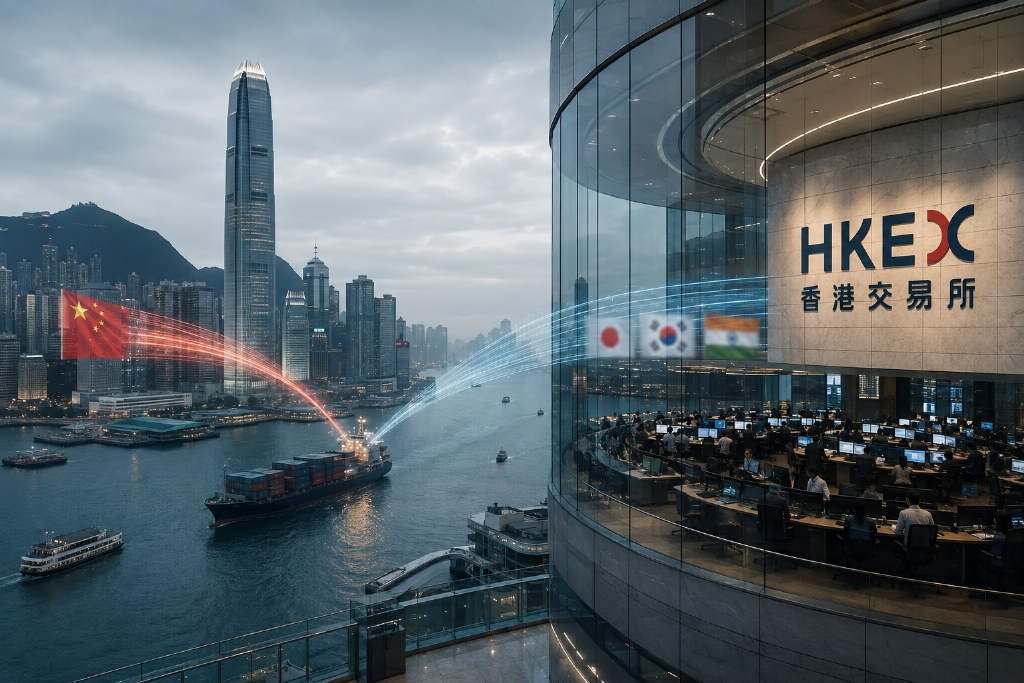
WuBlockchain republished a research note from China International Capital Corporation (CICC) Research Department titled “Who Is the ‘Smart Money’?” The note says Hong Kong equities have shown a clear seesaw pattern against nearby markets, including A-shares, in 2026.
According to the report, Hong Kong stocks lagged and saw outflows while South Korean shares and A-share technology names were gaining in the first half of the year. After technology stocks pulled back in late June, Hong Kong equities rebounded and flows turned positive. CICC says this was not unique to 2026. It points to a similar pattern in 2025 and even earlier: Hong Kong stocks were strong in the first half of 2025 with sustained southbound inflows, then southbound buying slowed after A-shares strengthened in the second half. Overseas investors also adjusted Hong Kong exposure as the relative appeal of markets such as Japan, India, and South Korea changed.
Why Hong Kong reacts so strongly to capital shifts
CICC says the core reason is that Hong Kong is an offshore market. With limited local capital, it must compete with other markets for investor attention and allocation. When investors rebalance across markets, Hong Kong tends to show a seesaw effect more clearly. The report adds that relatively low trading activity in Hong Kong amplifies the impact of changes in flow.
That leads to two questions in the note: what drives the behavior of different investor groups, and whether those flows have any forward-looking value for market direction. Put another way, which money leads the market.
CICC’s three main conclusions
After reviewing the relationship between southbound flows, overseas flows, and market performance since 2016, CICC reaches three conclusions.
- First, southbound inflows and outflows are strongly correlated with the market, but they also show some “smart money” characteristics. Inflows often slow after large gains and pick up when Hong Kong stocks fall or underperform A-shares. Compared with insurers, active mutual funds and ETFs show clearer trend-following behavior.
- Second, active foreign investors usually step up inflows only after market performance and earnings expectations improve, making them a lagging indicator. Passive foreign investors are smaller in scale and are influenced more by subscriptions and redemptions outside China, so CICC says they offer limited reference value.
- Third, funding signals matter more when China’s credit cycle is oscillating or when overseas liquidity is tightening. In those periods, faster southbound inflows often point to a coming rebound, while accelerating active foreign inflows are linked to weaker subsequent returns. The reverse also applies: a clear slowdown in southbound buying or a turn to net outflows can signal a market top, while active foreign outflows often reflect prior weakness rather than lead it.
Southbound funds: tightly linked to the market, but also buying weakness
CICC says both southbound money and overseas passive money have provided structural long-term inflows over the past decade, but short-term pricing is driven more by changes at the margin. The report therefore looks at two dimensions: changes in flow velocity and changes in relative returns. “Flow velocity” is defined as the difference between average daily net inflows over the past month and average daily net inflows over the past three months. “Return change” is defined as the recent one-month change in the Hang Seng Index relative to other market benchmarks.
At the broad trend level, southbound flows have tracked market performance closely. CICC notes that in years with larger southbound inflows, the Hang Seng Index also posted stronger gains: HK$339.9 billion in net inflows in 2017, HK$807.9 billion in 2024, and HK$1.4 trillion in 2025, when the index rose 36%, 18%, and 28%, respectively. In 2018, when the Hang Seng fell 14%, annual southbound net inflows were only HK$82.7 billion, the lowest since 2015.
The relationship was even clearer during periods when Hong Kong outperformed A-shares. From October 2020 to February 2021, policy support after the pandemic helped repair the household credit cycle, consumption, and property, and the Hang Seng materially outperformed the Shanghai Composite. Southbound 30-day average inflows reached a record HK$15.6 billion. A similar pattern appeared from April 2024 to April 2025. After “924,” policy expectations improved, and the re-rating of Chinese assets driven by DeepSeek in early 2025 helped Hong Kong outperform A-shares by 30 percentage points. Southbound 30-day average inflows reached HK$12 billion, the second-highest level on record.
But on a marginal basis, CICC says southbound funds do not simply chase momentum. The report says inflows often slow after sharp gains and increase when Hong Kong sells off or lags A-shares. In April 2021, excess returns of the Hang Seng against the Shanghai Composite were still rising, yet southbound flows turned into net outflows, and the market later lost relative strength. A similar pattern appeared in October 2024, when Hong Kong rapidly outperformed but southbound inflows slowed. On the other hand, southbound buying accelerated during heavy selloffs, including November 2022 and December 2024, with the market later finding a bottom.
CICC says its quantitative work supports that view. The correlation between southbound flow velocity and the Hang Seng’s relative return versus the Shanghai Composite over the prior one to two months is about -0.1, meaning southbound investors tend to buy faster when Hong Kong lags A-shares and slow their buying when it outperforms. When southbound flow velocity ranks in the top 20% of its own history, the Hang Seng rises an average of 1.7% over the following 20 trading days. When inflows shift from accelerating to slowing, the index usually weakens three to five trading days later and falls an average of 1.6% over the next 20 trading days. CICC says that pattern points to some ability to add at lower levels and take profit at higher levels.
Insurers, active mutual funds, and ETFs behave differently
By investor type, CICC says insurers are the main long-term buying force within southbound flows. They also tend to add exposure during deep pullbacks and reduce it after strong gains, with high-dividend sectors likely the main destination.
On scale, the report cites data from the Insurance Asset Management Association of China showing that insurer holdings in Hong Kong stocks stood at RMB 810.5 billion at the end of 2024, while Stock Connect investment balances were about RMB 762.2 billion. Assuming insurers increase equity exposure with a Hong Kong-to-A-share ratio of 1:4, CICC estimates their Hong Kong Stock Connect balance rose to RMB 1.2 trillion in the second quarter of 2026, accounting for 25% to 30% of southbound holdings.
On sector preference, the report says southbound investors have steadily added telecom and energy, two high-dividend groups that fit the long duration and liability-matching needs of insurers. On timing, insurers tend to buy more on weakness and less after rallies. CICC estimates the correlation between quarterly insurer net inflows and quarterly Hang Seng returns at about -0.4. Even as Hong Kong stocks fell from the third quarter of 2021 through the first quarter of 2022, estimated insurer inflows still exceeded HK$80 billion. In the fourth quarter of 2022 and the third quarter of 2024, by contrast, insurers cut allocations or even turned into net sellers after prices had risen.
Active mutual funds and ETFs behave more like trend followers, CICC says. It estimates the correlation between their quarterly net inflows and same-quarter Hang Seng returns at 0.4. Active mutual funds are affected by subscriptions and redemptions, relative performance, and manager positioning, while ETF flows are tied to product subscriptions, launches, and shifts in investor risk appetite. In both cases, rising markets tend to attract more inflows.
The report says southbound capital surged by HK$1.4 trillion in 2025, but only about HK$370 billion has flowed in so far in 2026, less than half the level seen in the same period last year. CICC estimates active mutual funds and ETFs explain 60% of that year-on-year decline and were the main drag. It also estimates insurers have delivered steady average quarterly inflows of roughly HK$25 billion over the past five years and maintained that trend through 2025 and 2026. The swing came mainly from active mutual funds and ETFs: active mutual funds went from HK$50 billion of inflows in the first half of 2025 to HK$76 billion of outflows in the first half of this year, while ETFs shifted from inflows to HK$74 billion of outflows.
Foreign capital: active money matters more, but it lags
For overseas investors, CICC cites MSCI statistics showing that funds benchmarked to its emerging markets index are about three-quarters active and one-quarter passive. Because active capital dominates in size, and passive flows often reflect broader emerging-market allocation rather than a direct China call, the report says active foreign money is the more useful series to track.
CICC describes active foreign capital as a lagging indicator for both market performance and earnings, usually by one to two quarters. The note gives several examples.
- After late April 2017, active foreign investors turned into buyers of Hong Kong stocks. By then, the Hang Seng had already rebounded 13% from its late-2016 low and earnings expectations had begun to improve. Active foreign investors added about $5 billion, but the Hang Seng topped out in early 2018 and flows did not turn negative until May 2018, lagging by roughly one to two quarters.
- Starting in November 2020, active foreign investors accelerated their return to Hong Kong after the Hang Seng had already rebounded about 12% from its March 2020 low and earnings expectations were rising. They added about $25 billion, yet the index peaked in February 2021 and inflows continued until September 2021, about half a year behind the market top.
- In early 2019, early 2020, and early 2023, three brief episodes of active foreign inflows also came only after market rebounds and better earnings expectations.
CICC says the quantitative work tells the same story. The correlation between changes in Hong Kong flow velocity versus other markets and prior one- to two-month relative returns is 0.4 and 0.3, respectively, indicating that active foreign investors raise their Hong Kong exposure after outperformance has already occurred. The report links that to the way overseas active funds are run against regional benchmarks. To beat an index that includes several markets, managers tend to rotate toward the stronger sub-market first.
The note also cites EPFR data showing that because Chinese equities underperformed South Korea and Taiwan, global emerging-market active funds cut their allocation to Chinese equities from 27.8% to 18.8% between September 2025 and June 2026. Over the same period, their allocation to South Korea rose from 11.0% to 21.6%, and their allocation to Taiwan rose from 17.1% to 23.6%.
Passive foreign flows, in CICC’s view, carry weaker signals. Since mid-2020, passive overseas money has continued to flow into Hong Kong, with cumulative inflows of about $120 billion, yet that did not prevent the market’s prolonged decline and range trading from 2021 through 2024. The report says the reason is simple: passive funds are driven mainly by global passive investment growth, with money flowing first into emerging-market index products and then into Hong Kong according to benchmark weights.
When flow signals matter more
CICC says Hong Kong, as an offshore market, is highly sensitive to changes in capital, but money is only one factor behind market direction, and other forces can affect flows themselves. In its framework, flow signals become more useful when the fundamental trend is unclear and the external liquidity backdrop is not supportive. When fundamentals are clear, flows matter less.
In periods when China’s credit cycle is clearly expanding or contracting, the direction of fundamentals is more obvious and the reference value of flows declines. CICC says the correlation between southbound flow velocity and Hang Seng returns over the following three months is close to zero during clear expansion or contraction phases. The same is true for active foreign inflows and future Hang Seng returns.
The report points to several examples. In the second half of 2020, China’s credit cycle was clearly expanding, and Hong Kong stocks kept rising even though southbound inflows slowed at different points. In 2021, the credit cycle turned into contraction, and the Hang Seng remained under pressure even though overseas liquidity was loose and southbound inflows temporarily accelerated. After “924” in 2024, the credit impulse improved and both flows and the market rose together for an extended period. CICC says these episodes show that when the credit cycle direction is clear, funding signals are less informative.
In a choppy credit cycle, the opposite is true. When broad fiscal deficit impulse and private social financing impulse move back and forth, fundamentals lose a clear direction and the market trades sideways. In those conditions, CICC estimates that the correlation between changes in southbound flow velocity and past Hang Seng returns is about -0.1, while the correlation with future returns is 0.2. That suggests southbound buying tends to accelerate near lower levels and may be followed by a rebound. Active foreign capital shows the reverse pattern: its flow size has a 0.4 to 0.6 correlation with Hang Seng returns over the previous one to three months, but around -0.3 versus future returns. In other words, active foreign investors improve their pace only after the market has already done well, and later returns tend to soften. CICC cites the fourth quarter of 2022 as an example: southbound buying accelerated before Hong Kong stocks found a near-term bottom, while active foreign money kept selling based on the earlier weak trend, and the market then rebounded.
Funding signals also matter more when overseas liquidity is tightening. During Federal Reserve hiking phases, CICC estimates the correlation between active foreign inflows and one-month forward Hang Seng returns at -0.3, meaning faster inflows can be followed by weaker returns. During rate-cut periods, that relationship narrows to near zero. For southbound flows, the report says Hong Kong’s discount to A-shares tends to widen more easily during Fed hiking cycles because of the linked exchange rate regime and high overseas ownership. In those phases, southbound investors show a clearer tendency to buy more aggressively at lower levels and sell faster after strong gains. CICC estimates the correlation between southbound flow velocity and the Hang Seng’s return over the prior one to three months at about -0.5, and the correlation with relative returns over the next three months at 0.3. It says that relationship also weakens in easing cycles.
The report notes that the statistical sample for this section runs from June 2016 to August 2026.
CICC’s current reading
CICC says China’s credit cycle is still oscillating and weakening in aggregate, while external liquidity constraints are rising, so flow signals deserve more attention at present.
On China’s credit cycle, the report says the current backdrop is one of aggregate fluctuation and structural divergence, with a possible modest repair in the broad fiscal deficit impulse in the third quarter. In July, the private social financing impulse edged higher, and the divergence between corporate and household credit impulses narrowed slightly, but the broad fiscal deficit impulse weakened further. Looking ahead, CICC estimates the fiscal deficit impulse could improve in the third quarter mainly because January-to-July fiscal financing ran slowly, with a year-on-year shortfall of RMB 1.1 trillion that leaves room for later support. Even so, it says the annual fiscal expansion is limited and investment remains tilted toward technology and industrial upgrading, which points to a temporary repair rather than a full credit-cycle expansion.
On overseas liquidity, CICC says tightening concerns picked up after the Jackson Hole meeting. The report cites Warsh as saying the economy and labor market remain resilient and financial conditions cannot yet be described as tight, and that only a clear and sufficiently fast return of inflation to the 2% target would mean no further action is needed. CICC says that suggests the Federal Reserve is unlikely to pivot clearly toward easing in the near term. CME rate futures, it adds, imply a 60.2% probability of a September rate hike.
Current signal mix: southbound slowing, active foreign money accelerating
In that environment, CICC says the latest flow picture stands out. Over the past month, southbound inflows have slowed while active foreign inflows have accelerated. Based on the behavior patterns laid out earlier in the report, that combination suggests the chance of a large near-term market opportunity is limited and that the market could even weaken. The firm says that view is consistent with recent price action.
CICC therefore argues that Hong Kong stocks are better suited to tactical trading and structural opportunities at this stage, and it keeps its base-case Hang Seng target range at 26,000 to 27,000. The report says this year’s market path has broadly matched that view. It recalls that while many in the market were looking for 30,000 or higher late last year, CICC flagged bottoming characteristics in early July and fading rebound momentum in early August.
The note says short-term positioning should still focus on odds and payoff. For a more durable medium- to long-term trend, it says the market still needs either a recovery in the household credit cycle or a major industrial breakthrough from leading internet companies, which it describes as requiring a “924 moment” or a “DeepSeek moment.”
Portfolio takeaways in the report
CICC offers two tactical suggestions.
- If Hong Kong stocks rise close to the range in its base case, while active foreign inflows accelerate relative to their prior trend and southbound buying slows, investors can consider taking some profits.
- If the market later pulls back and southbound inflows accelerate again relative to the prior trend, allocations can be raised again.
On sector direction, the report says “technology depends on industry progress, cyclicals depend on the Federal Reserve, and consumption depends on policy.” If progress in technology is limited in the near term, investors can use dividend plays to offset portfolio volatility, it says. CICC adds that its in-house AI pressure index has dropped sharply from earlier extreme levels, suggesting the worst stage of pressure has been easing, though a fresh catalyst is still needed to lift demand beyond its current ceiling.
That leads to a sector stance where technology remains the main allocation direction. Outside technology, the report says positioning can be balanced moderately toward cyclical sectors, while consumption may need to wait for fiscal policy developments in the fourth quarter. Under CICC’s cross-market and cross-sector framework combining win rate and payoff, the sectors with relatively high composite scores in the week of Sept. 4 were insurance, transportation, raw materials, energy, and semiconductors.