
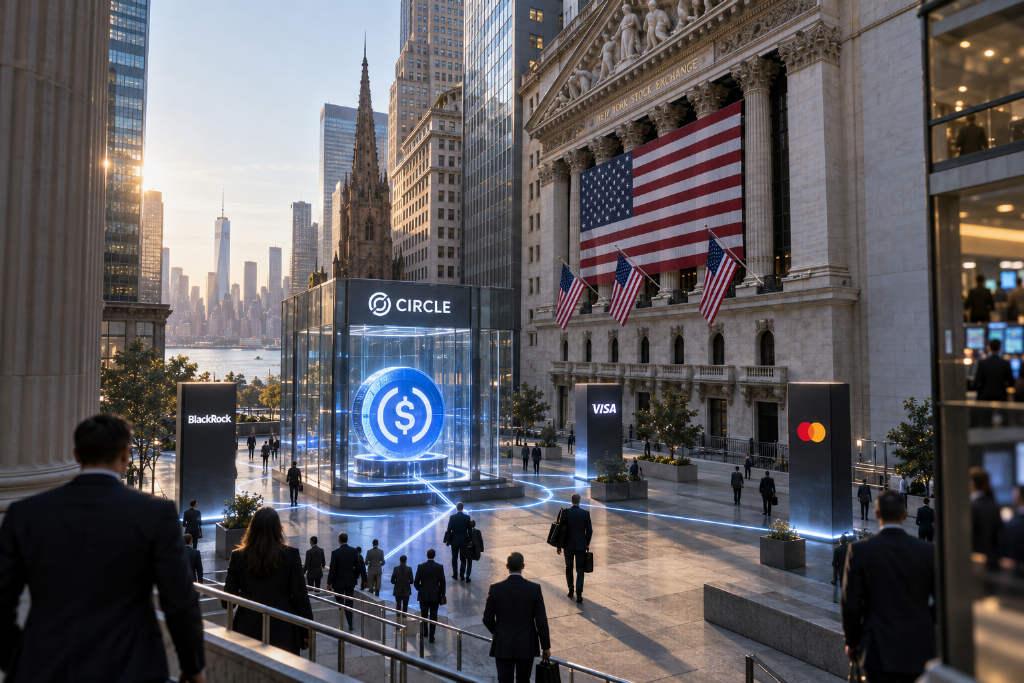
Circle has widened the USDC playbook from stablecoin issuance into two larger arenas: public-market valuation and institutional blockchain infrastructure. On Sept. 16, the company’s institutional Layer 1 network Arc went live on its public mainnet. The chain is built for payments, foreign-exchange settlement and asset tokenization, uses USDC as its native gas token, and launched with 11 founding validators including BlackRock, Visa and Mastercard.
Arc is easier to understand in the context of USDC’s place in the stablecoin market. According to statistics cited from ARK Invest analyst Lorenzo Valente, the number of stablecoins with market capitalizations above $1 billion rose from the single digits to 12 over four years. At the tier above $10 billion, there were four issuers at the 2022 peak. Now only Tether and Circle remain. That drop-off reflects the network effects of the sector: exchanges, payment rails and DeFi protocols are far more likely to integrate a token once it has already reached meaningful scale.
USDC was built as a compliance-first alternative
USDC was launched in 2018 by the CENTRE consortium, which was formed by Circle and Coinbase. From the start, Circle positioned it as a dollar token built around regulatory cooperation and reserve transparency, a direct contrast to USDT, whose reserve disclosures had faced repeated scrutiny while it led the market on size.
That positioning did not hand USDC an easy path. For several years, the market favored liquidity depth over regulatory credentials. Tether’s early scale advantage kept USDC in the role of an alternative option rather than the dominant stablecoin.
The Silicon Valley Bank episode exposed the weak point
Circle’s first attempt to reach the public market came in 2021, when it planned to list through a SPAC merger. That effort failed by the end of 2022.
The more serious shock came in March 2023, after Silicon Valley Bank collapsed. Around $3.3 billion of Circle’s reserves were temporarily trapped at the failed bank, and USDC briefly depegged to around $0.87. The incident laid bare a core vulnerability for any stablecoin issuer: its credibility can still depend on the health of the traditional banking system.
IPO gave Circle a new capital-markets narrative
After that lesson, Circle spent the next two years recasting itself as a model compliance story. On June 5, 2025, the company listed on the New York Stock Exchange under the ticker CRCL, becoming the first major stablecoin issuer to complete an IPO.
The offering was priced at $31 per share, with 34 million shares sold in the initial deal for about $1.05 billion. One week later, underwriters exercised the greenshoe in full, taking total deal size to about $1.2 billion. Most of the cash went to existing holders. In the initial offering, Circle sold 14.8 million shares while early shareholders sold 19.2 million. After the full greenshoe exercise, Circle had sold about 19.9 million shares in total and received roughly $583 million in net proceeds after underwriting fees.
The stock’s first days were volatile and highly bullish. CRCL opened up 122.58% on its first day and closed up 168.5%, pushing market capitalization above $18 billion. On the second trading day, the shares climbed to $119. Less than three weeks later, on June 23, they touched an all-time high of $298.99 before dropping nearly 40% over the next four trading sessions. The article describes it as one of the strongest first-day performances for a U.S. IPO above $1 billion in decades.
Circle still relies overwhelmingly on reserve income
The prospectus showed that, as of April 2025, USDC circulation stood at about $60.1 billion, equal to roughly 29% of the stablecoin market. USDT’s share at the time was about 61%.
In 2024, Circle posted $1.676 billion in total revenue, and 99% of that came from interest income on reserve assets. The business is often compared with a narrow bank model: it does not lend, but invests the funds backing USDC into short-term U.S. Treasuries and earns the spread.
Distribution, however, absorbs a large part of that revenue. In 2024, Circle paid Coinbase about $908 million, or roughly 54% of annual revenue.
USDC growth has been bought through distribution and infrastructure
If the IPO told an equity story, the fight with USDT has centered on distribution. Binance offers the clearest example. After the two sides entered a strategic partnership in December 2024, Binance committed to hold at least $3 billion of its own treasury in USDC. Circle also paid Binance an upfront fee of about $60.25 million and set ongoing incentives tied to USDC balances.
This was not network effect spillover arriving on its own. It was a paid distribution arrangement.
Outside exchange channels, Circle’s earlier and more foundational move was CCTP, short for Cross-Chain Transfer Protocol. The system uses a burn-and-mint model: a user burns USDC on the source chain, and Circle mints native USDC 1:1 on the destination chain. That means supported networks carry officially issued USDC rather than wrapped versions.
Through CCTP, USDC has achieved native deployment on more than 20 public blockchains. The structure avoids an older USDT problem, where each chain effectively had its own separate issuance and fragmented liquidity. The article notes that Tether later introduced USDT0 to address the same issue, but through LayerZero’s lock-and-mint route.
Arc and CPN push the strategy toward institutions
Arc and its sister product, Circle Payments Network, or CPN, are aimed at that next layer of competition. Circle appears to be working from a straightforward premise: issuing a stablecoin alone will not be enough to catch USDT after a decade of accumulated scale. So the company is trying to move the battle to the institutional side.
Under that approach, firms such as BlackRock, Visa and Mastercard are not only customers at the asset layer. They become founding validators in Arc itself, directly involved in transaction validation and network security.
In May 2026, Arc completed a private token sale that raised $222 million at a fully diluted network valuation of $3 billion. Andreessen Horowitz, or a16z, led the round, with BlackRock, Apollo and Intercontinental Exchange also participating. The article says that made Circle the first U.S.-listed company to conduct a private token sale after going public.
Those tokens have not been offered publicly. They are limited to institutions and carry multi-year lockups. Governance voting and staking functions will only go live after the network transitions to proof-of-stake.
USDC has outgrown USDT on rate, not on absolute scale
USDC has posted faster annual growth than USDT for two straight years. In 2024, USDC grew 77% while USDT grew 50%. In 2025, USDC rose another 73% to $75.1 billion, while USDT increased 36% to $186.6 billion.
But a higher growth rate has not erased the gap. USDC remains well below half the size of USDT.
By 2026, that momentum had also begun to cool. In the second quarter, USDC circulation growth slowed to 19% year over year, leaving supply at around $73.3 billion. On the day Circle reported fourth-quarter 2025 earnings, the stock jumped nearly 30%, driven by an above-consensus print of $770 million in combined revenue and reserve income rather than by supply expansion alone.
Arc is now part of Circle’s valuation debate
Public-market investors are not valuing Circle purely through a conventional banking lens. The article argues that the company’s valuation already includes expectations tied to future USDC growth as well as businesses such as CPN and Arc.
That also leaves the stock exposed to regulatory shifts. At the end of March, the market circulated a draft of a revised CLARITY Act that could ban interest-sharing on stablecoins, and CRCL fell in response. A change in the regulatory direction could force a re-pricing of the entire thesis.
By the Sept. 17 close, Circle shares were at $85.09, giving the company a market value of about $21.6 billion. That was down more than 70% from the record high of $298.99 set on June 23, 2025.
Arc is public, but the market is waiting for proof of real usage
Arc opened to the public on Sept. 16. The article says token launch platforms that had already been active during the private mainnet phase, including Tolly, ArcPad and Flipt, also opened to all users. Ahead of the launch, USDC at one point traded up to a 1.8x premium.
Within the industry, Arc has been compared with Robinhood Chain. The distinction in the article is clear: Robinhood Chain was powered by retail traffic and became one of the fastest-growing on-chain ecosystems of 2026, while Arc brings USDC liquidity, financial institutions and a ready-made infrastructure stack.
CRCL closed down about 6.8% on Sept. 16. The day before, a procedural vote in the U.S. Senate failed to advance the CLARITY Act. On the same day, the Federal Reserve announced a 25-basis-point rate hike. The article identifies those two developments — weaker regulatory expectations and a shift in the rate environment — as major factors shaping market sentiment at the time.
The next test is whether names such as BlackRock, Visa and DTCC can actually bring institutional capital and settlement demand onto Arc, or whether the chain follows a more familiar path in which speculative money arrives first.
