

Circle’s second-quarter results showed a wide gap between USDC activity on-chain and the pace of revenue growth. In its unaudited earnings release filed with Form 8-K, the stablecoin issuer said USDC on-chain transaction volume reached $14.8 trillion, while “total revenue and reserve income” was $701 million.
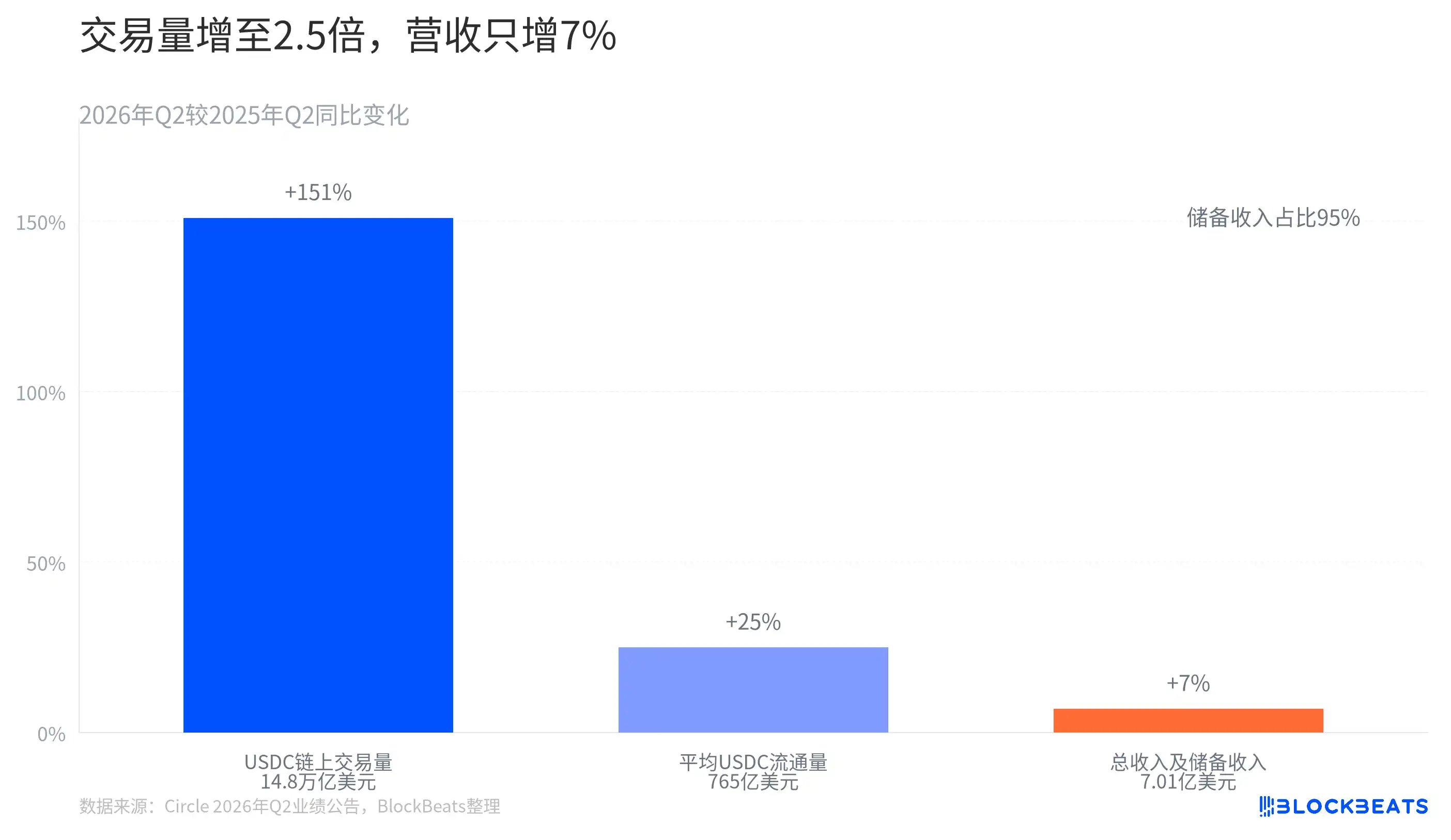
Placed side by side, those numbers can make transaction volume look like a direct revenue engine. The year-over-year comparison tells a different story. USDC transaction volume rose 151%, while revenue increased 7%. The mismatch does not suggest a broken data set. It shows how Circle’s business actually works: on-chain volume measures how intensively USDC is used, while revenue depends more on how much USDC stays in the system on average and what that reserve base earns during the quarter.
Heavy on-chain use did not translate directly into revenue
Circle’s disclosure puts three growth lines in view: transaction volume, average USDC in circulation, and revenue. Transaction volume was the fastest-growing figure in the quarter. Average circulation sat in the middle. Revenue posted the smallest increase. Circle said reserve income accounted for more than 90% of “total revenue and reserve income,” which means transaction volume was not the variable most tightly linked to the company’s income statement.
A transfer on-chain can show that USDC was used for payments, conversion, or settlement. It does not mean Circle collects income in direct proportion to each transaction. The company did not list on-chain transaction volume as a revenue accounting metric. Reserve income, by contrast, moves with average circulation and reserve yield. Those two figures were the clearest revenue drivers for the quarter.
Circle reported $34 million in other revenue for the quarter. The company said the year-over-year increase mainly came from subscription and services revenue. At the same time, the filing did not break out Circle Payments Network, Arc, or Agent Stack as separate revenue lines, which leaves no basis to convert operating progress in those products into disclosed quarterly revenue.
More USDC was outstanding, but reserve yield was lower
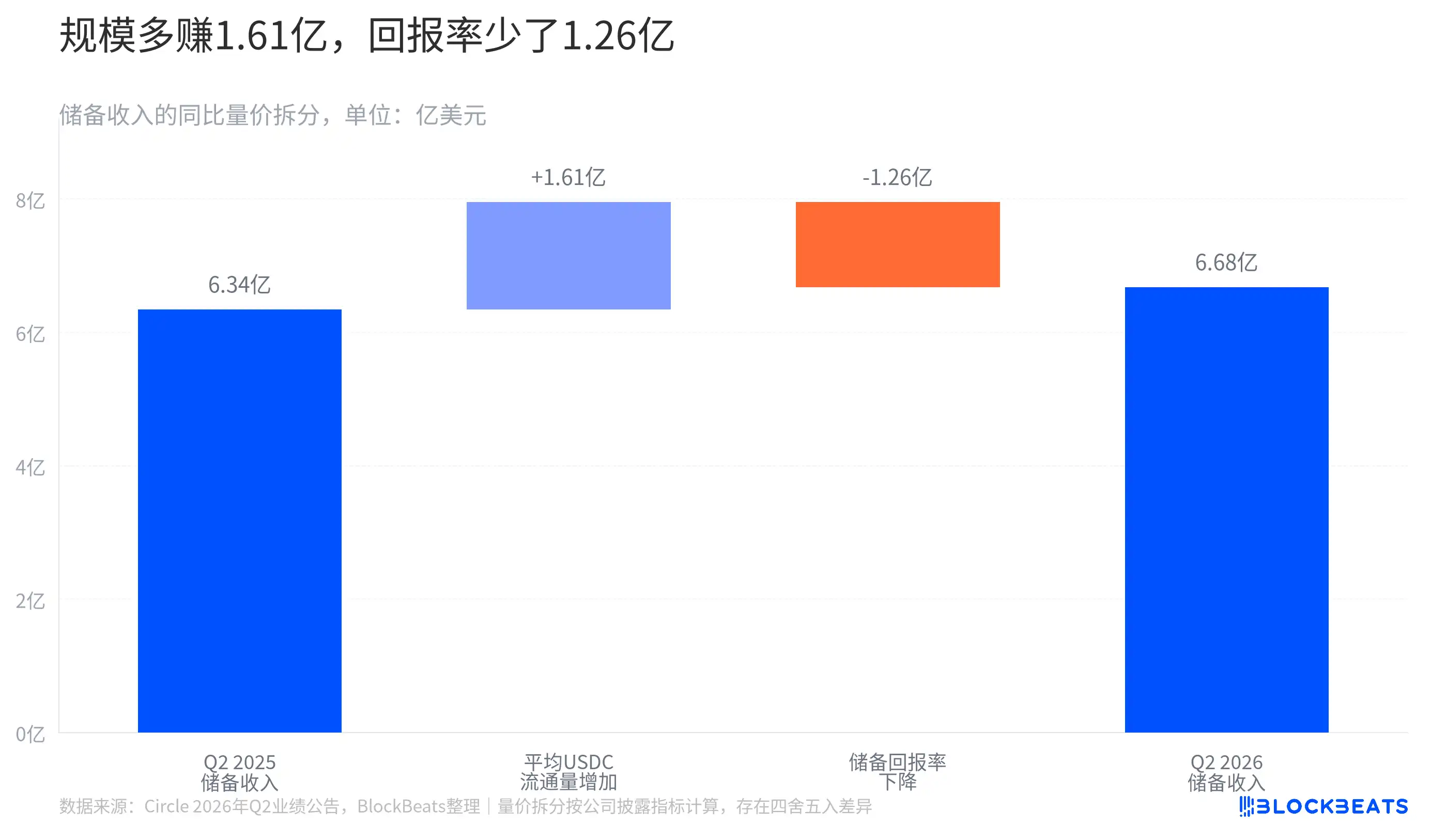
Circle’s explanation of reserve income was direct. In Exhibit 99.1 of the 8-K, the company said average USDC in circulation increased 25% from a year earlier, while reserve yield declined by 66 basis points. One figure got larger, the other thinner. The result was reserve income growth of only about 5%.
This is a volume-and-price story. Based on the company’s disclosed average circulation and reserve yield, a static quarterly estimate suggests reserve income would have been materially higher if balance growth had been the only change. The drop in yield offset most of that increase.
Another way to read it: on-chain activity around USDC remained strong, but that activity has to become persistent USDC balances before it can feed into Circle’s revenue base, and it then has to pass through reserve yield. That process is slower than a single blockchain transaction and more exposed to the interest-rate environment.
That is why Circle could say in the same release that the network is expanding while the current rate environment is slowing revenue growth. One statement refers to USDC usage and distribution. The other refers to how reserve income is priced. Both can be true at once.
Revenue still had to pass through distribution and transaction costs
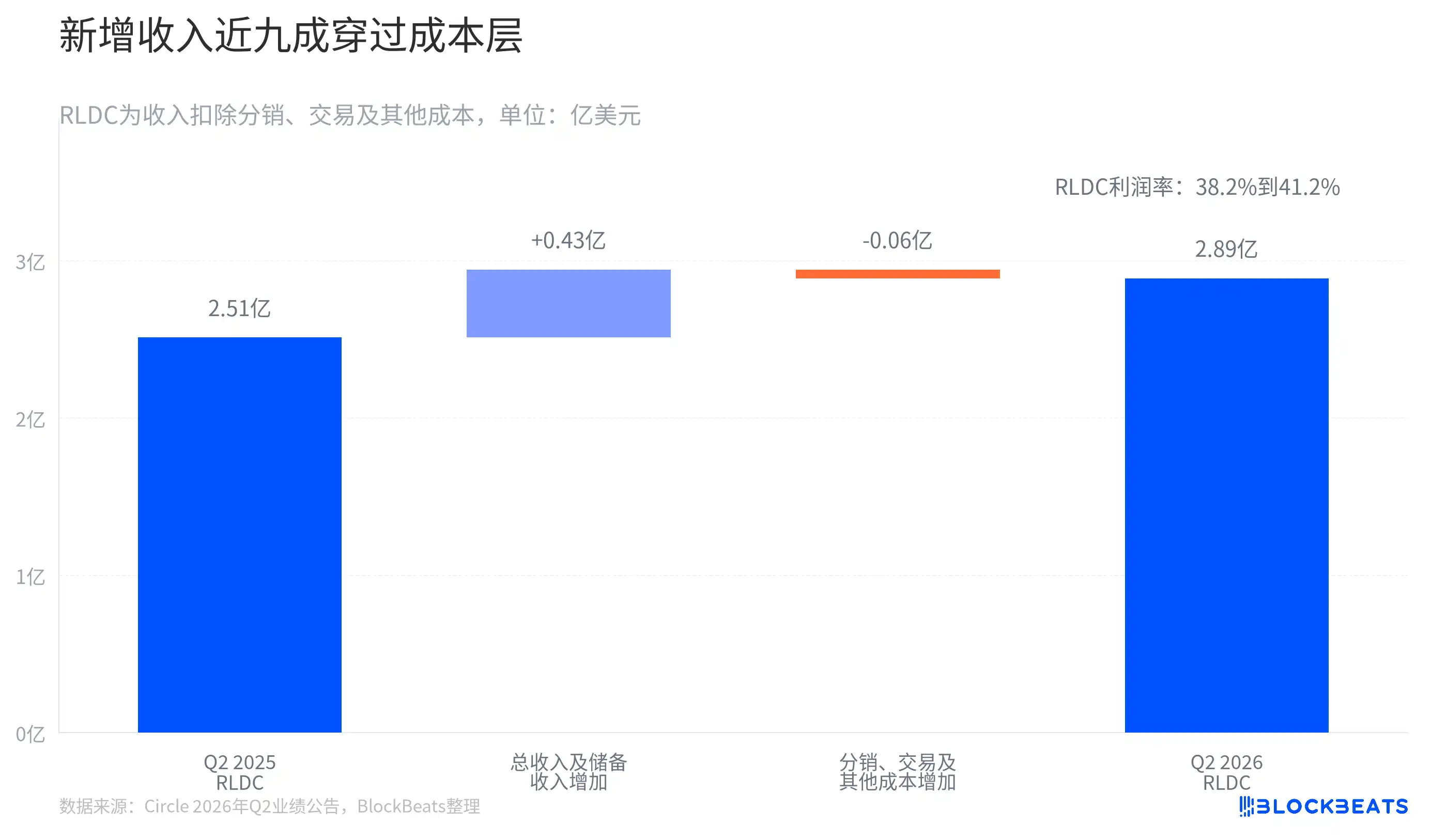
Revenue reaching Circle did not mean it was already operating profit. The company uses RLDC as an intermediate metric after subtracting “total distribution, transaction, and other costs” from “total revenue and reserve income.” Circle said RLDC rose from $251 million to $289 million, a faster rate of growth than total revenue and reserve income.
The easiest figure to misread here is the relatively small increase in incremental cost. It does not mean Circle paid little in absolute costs. It means the year-over-year rise in those costs was far smaller than the increase in revenue. Using the company’s unrounded figures, close to 90% of incremental revenue passed through that layer and became RLDC growth. RLDC margin improved from 38.2% to 41.2%.
Still, RLDC is not gross profit, and it is not adjusted EBITDA or net income. Research and development, infrastructure, and personnel costs remain below that line. Circle said adjusted operating expenses increased 23% year over year, while adjusted EBITDA rose 8%. A cleaner conversion after distribution costs did not flow straight through to the final profit picture.
The quarter-over-quarter pattern was less dramatic than the annual comparison. Based on Circle’s first-quarter release and the latest filing, average USDC in circulation increased 1.7% sequentially, while total revenue and reserve income rose 1.0%. Over the same period, adjusted operating expenses increased 7.9% and adjusted EBITDA fell 5.2%.
That does not point to a stalled business. It does show timing. When the USDC base moves only modestly from one quarter to the next, spending on new products and infrastructure can hit the expense line before the income statement shows the same pace of acceleration.
Network expansion signals are growing, but the revenue boundary remains outside the filing
Circle also disclosed several network-level developments in the quarter. As of quarter-end, Circle Payments Network had a past-30-day annualized transaction volume of $14.7 billion and 175 financial institutions connected. That is a network-density metric, not quarterly revenue, and it cannot be compared with USDC on-chain transaction volume on the same basis.
The company also said Arc is scheduled to launch its public mainnet on Sept. 16, and Agent Stack has more than 900 paid services. The first is still a disclosed launch plan. The second is a service count, not a customer count, revenue figure, or profit metric.
Taken together, those updates show Circle is building out infrastructure beyond stablecoin issuance. The current quarter’s disclosures do not yet show that these products have become a second revenue curve.
Circle’s second-quarter report ultimately reads as a set of results shaped by three factors: average USDC balances, reserve yield, and the structure of distribution costs. Transaction volume showed that USDC was used frequently. The income statement showed how that usage had to move through reserves and costs before it appeared as revenue.