
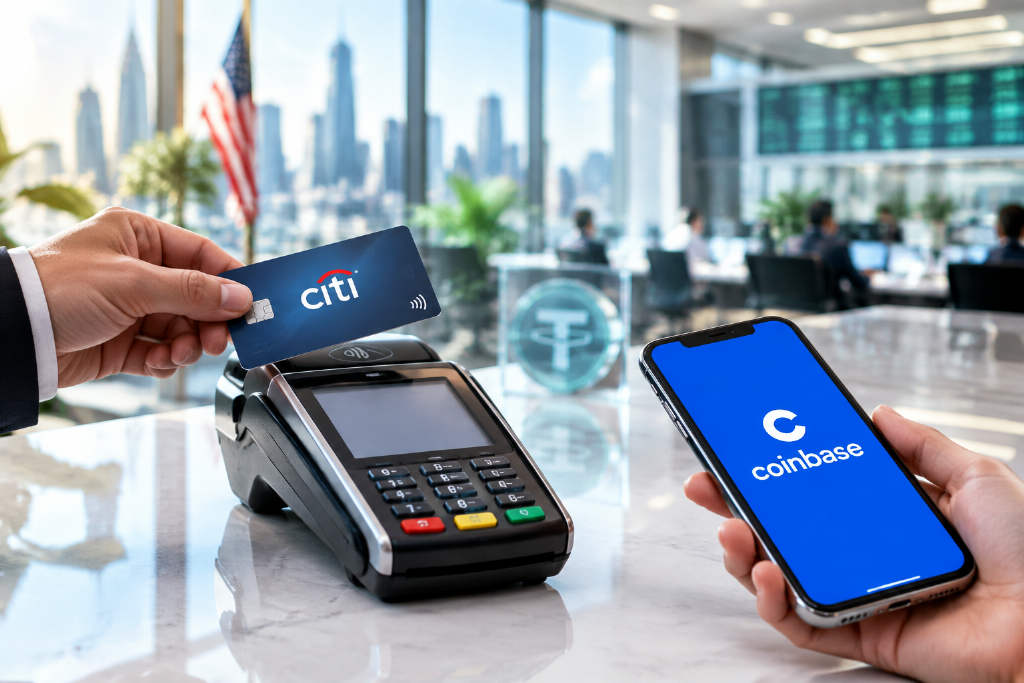
Decrypt’s Morning Minute, a daily newsletter written by Tyler Warner, said on September 29 that Citi and Coinbase have partnered on a stablecoin payments product built to remove the crypto layer from the user experience.
According to the newsletter, large companies that bank with Citi can now allow their customers to pay in stablecoins. The business itself does not hold a token, does not open a crypto account, and does not see a wallet address. Coinbase converts the stablecoins into dollars behind the scenes, and Citi deposits the funds like any other payment.
The newsletter said that is the point of the product: the company using it does not need to learn the crypto side of the process.
The setup also runs in the opposite direction. Companies building on Coinbase can now open accounts that behave like bank accounts, powered by Citi’s banking software. Dollars coming in are automatically turned into stablecoins.
Stablecoin settlement is pushed out of view
Morning Minute described the arrangement in simple terms: Citi clients get paid in stablecoins and receive dollars, while Coinbase clients get paid in dollars and receive stablecoins. Whichever side a company banks with, funds arrive in the form it already uses, while the conversion happens in the background.
The newsletter argued that this is how the technology gets adopted in practice—by disappearing into the plumbing. No one has to buy a coin or download a wallet. A company adds another payment option, and somewhere underneath, a stablecoin moves in seconds instead of a wire transfer taking two days. Coinbase said more than 150 million people worldwide hold stablecoins, and the product gives businesses a way to accept money from those users without entering the crypto system directly.
Macro, crypto, and market moves
The market section said major cryptocurrencies were higher as oil and yields fell. BTC was up 2% at $84.4K, ETH rose 3% to $2,730, SOL added 1% to $120, HYPE fell 1% to $88.70, and ZEC dropped 8% to $1,450.
Among altcoins, the top movers listed were CRV at +20%, AAVE at +16%, ETHFI at +11%, and LINK at +9%.
In other markets, oil was down 4% at $92, while gold was flat at $4,185. Stock futures were slightly higher, with the Dow up 0.15% and the Nasdaq up 0.3%.
Institutions, protocols, and policy-related developments
- Goldman Sachs made its $100 billion Treasury fund available to crypto firms through the Lynq settlement network, without turning the fund into a token.
- NEAR Intents said it turned away more than $50 million in transfers tied to the Bitget hack, froze about $503,000 mid-swap, and waived its 10% share of Bitget’s recovery bounty.
- Chainlink launched CCIP 2.0, which lets companies add their own security checks to transfers between blockchains. The newsletter noted that a rival’s setup lost $292 million five months ago because it relied on one checker.
- Senate Democrats called Tether a “significant financial lifeline” for Iran in a report led by Richard Blumenthal. The report said 84% of 846 sanctioned wallets used USDT. Tether said it helped freeze nearly $550 million in Iran-linked tokens this year.
- Apollo’s Torsten Slok warned that AI agents could drain bank deposits by automatically moving household cash from low-interest checking accounts into better-paying alternatives.
Corporate treasuries and ETF flows
On Monday, the Bitcoin ETFs posted $31 million in net inflows. Ethereum ETFs saw $17 million in inflows, and Solana recorded $8 million.
Strategy bought 1,665 BTC for $142.7 million at an average price of $85,681, taking its holdings to a record 847,666 BTC and fully replacing everything it sold this summer. The company also spent $151.7 million buying back STRC.
Strive added 1,107 BTC for $94.5 million, lifting its holdings past 27,000 coins to 27,462, worth about $2.3 billion according to the newsletter.
Bitmine bought 17,362 ETH for about $47 million, bringing its position to 4.9% of all Ethereum.
Meme coins and chain activity
Meme coin leaders were mostly higher: DOGE gained 3%, SHIB rose 3%, PEPE added 2%, PENGU climbed 3%, TRUMP rose 2%, SPX fell 1%, and BONK gained 6%.
On Robinhood’s chain, most leaders were lower ahead of the day’s RH Summit. Pons fell 1% to $364 million, AI dropped 7% to $208 million, and Cashcat slipped 8% to $175 million. BUN, up 65%, and Shroom, up 26%, led the biggest movers.
On Solana, the biggest movers listed were Parasite at 24x, Sapijiju at 20x, and Hooked at 20x. Ansem fell 7% to $160 million, while Cards rose 23%.
Tokens, airdrops, and protocol revenue
Coinbase teased a new gacha product that is set to arrive in its app soon. The newsletter said CARDS jumped 25% on speculation that it could be integrated with that product.
Pump.fun generated $13.64 million in fees last week, up 25%, marking its second-biggest week since June. Saturday set a single-day volume record of $846 million.
For Monday’s on-chain protocol revenue, Pump led again with $2.53 million, followed by Hyperliquid at $1.92 million and Collector Crypt at $609,000.
NFT prices
NFT leaders were slightly lower. CryptoPunks were flat at 33.69 ETH, BAYC fell 1% to 6.2 ETH, and Pudgy dropped 2% to 3.2 ETH.
Identity MD, up 23%, and Credits, up 10%, led the top movers.
Disclosure
Morning Minute is a daily newsletter written by Tyler Warner. The analysis and opinions expressed are his own and do not necessarily reflect those of Decrypt.