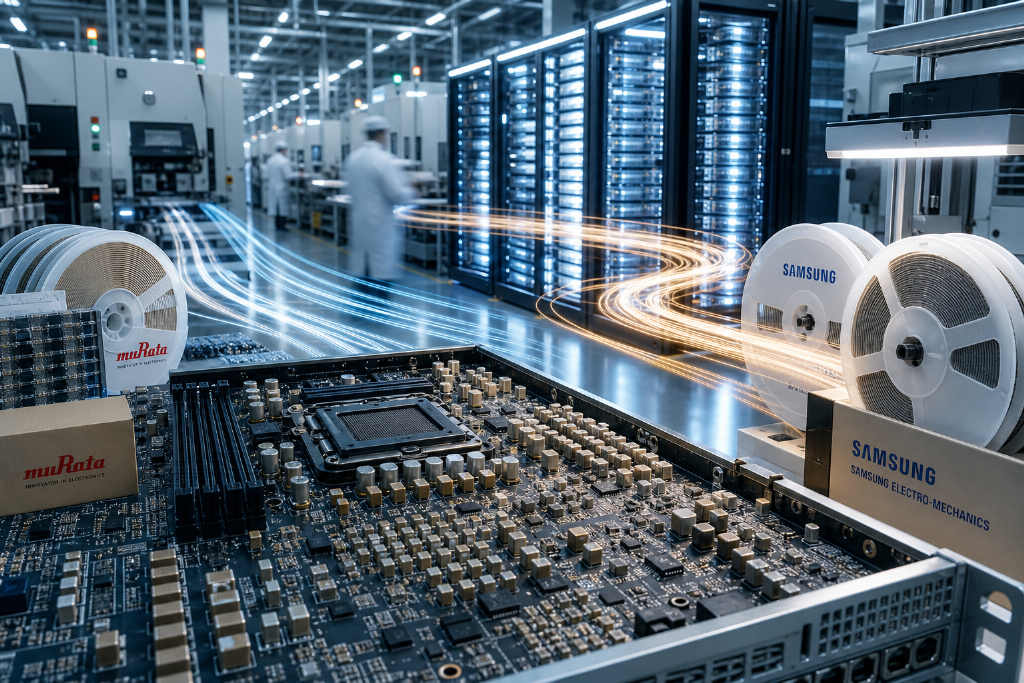
Citrini says AI server demand is splitting MLCC lead times, with top-end parts nearing 10 months

Citrini says AI server demand is splitting MLCC lead times, with top-end parts nearing 10 months

N
News Editor
2026-08-18 11:01:32
Citrini analyst Jukan said MLCC lead times are diverging sharply by product type as demand tied to AI servers and data centers keeps rising. General-purpose MLCCs are still holding at 14 to 18 weeks, while high-capacitance and high-voltage parts are running at roughly four to five months. The tightest conditions are in high-end server-grade components used in AI systems. According to Jukan, server-grade MLCC lead times at Murata and Samsung Electro-Mechanics have moved beyond 20 weeks. Some high-capacitance products from Samsung Electro-Mechanics are averaging around 40 weeks. For Murata, lead times on products above 1 microfarad rose to 30 weeks in July from 24 weeks in June, and some channel quotes have reached 36 weeks, or close to 10 months. Jukan expects the split in lead times to last through the second half of 2026. He said AI servers require five to 13 times as many high-capacitance, miniaturized and high-reliability MLCCs as traditional servers. He also noted that new capacity expansion has been pushed back from Q4 2026 to 2027, leaving the supply-demand imbalance intact in the near term as major suppliers raise prices and expand long-term supply agreements.

BlockBeats reported on Aug. 18 that Citrini analyst Jukan said MLCC lead times are now splitting sharply depending on product specifications.

General-purpose products are still steady at 14 to 18 weeks, or about 3.5 to 4.5 months. High-capacitance and high-voltage products are running at roughly four to five months. High-end components used in AI servers, however, have entered what Jukan described as a state of severe supply tightness.

Jukan said server-grade MLCC lead times at Murata and Samsung Electro-Mechanics have moved past 20 weeks, or more than five months. Some high-capacitance products from Samsung Electro-Mechanics are averaging about 40 weeks. For Murata, lead times for products above 1 microfarad rose in July to 30 weeks from 24 weeks in June. Some channel quotes have even reached 36 weeks, close to 10 months.

He expects this extreme divergence to continue through the second half of 2026.

Jukan said the main driver is strong demand from AI servers and data centers. AI servers require five to 13 times as many high-capacitance, miniaturized and high-reliability MLCCs as traditional servers.

He also said new capacity expansion has been delayed from Q4 2026 to 2027, making the supply-demand imbalance hard to ease in the short term. Major manufacturers are raising prices in parallel and adding more long-term supply agreements.

In Jukan’s view, lead times above five months and in some cases close to a year show that manufacturers cannot quickly add supply in the near term. He said the trend also points to stronger pricing power and the start of a material improvement in profitability driven by a higher-value product mix.

Jukan added that the AI bottleneck is spreading from GPUs and memory to the smallest components on the board.

This article was originally published by Bit.Fan. For more cryptocurrency news and market insights, visit www.bit.fan.
30

Disclaimer:

The market information, project data, and third-party content displayed on this platform are for industry information sharing only and do not constitute any form of investment advice or return commitment.

Cryptocurrency trading carries high risks. Users should fully assess their risk tolerance and make independent decisions. All profits, losses, and legal responsibilities are borne by the users themselves.