
This article was originally published by Bit.Fan. For more cryptocurrency news and market insights, visit www.bit.fan.
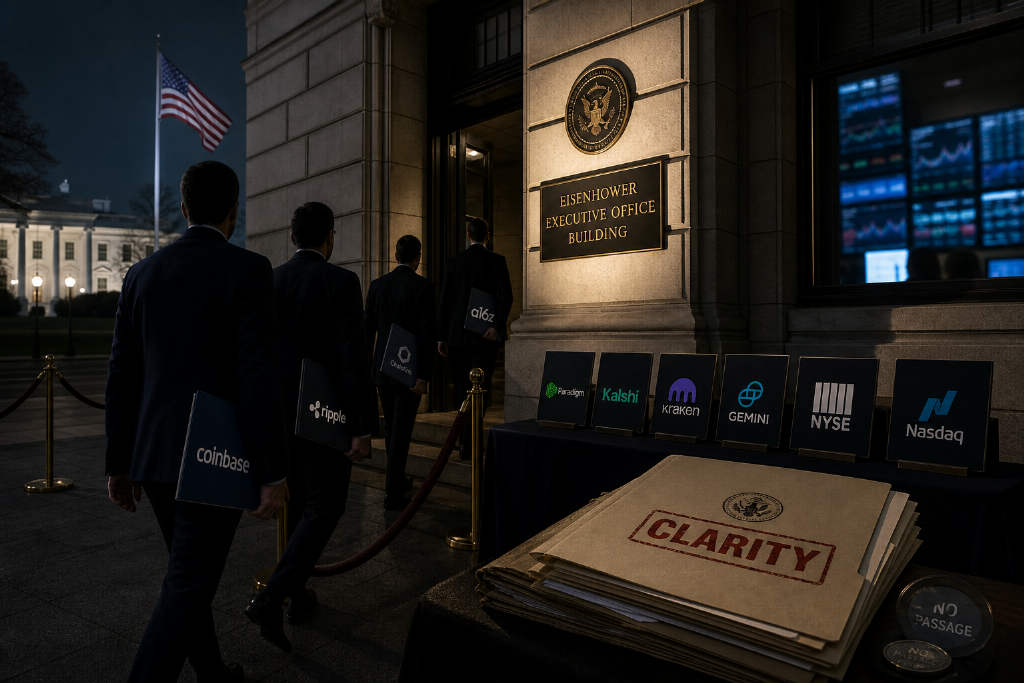
CLARITY Act Odds Fall to 10% as Trump Meets Crypto Executives
N
News EditorPresident Donald Trump is set to meet executives from crypto, prediction market and fintech firms on Aug. 19 at the Eisenhower Executive Office Building near the White House. The meeting is expected to include SEC Chair Paul Atkins and CFTC Chair Michael Selig, with Treasury Secretary Scott Bessent and Commerce Secretary Howard Lutnick possibly attending. Bloomberg said the guest list includes Coinbase, Ripple, Chainlink, Andreessen Horowitz, Paradigm and Kalshi, while Kraken, Gemini, NYSE and Nasdaq have also reportedly been invited. The talks come as the CLARITY Act remains stalled in Congress. Galaxy Digital now puts the bill’s odds of becoming law this year at about 10%, while Polymarket traders price the chance at roughly 19%, down sharply from a Feb. 19 peak of about 82%. The legislation would create a federal digital asset market framework and divide oversight between the SEC and the CFTC. It has already cleared the Senate Banking Committee and passed the House, but negotiations have slowed over ethics limits, stablecoin yield and anti-illicit finance provisions. Democrats want stricter conflict-of-interest rules covering Trump, senior officials and their families, a sticking point that has turned the debate from technical regulation into political bargaining. A procedural vote is now expected on Sept. 15, and supporters need 60 votes to advance the bill in the Senate.
Trump is scheduled to meet crypto, prediction market and fintech executives on Aug. 19 at the Eisenhower Executive Office Building near the White House, a gathering that comes as the CLARITY Act’s chances of becoming law this year have dropped to about 10%, according to Galaxy Digital.
Bloomberg reported that attendees are expected to include representatives from Coinbase, Ripple, Chainlink, Andreessen Horowitz (a16z), Paradigm and Kalshi. Another report said Kraken, Gemini, the New York Stock Exchange and Nasdaq have also been invited. SEC Chair Paul Atkins and CFTC Chair Michael Selig are also expected to attend, while Treasury Secretary Scott Bessent and Commerce Secretary Howard Lutnick may appear.
The meeting is set for 2:30 p.m. ET and is expected to serve as a warm-up for the CFTC’s first Innovation Advisory Committee meeting the following day. The agenda spans crypto assets, artificial intelligence and prediction markets, but the biggest focus remains the CLARITY Act, which seeks to establish a federal digital asset market structure and split oversight between the SEC and CFTC.
Galaxy Digital has cut its estimate of the bill becoming law this year to about 10%. Polymarket traders have pushed the implied odds down to around 19%, far below the roughly 82% peak recorded on Feb. 19.
The legislation has already shown it can attract bipartisan support. On May 14, the Senate Banking Committee approved it by a 15-9 vote, with Democratic Sens. Ruben Gallego and Angela Alsobrooks backing the measure. The House passed its version in 2025 by a 294-134 vote, including support from 78 Democrats.
The remaining fight has shifted to ethics limits for government officials involved in crypto, stablecoin rewards and anti-illicit finance provisions. Banks have also pushed to restrict yield paid to stablecoin holders, arguing that high-return products could pull deposits away from traditional lenders.
That political fight is now centered on Trump and his family’s business ties to crypto. Democrats want stricter conflict-of-interest language in the CLARITY Act, limiting how the president, senior officials and their families can profit from crypto businesses.
Trump’s family has built a broad business footprint through World Liberty Financial, the $TRUMP token, stablecoins and other digital asset ventures, keeping the overlap between crypto legislation and the president’s personal finances under scrutiny on Capitol Hill. On July 30, a bipartisan group of senators sent the White House an ethics framework, but the Trump administration has not publicly accepted it.
Galaxy says the main obstacle has moved from technical regulation to political bargaining. Without an agreement between the White House and Democrats on ethics language, supporters will struggle to reach the 60 votes needed in the Senate.
Senate Majority Leader John Thune filed cloture before the recess, setting up a procedural vote on Sept. 15. That vote will decide whether the chamber formally begins debate on the bill. Supporters need 60 votes to clear the threshold.
Sen. Bernie Moreno said all 53 Republican senators are expected to back the move, which means supporters would still need at least seven Democrats. Patrick Witt, executive director of the White House’s Presidential Council of Advisers for Digital Assets, has also pressed Democrats, saying years of negotiations have already provided enough time.
Timing is another obstacle. Once the Senate returns in September, lawmakers are expected to have only about three weeks of actual floor time before leaving Washington in early October for the midterm campaign. If the Sept. 15 vote stalls again, the path to getting the CLARITY Act done in 2026 will narrow further.
Beyond market-structure legislation, the CFTC’s next meeting will also examine federal and state authority over prediction markets, along with how the SEC and CFTC can use existing powers to push digital asset rules forward. Whether Washington can realign industry, the White House and Congress before the September vote will shape how much legislative runway remains this year.
40
Disclaimer:
The market information, project data, and third-party content displayed on this platform are for industry information sharing only and do not constitute any form of investment advice or return commitment.
Cryptocurrency trading carries high risks. Users should fully assess their risk tolerance and make independent decisions. All profits, losses, and legal responsibilities are borne by the users themselves.