
The U.S. Senate has decided to delay a vote on the Clarity Act until September, preventing the bill from clearing Congress before the summer recess and leaving it short of a full Senate floor vote.
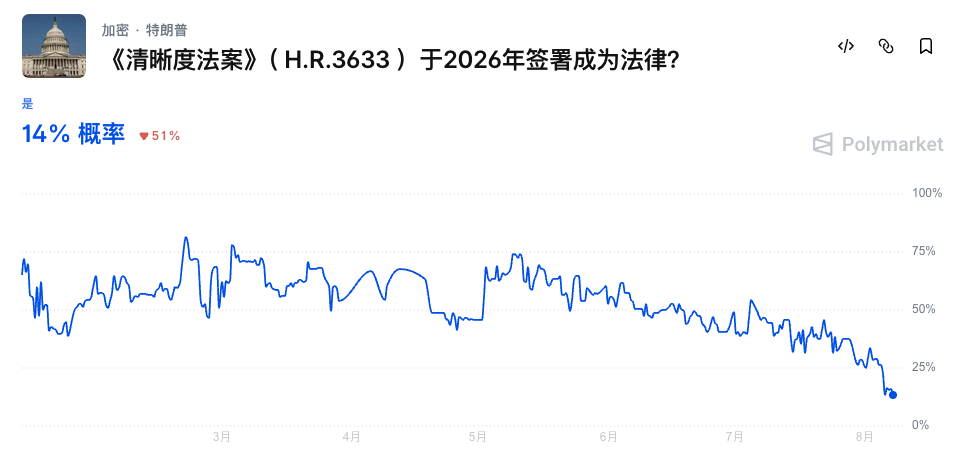
Reported on Aug. 7 by U.S. media and discussed in an Odaily analysis, the delay means legislation intended to draw clearer lines around digital asset market structure and crypto regulatory authority has once again been pushed back. Polymarket data cited in the article shows the probability of the Clarity Act being signed into law by the end of 2026 has dropped to 14%.
Ethics language is the visible dispute, but not the whole story
At first glance, the bill appears to be stuck just before the finish line. The most immediate obstacle is Democratic opposition to the current version of the bill’s ethics provisions. Democrats argue those provisions still leave major gaps, including failure to cover officials’ children, no ban on holding existing crypto assets, and an enforcement framework that leans on the Department of Justice, or DOJ. In their view, the bill still does not adequately address crypto corruption or consumer protection.
Odaily argues, however, that the fight is no longer just a technical argument over legislative wording. In the article’s telling, the Clarity Act has become a casualty of a wider partisan struggle, one tied to Trump, Republican political interests, and the midterm elections. Democratic criticism of the ethics section and its anti-corruption framing, the article says, has become a way to target Republicans while also weighing on Trump politically.
That helps explain why a delay serves Democratic interests. Once Congress returns in September, floor time will be tighter because lawmakers will be dealing with federal appropriations fights and election-year politics. In that setting, the best chance for the bill to advance this year may shift to the lame duck session after the November midterms.
From stablecoin disputes to a stalled floor vote
Earlier this year, the Clarity Act was already held up for more than four months because the banking sector and the crypto industry disagreed over rules governing stablecoin yield. After that issue was resolved and the bill cleared the Senate Banking Committee in May, Democrats continued to block it from reaching the Senate floor.
Odaily notes that the Banking Committee approved the CLARITY Act by a 15-9 vote, with only two Democratic members backing it.
Sen. Elizabeth Warren, a Democratic member of the committee, had submitted more than 40 amendments during committee consideration. Democrats later used both the ethics provisions and developer protection language in the Blockchain Regulatory Certainty Act to pressure Republicans. Once disagreement over the developer protection language was resolved, it appeared Democratic efforts to stall the bill might fail. Instead, Trump’s own ties to crypto business gave opponents a new line of attack.
Trump’s financial disclosure changed the debate
On June 30, the U.S. Office of Government Ethics, or OGE, publicly released Trump’s 2025 financial disclosure report. According to the figures cited in the article, Trump posted about $2.2 billion in income in 2025, and roughly $1.4 billion of that came from crypto-related business activity.
That crypto-linked income included about $635 million connected to the TRUMP meme coin, while token sales, equity and related interests tied to World Liberty Financial contributed about $800 million.
Odaily says those disclosures gave Democrats room to shift the Clarity Act fight directly onto Trump and the White House, while claiming the moral high ground. In this reading, pressing ethics language aimed at curbing official corruption looks defensible on its face, even if it ends with the bill delayed. At the same time, placing anti-corruption and retail investor protection at the center of the public debate could help Democrats reach voters uneasy about crypto or already hurt by it.
At the outset, ethics language was not the main issue blocking the bill. Republicans had largely brushed it aside on the grounds that it did not belong inside a banking or market structure bill and should instead be addressed in standalone ethics legislation. Odaily stresses that Republicans were not arguing the provisions were unnecessary, only that they should not be folded into the Clarity Act.
That distinction became harder to sustain once Trump family crypto profits moved to the center of public attention. What had looked like a politically targeted ethics demand became an issue the bill could no longer avoid.
Trump agreed to add ethics language, but Democrats still objected
Under pressure, Trump agreed on July 21 to include ethics provisions in the Clarity Act. Odaily argues that the concession did not resolve the dispute and instead appeared to preserve advantages for the Trump family.
The article says the language would require Trump to divest crypto-related business assets, but that arrangement could also allow him to avoid immediately paying federal taxes on related gains for years, potentially saving millions of dollars.
That was not enough for Warren and other Democrats, who argued the language lacked teeth and pushed for stricter requirements. From that point on, the debate was no longer really about whether ethics language belonged in the bill. The focus shifted to whether Trump and Republicans would make broader concessions.
Odaily’s conclusion is that the delay was not simply the result of a flawed ethics provision. The article says Democrats are deliberately using the issue to create political pressure for Trump and Republicans. Even if Republicans accepted a stronger version of the ethics section, Odaily argues, Democrats would probably raise new demands. At the same time, the article sees little sign that Trump or Republicans are prepared to keep giving ground.
A politics of veto leaves the industry paying the cost
Trump has not publicly laid out his own response to the ethics provisions or to the Democratic position. Still, Patrick Witt, executive director of the White House Digital Assets Advisory Council, said the president had already made a historic concession and Democrats were still unsatisfied, adding, “you can’t hit a home run and then hit two home runs.”
That comment suggests the Trump administration believes it has already yielded enough. In a prolonged political standoff with Democrats, continued unilateral concessions could carry their own political cost and might be read by voters as weakness. Odaily says that makes further compromise from Trump before the midterms unlikely.
On Aug. 6, Warren said publicly that she supports advancing crypto-related legislation but does not support the current Clarity Act because it fails to fully address corruption, consumer protection, national security and economic risk. Odaily reads that as an attempt to place responsibility for those unresolved issues on the Trump administration and congressional Republicans.
The article also notes that Warren, despite a long record of caution toward crypto assets, is now pairing a pro-legislation message with an argument that Trump is to blame for the bill’s delay. Odaily says that strategy is aimed at weakening Trump’s standing with younger voters who support the crypto sector. At this stage, the article argues, Democrats may no longer need a better trade from Trump or Republicans. Keeping the Clarity Act from advancing could itself become a useful political weapon in the midterms.
Odaily describes this dynamic as a form of “veto politics” born out of partisan polarization. In that environment, the bill’s outlook deteriorates, while the broader cost is borne by U.S. society and the crypto industry.
Supporters warn that enforcement will keep filling the legal vacuum
Economist James E. Thorne wrote on Aug. 7 that pushing the vote to September means the anti-innovation progressive camp has once again gained the upper hand.
Thorne said the delay sends a message that protecting the existing interest structure still matters more than ensuring U.S. leadership in the next generation of money and financial architecture. If the bill keeps slipping, he argued, enforcement actions will continue to fill gaps that legislation should have addressed, and the end result could be a United States that fails to lead the crypto industry.
The article points to one recent example: the closely watched lawsuit over “lawful claiming” of 3.8 million BTC. Odaily says that if the Clarity Act had passed before the summer recess, Section 20216 of the updated bill would have effectively undercut the case. Under the current timeline, attention now shifts to a Sept. 8 hearing.
Bitwise Chief Investment Officer Matt Hougan offered a different view. He said the crypto industry can keep moving even if the Clarity Act does not pass in the near term, because the U.S. Securities and Exchange Commission, or SEC, could address some of these issues through rulemaking. Hougan added that rules introduced in the short term by the SEC under Paul Atkins could end up being more favorable to crypto and innovation than a bipartisan bill.
September looks crowded, leaving the lame duck session as the best remaining window
In procedural terms, the Senate is expected to resume work on the Clarity Act after lawmakers return in September. But the opening is narrow. Odaily says federal spending fights and campaign politics will consume most of Congress’s time, making time an ally for Democrats and an obstacle for Republicans.
The two parties are also divided over appropriations for the second half of the year. During a speech in Georgia on July 22, Trump said a federal government shutdown could happen again in September because Republicans and Democrats remain split over spending priorities. If Congress does not pass appropriations on time, funding for most federal agencies and programs will expire on Sept. 30, the end of the fiscal year.
Even if appropriations are resolved smoothly, September and October will be dominated by the final midterm push. Debates and advertising campaigns are expected to take over the calendar, leaving only limited working days for the Clarity Act.
That is why some observers now think the odds of the bill passing on its own before the election are already low. Odaily says some supporters have even considered trying to attach parts of the bill as sections within the must-pass appropriations package due by the end of September.
But the article also says that route may not be any easier than passing the bill as standalone legislation. On balance, the most promising period left this year appears to be the lame duck session, which the article places between the end of the Nov. 4, 2026 midterm election and Jan. 3, 2027, when the 120th Congress formally convenes.
Why the lame duck session matters
The lame duck session refers to the period after the midterm election and before the incoming Congress is sworn in. It takes its name from the fact that lawmakers who have lost re-election or are on the way out can still vote and legislate during that stretch.
That makes it a distinctive stage in the U.S. legislative calendar. Because the composition of Congress is about to change, the odds of partisan compromise can rise, and bills that face intense resistance during ordinary sessions may move more quickly.
Odaily points to several major precedents passed during lame duck periods, including the Tax Relief, Unemployment Insurance Reauthorization, and Job Creation Act of 2010, the 2013 fiscal cliff deal, and the Respect for Marriage Act of 2022.
Based on that history, the article says the Clarity Act could still pass during the lame duck session, as long as both parties continue to see value in digital asset regulation.
Galaxy, however, warned that risks would remain. As leadership attention turns to committee formation, nomination confirmations and planning a new legislative agenda, political energy for a complicated financial regulatory bill involving many stakeholders could fade.
If the bill fails this year, the process resets in the next Congress
Odaily ends with a more severe scenario. If the Clarity Act does not pass during the lame duck session, meaning by the end of this year, then the progress made so far would be wiped away once the 120th Congress begins its work.
A new Congress would have to restart the legislative process from scratch. New committee membership and potentially very different political incentives would reshape the path of the bill. At that point, the article says, it is impossible to know what scale of partisan struggle the Clarity Act would be pulled into next, or which side would end up using it as a political tool.