
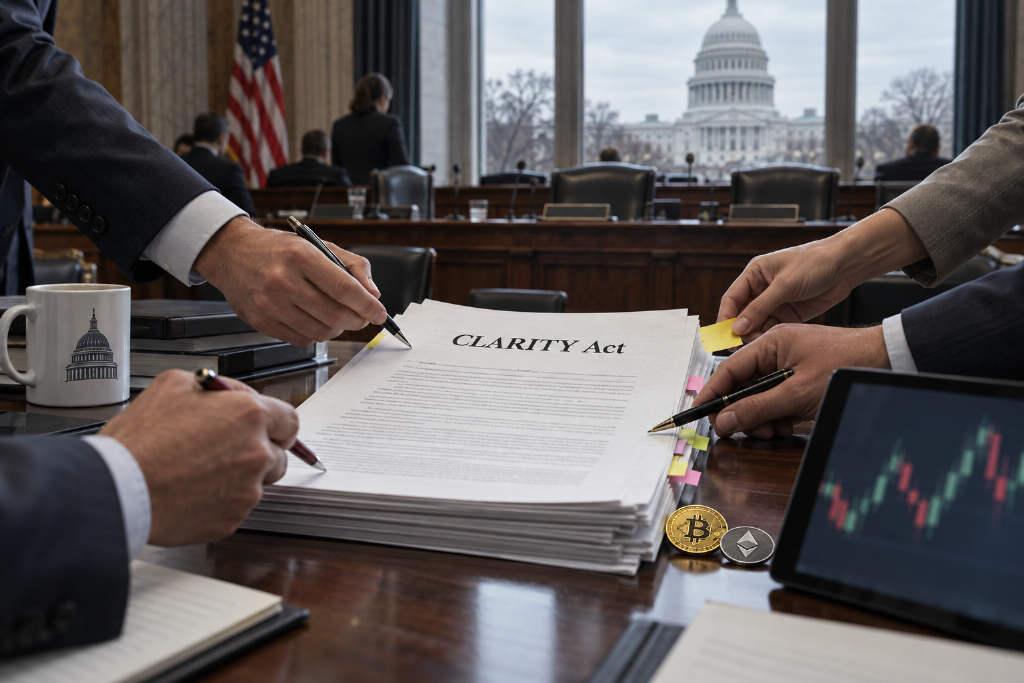
The battle over the CLARITY Act is no longer just about whether the bill survives. The immediate question is who gets to write the next version of it.

The source article says even Senator Elizabeth Warren, long viewed by the industry as one of crypto's toughest critics, wants a role in shaping the rules. Since the Senate version was blocked in January, the list of groups seeking a seat in the drafting process has continued to grow.
Armstrong says the January draft had major flaws
Coinbase Chief Executive Officer Brian Armstrong said in a recent social media post: 「In January, I opposed sending the draft bill to committee because it still had major issues to work through in decentralized finance, tokenization, Commodity Futures Trading Commission authority, and stablecoin yield provisions. At the time, the draft had serious flaws that would have harmed the crypto industry; support was badly split, and the bill had no chance of passing. We worked with multiple parties to revise it so it had a path forward. In the new draft submitted to committee about four months later, all four of the issues I had raised were fixed. I'm proud of that work, and I would do it again, because it produced a better bill. This is just one step in a long process.」
The article describes the response to Armstrong's January move as almost ironic: many other stakeholders effectively answered by saying they wanted in on the rewrite too. A wider set of institutions then emerged, each arguing it could help make the bill better.
Competing demands are now colliding
Banks were the first group to object to the changes Armstrong supported. That pushback later led the White House to hold several small meetings with crypto companies and banking executives.
Law enforcement officials then raised their own concerns, focusing on developer protection provisions and illicit finance risks.
June disclosures showing President Trump had $1.4 billion in crypto-related income added momentum to demands from both parties for ethics provisions in the bill.
Regulatory specialists have also warned that both the Commodity Futures Trading Commission and the U.S. Securities and Exchange Commission face commissioner vacancies. The article says the political tug-of-war between the legislative and executive branches over the path for crypto legislation is also shaping how the broader industry reads the situation.
Even with those disagreements, bipartisan lawmakers on the Senate Banking Committee and the Senate Agriculture Committee are still negotiating in search of a compromise that could move the measure forward.
After the failed cloture vote, attention turns to the next window
It has been nearly two weeks since the CLARITY Act failed on a cloture vote, and the divide has not eased. The article says opposing policy advocates are still conducting their post-mortems, while nearly all sides insist their goal remains the same: improve the bill.
Several possible paths are now being discussed:
- Some want to revive the bill during the lame-duck session after the midterm elections.
- Others are looking to financial regulators to write rules directly and fill the gap.
- Another camp believes the bill is finished.
Still, the article says most stakeholders have already been planning for the next Congress behind the scenes. Whether Democrats retake the House or gain control of both chambers, outside factions will need stronger bipartisan strategies and sharper tactics.
The Bank Policy Institute said in a statement after the failed cloture vote that its member institutions would keep pressing ahead: 「The U.S. banking industry continues to support the establishment of a durable, long-term regulatory framework for digital assets, one that will underpin America's global leadership for decades to come. We believe Congress can achieve that goal while also protecting the bank lending activities that support economic growth. As lawmakers consider next steps, we recommend targeted adjustments to policy on stablecoin yield. We are prepared to work with all stakeholders to accomplish this important objective.」

Crypto trade groups signaled the same. Blockchain Association CEO Summer Mersinger said last Friday that she will step down, with founding leader Kristin Smith returning as interim CEO.
After the vote, Mersinger said: 「The work to deliver long-awaited consumer protections and clear rules for digital asset users and entrepreneurs in the United States is not over. Tens of millions of Americans own digital assets, but U.S. builders still lack clear federal rules, while Europe, the United Kingdom, Singapore, the United Arab Emirates, and Japan already have their own regulatory frameworks ... We will not stop until the industry has regulatory clarity in the United States.」
Key Republican negotiators are heading out
The article says one of the biggest complications is personnel turnover in Washington. Several officials who served as important bridges in crypto policy and regulatory debates over the past decade are now on their way out.
Senator Thom Tillis of North Carolina will not seek a third term and is set to leave office at the end of the year. The article says he worked with Maryland Democrat Angela Alsobrooks on a compromise tied to yield provisions, and with Arizona Senator Ruben Gallego on stronger bipartisan ethics language to be included by the White House.
Senator Cynthia Lummis of Wyoming also will not run for another six-year term and said she plans to return to her ranch. Lummis, chair of the Senate Banking Committee's digital assets subcommittee, has been a leading figure in the CLARITY Act effort. She has also built a reputation for working across party lines, including with New York Senator Kirsten Gillibrand on the GENIUS Act. The article says her departure will be difficult to replace.
The core regulatory agencies tied to the bill are also dealing with vacancies. SEC Commissioner Hester Peirce, after serving two terms, is due to leave this Friday and return to academia. Since 2018, she has been one of the most influential figures in the crypto regulatory debate.
Before her Oct. 2 departure, Peirce wrote on X to the White House last week: 「A subtle but essential task for regulators is to preserve, within a sound regulatory framework, as much freedom as possible for people to make the best choices for themselves and their families, and to let them enter into transactions with confidence. As I leave, I am confident that under the outstanding leadership of Chair Paul Atkins and Commissioner Mark Uyeda, the talented team at the Securities and Exchange Commission will continue to maintain that balance.」
According to the article, when Washington returns to crypto legislation and tries again to build lasting policy that supports innovation and U.S. competitiveness, the departures of Peirce, Lummis, and Tillis will be felt.
The 120th Congress will decide who shapes the next draft
The article argues that members of the 120th Congress, both new and returning, will need to work with crypto trade groups, bank lobby organizations, law enforcement, compliance bodies, and other parties seeking changes to the digital asset market structure bill if the legislation is to reach the president's desk and move into the harder phase of rulemaking.
It also notes that Congress has never passed a bill that satisfied every side. In that environment, compromise legislation with bipartisan backing stands the best chance of surviving the process.
The concluding view is straightforward: institutions with deep relationships in both parties are likely to be in the strongest position to help draft the next version of the CLARITY Act.