
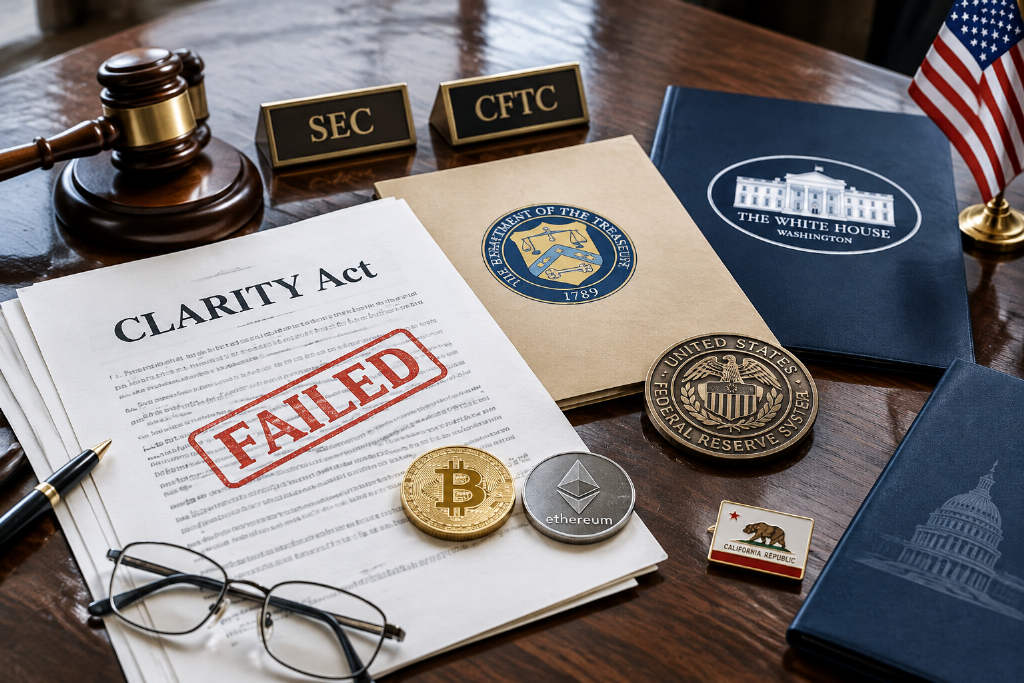
The U.S. Senate failed to move the CLARITY Act forward on Sept. 16, but the crypto market did not trade as if the legislative effort had collapsed. In a roll-call vote on a cloture motion for the CLARITY Act, H.R. 3633, senators split 49-50, leaving the measure short of the 60 votes required to proceed.
Bitget market data cited in the source showed Bitcoin rose about 10.77% between Sept. 16 and Sept. 29, while Ether gained about 12.81%. On Sept. 21 alone, Bitcoin climbed 6.7% and Ether rose about 4.95%.
Key industry figures responded quickly after the vote. According to public information cited in the article, CFTC Chair Michael S. Selig said the result was disappointing, but the U.S. would keep using its existing statutory authority to build a regulatory framework for crypto asset markets.
Coinbase CEO Brian Armstrong said bipartisan talks could still continue, but added that market participants could no longer rely on Congress, arguing that the SEC and CFTC already have the authority to write clear rules under existing powers. Binance founder Changpeng Zhao said the remaining consolation was that stablecoins could still continue to generate yield.
The broader point in the article is that a failed bill did not stop the regulatory process. Over the following two weeks, the SEC and CFTC released a series of documents and exemptions aimed at filling gaps inside the current legal structure. Even so, those steps were described as patchwork compared with the federal spot-market framework the CLARITY Act had tried to establish.
SEC moved first with exemptions, a formal proposal, and FAQ updates
The SEC was the most active agency in the period after the vote. On Sept. 17, it issued a statement on innovation exemptions and approved a temporary conditional exemption allowing limited trading in tokenized NMS stocks on certain on-chain trading venues, described as tokenized securities venues, or TSVs.
The exemption lets TSVs avoid being treated as an "exchange" under the Securities Exchange Act solely because they offer tokenized NMS stocks through automated market makers and liquidity pools.
To qualify, a TSV must meet conditions covering public notice, trading transparency, coordination of trading halts, books and records, and technical safeguards. The exemption also places caps on products and trading volume, and requires periodic public disclosure of U.S. dollar-denominated trading data. The relief expires five years after publication.
SEC Chair Paul S. Atkins said the move was an important step in bringing U.S. capital markets into the digital era. He also released remarks from a roundtable on 24-hour trading in U.S. equity markets, saying the Depository Trust & Clearing Corporation, or DTCC, had launched a "23×5" trade capture system to support clearing and settlement, that securities information processors were preparing overnight price dissemination, and that tokenization could help the securities industry manage inventory in real time, improve efficiency, and reduce naked short-selling risk.
Robinhood CEO Vlad Tenev commented that "tokenization is coming to America," adding that the benefits of instant settlement, around-the-clock trading, and default fractionalization would begin reaching U.S. users.
A more formal SEC action came through its proposed Regulation Crypto Assets. According to the agency's proposal, the rule was introduced on Aug. 18, 2026, published in the Federal Register on Aug. 21, and opened for a 60-day public comment period running through Oct. 20.
The proposal would create a dedicated issuance regime for investment contracts involving crypto assets and establish two registration exemptions. One would allow aggregate fundraising of no more than $5 million over four years. The other, modeled on existing Regulation A, would allow fundraising of up to $75 million in any 12-month period, with two tiers.
Under both exemptions, issuers would have to provide principles-based narrative disclosures. Issuers using the second exemption would also need to provide financial statements and comply with ongoing reporting obligations. The proposal also includes a conditional safe harbor under which a crypto asset would be treated as not constituting an investment contract if the relevant conditions are met.
On Sept. 26, the SEC's Division of Corporation Finance updated its crypto asset FAQs and said token buybacks, network upgrades, and marketing do not automatically make a crypto asset a security.
The division said that for a crypto network already in operation, announcing a buyback plan by itself would not make the related token an investment contract. For a network that is not yet operational, that conclusion would not necessarily apply if the issuer markets the buyback as a source of returns for holders. The document also said that once a crypto system is operational, services used to protect, maintain, improve, or enhance the system and its functionality, or to promote network effects, do not count as managerial efforts under the Howey test.
On Sept. 29, the SEC updated the FAQ again and added that if there is no central actor behind a token buyback, the arrangement would generally not constitute an investment contract.
Peirce is set to leave, leaving the SEC with two commissioners
The article also pointed to personnel changes at the SEC. Crypto reporter Eleanor Terrett reported on Sept. 26 that SEC Commissioner Hester Peirce would leave on Oct. 2 to become an associate professor at Regent University School of Law.
Peirce, often referred to in the industry as "Crypto Mom," has long pushed for clearer rules for the sector. The article said she continued that work during the chairmanships of Jay Clayton and Gary Gensler, and was appointed last year to lead the SEC's newly created crypto task force. Her work on crypto policy covered mining, staking, and meme coins, among other areas.
The SEC's first formal crypto rule proposal, Regulation Crypto Assets, and the innovation exemption tied to the tokenization path for securities both advanced during her tenure.
After Oct. 2, the SEC will have only two commissioners left: Paul Atkins and Mark Uyeda. Under the agency's rules, two commissioners are enough to form a quorum.
The article described both men as relatively friendly toward crypto. Atkins, as SEC chair, has taken a more proactive line on bringing crypto into the U.S. financial system. He has criticized the agency's past use of "regulation by enforcement," arguing that regulators should write rules first and let firms operate under them.
Atkins has openly backed the CLARITY Act. He previously said that "legislation remains indispensable" and that the SEC would continue supporting Congress in sending the bill to the president for signature. After the procedural vote failed, he did not pivot to retrenchment and instead moved quickly on the innovation exemption as the next step available under current law.
Uyeda has also supported crypto industry development, though with more emphasis on limiting the SEC's jurisdictional reach and clarifying statutory authority. On Jan. 21, 2025, he announced the creation of a Crypto Task Force aimed at producing a comprehensive and clear regulatory framework for crypto assets.
He has long argued that the SEC should not treat an entire economic activity as securities-regulated simply because a project involves a token, and he has supported tokenization as part of securities market infrastructure. In the vote on the Regulation Crypto Assets proposal, Uyeda voted in favor.
CFTC took a narrower path but has a formal project in motion
The CFTC's formal actions after the CLARITY vote were more limited. On Sept. 25, it updated its FAQ on crypto asset and blockchain-related activities for registered entities and registrants, stating that futures commission merchants and derivatives clearing organizations may invest customer funds in tokenized forms of assets that already satisfy Regulation 1.25 requirements.
That treatment depends on the underlying asset being compliant, the tokenized form giving holders the same or functionally equivalent legal and economic rights as the traditional form, and the arrangement meeting requirements on liquidity, concentration, maturity, and custody.
The CFTC also confirmed that qualifying tokenized assets may be used as margin for uncleared swaps. It further said entities subject to the relevant rules may create and maintain regulatory records directly on blockchain or distributed ledger systems, without having to keep an extra off-chain copy solely because the records are on-chain.
A separate development may matter more over time. According to the U.S. government regulatory review database cited in the article, the CFTC has listed "Regulation Crypto Asset Transactions and Regulation Crypto Asset Markets" as a formal regulatory project, and the matter entered OMB/OIRA review on Sept. 17, 2026.
As of Sept. 29, the project remained in Prerule status, meaning the text of a proposed rule had not yet been released publicly. The next step is for the CFTC to publish the proposal, after which the public comment process would begin.
The White House, Treasury, the Fed, and California all kept moving
At the White House level, the article described Donald Trump as one of the CLARITY Act's most important political backers. According to an Associated Press report from Sept. 14 cited in the piece, Senate Republican leaders said Trump had agreed to add stricter ethics limits to the bill, including a role for state attorneys general in enforcement, in response to Democratic concerns that the president and other federal officials could profit from digital assets.
The article said Trump did not publicly declare that he was abandoning CLARITY after the final text failed.
Treasury Secretary Scott Bessent was also described as a clear supporter of the bill. Reuters reported, according to the article, that he said in February that Congress should pass crypto market structure legislation in the spring, and warned again in September that failure to advance CLARITY would send a "troubling signal" to U.S. allies and competitors.
On Sept. 16, Senator John Kennedy said he was not surprised the bill had failed to pass, but did not view it as definitively dead. He said the legislation might return during the lame-duck session of Congress.
Other agencies were also moving on related crypto rules. The Federal Reserve has formally begun work on implementing the GENIUS Act. Under a proposed rule released by the Fed on Sept. 24, the framework addresses reserve assets, capital requirements, and risk management for payment stablecoin issuers, with permitted reserve assets including qualifying short-term U.S. Treasuries.
The U.S. Treasury Department has also released rules tied to implementation of the GENIUS Act. A key effective date is Jan. 18, 2027. From that date, payment stablecoins issued in the United States will generally require an appropriate federal or state license.
At the state level, California Governor Gavin Newsom signed several bills on Sept. 27. Among them, AB 2409 bars California public officials from issuing meme tokens and also bars companies from launching meme tokens using the names, likenesses, or images of public officials. SB 1208 expands anti-money laundering, forfeiture, and victim compensation mechanisms involving crypto assets, and sets clearer legal procedures for seizing crypto assets held by transnational criminal networks.
