
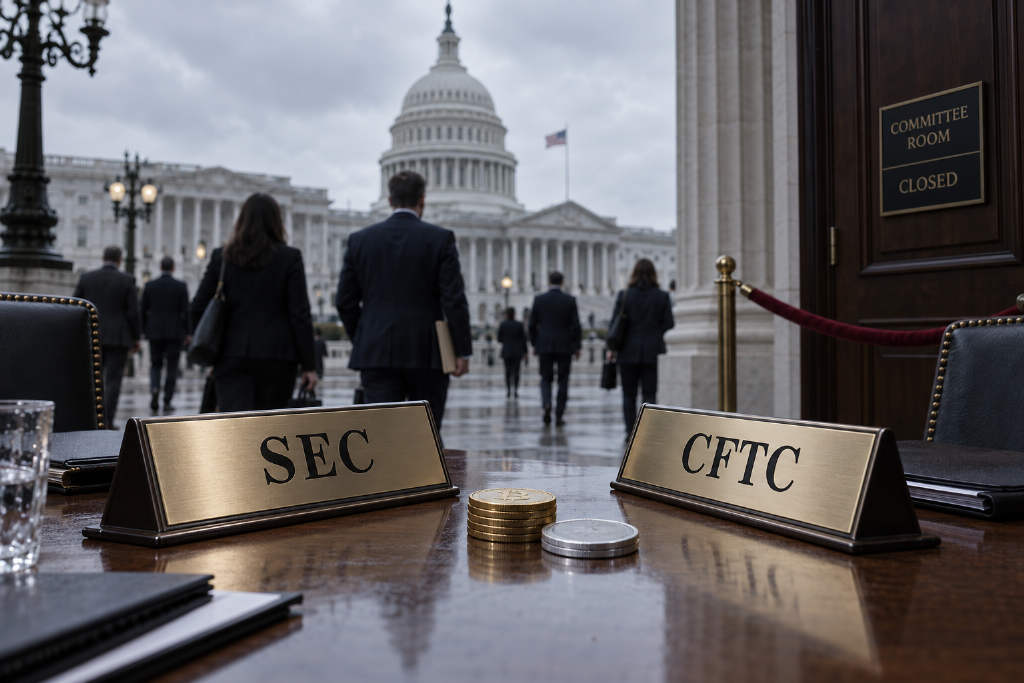
The U.S. Senate voted 49-50 on Sept. 15, 2026, failing to advance a procedural motion for the Digital Asset Market Clarity Act, or CLARITY Act. The chamber did not reject the bill on its substance that day. Instead, supporters fell short of the votes needed to end procedural obstruction and move the measure into the next stage of consideration. With the congressional calendar tightening and midterm elections approaching, the result sharply reduced the time available for the current Congress to keep working on the bill.
The CLARITY Act had been framed as an attempt to address a set of long-running questions in the U.S. crypto market: whether a digital asset should be treated as a security, a commodity, or something in between; whether trading venues should register with the Securities and Exchange Commission (SEC) or the Commodity Futures Trading Commission (CFTC); and when legal relationships created during token fundraising can come to an end. After the procedural setback, those questions are likely to be handled more heavily by regulators, courts, and state-level authorities.
What the 49-50 vote actually means
In the Senate, major legislation often needs enough support to cut off debate before it can move into substantive consideration. That threshold was not met here, so the bill never reached the amendment stage, floor debate, or a final vote.
That does not mean the underlying policy ideas are gone. Similar provisions could return through renewed negotiations, a substitute text, or by being attached to another bill.
Still, a procedural failure carries real consequences. A market structure bill touches SEC and CFTC jurisdiction, exchange registration, customer asset segregation, disclosure rules, and decentralized finance. Rebuilding a coalition across committees takes time. As the election cycle gets closer, lawmakers have less room to compromise on issues tied to conflicts of interest, national security, and financial stability. Even if the core architecture survives in a future version, the bill’s name, text, and political coalition could all change.
The vote also showed that Republican support alone was not enough. Senate procedure means legislation of this kind usually needs bipartisan backing. Committee leaders had repeatedly described the text as the product of long-running bipartisan negotiations, yet Democrats voted against it as a bloc, and four Republican senators also voted no. The bill had industry support and had incorporated some investor-protection provisions sought by Democrats, but that work did not produce a coalition strong enough to survive a full Senate procedural vote.
What the bill was trying to solve
The central problem in the current U.S. framework comes from the division between securities law and commodities law. The SEC oversees securities offerings, securities trading venues, and intermediaries. The CFTC has established authority over commodity derivatives, but its direct authority over spot markets in digital commodities is much more limited. Bitcoin is often treated as a commodity, while many tokens may involve an "investment contract" at the issuance stage. The same token can present different legal characteristics across fundraising, network operation, and secondary-market trading.
The CLARITY Act tried to separate the asset itself from the legal relationship created when it is issued or sold, using concepts such as "digital commodity" and "investment contract asset." In practical terms, a development team selling tokens to raise funds could still be engaged in a securities transaction, but the token would not automatically remain a security forever. Once a network reached a certain level of decentralization or functionality, and once the issuer completed the required disclosures, some secondary-market activity could move into a CFTC-led digital commodity framework.
That structure had obvious value for the industry. Platforms could make earlier judgments about which regulator they needed to register with. Project teams could build compliance plans around network maturity, disclosure, and affiliated holdings. If the CFTC gained spot-market authority over digital commodities, it could also require trading platforms to maintain customer asset segregation, recordkeeping, capital standards, and market oversight. In theory, that would reduce the cost of relying on enforcement actions to define the boundaries one case at a time.
But the same design created its own dispute. If "investment contract asset" were interpreted too broadly, an issuer might be able to move a token out of the securities-law framework relatively quickly after only limited disclosure, even when investors still depended on the development team to maintain code, organize the ecosystem, or control the treasury. In that case, investors might be left mainly with anti-fraud protections available in commodity markets. There is still no full consensus on how to separate the asset from the transaction around it.
Why conflicts of interest became a procedural obstacle
Compared with earlier market structure proposals, the 2026 debate carried a sharper political dimension: the economic ties between the sitting president and the president’s family and crypto projects. Democratic lawmakers pushed for stronger ethics provisions that would restrict the president, senior executive officials, and related parties from issuing, promoting, or holding crypto assets that could be affected by their own policy decisions.
Supporters of the bill argued that the revised text already placed limits on some issuance and sponsorship activity. Opponents said related entities, family members, and preexisting projects could still profit through carve-outs and exceptions.
This dispute could not be resolved through ordinary securities-law disclosure logic alone. A president can appoint agency leaders, influence executive enforcement, and shape digital-asset policy, while those same policies can directly affect the value of assets or projects tied to that president. The core concern is the lack of sufficient separation between public power and private economic interest. Even if a transaction does not amount to securities fraud, the public may still question whether official decisions are being influenced by personal financial interests.
Democrats also questioned the enforcement design, including who would have standing to sue, whether liability could continue after an official leaves office, and whether state attorneys general and private parties could take part in enforcement. Supporters of the bill said those criticisms were amplified by election politics. The procedural vote, however, showed that ethics concerns were strong enough to change how some senators voted. If a future version is meant to regain bipartisan support, revising token classification rules alone may not be enough. The conflicts-of-interest provisions would likely need clearer covered persons, prohibited conduct, and enforcement channels.
DeFi and national security remain unresolved
Another source of resistance came from the anti-money laundering boundary for decentralized finance, or DeFi. Traditional financial institutions have clear obligations around customer identification, suspicious activity reporting, and sanctions screening. A DeFi protocol may run through smart contracts, while its front end, developers, governance bodies, liquidity providers, and validators are spread across different places. No single participant necessarily controls customer identity data or transaction execution. Imposing bank-style obligations directly on code may be technically difficult. Granting a full exemption would leave an obvious channel for funds to move.
Democratic committee staff argued that the text left overly broad exceptions for some DeFi services and offshore stablecoin payments, which could weaken controls on mixers, sanctioned actors, and cross-border illicit funds. Supporters worried that treating software development, open-source code maintenance, or transaction validation as financial intermediation would pull technical participants who do not control user assets into licensing and monitoring obligations, pushing development activity out of the United States.
The harder question is how to define the regulatory relationship between control and profit. A team may not directly custody user assets, yet it may still be able to change the front end, collect fees, control upgrade keys, or set protocol parameters. If the law looks only at whether someone holds private keys, operators with real influence may fall outside the system. If anyone who profits from transactions is treated like a full financial institution, liquidity providers and infrastructure nodes may be swept in too broadly. Future legislation would need a more granular breakdown of technical roles rather than a one-step judgment based on whether something is "centralized" or "decentralized."
Stablecoin rewards were part of the fight
Stablecoin yield and reward structures also entered the market structure talks. Banks argued that if trading platforms or stablecoin issuers pass reserve income to holders through "rewards," they create a deposit-like mechanism for attracting funds without taking on deposit insurance, liquidity regulation, or bank capital requirements. The crypto industry argued that banning all rewards would limit platform competition and could concentrate returns in the hands of issuers and large financial institutions.
This issue is not identical to the CLARITY Act’s asset-classification framework, but it affects whether banking groups and some lawmakers will support the broader package. Stablecoins already have a dedicated legislative framework in the GENIUS Act. If a market structure bill addresses income distribution again, it would need to distinguish among payment stablecoins, securities-like products, platform marketing rewards, and staking yield. Putting those different economic activities under a single prohibition could create avoidance structures and deepen jurisdictional conflict among the SEC, bank regulators, and state regulators.
Regulators have already started filling the gap
Even without congressional action, the U.S. is not back to a ruleless environment. In March 2026, the SEC issued an interpretation on the application of securities law to crypto assets, and the CFTC said at the same time that it would align within the scope of the Commodity Exchange Act. That interpretation distinguished among digital commodities, digital collectibles, digital tools, stablecoins, and digital securities. It also explained when a non-security crypto asset could still be involved in an investment contract arrangement and how that investment-contract relationship could end.
On Sept. 17, one day after the Senate procedural vote failed, the SEC also announced an "innovation exemption" for certain tokenized stock trading activity. The exemption allows qualifying tokenized securities trading venues and liquidity providers to operate temporarily without being treated under some exchange and dealer definitions, while still preserving conditions tied to anti-fraud, anti-manipulation, sanctions compliance, permissioned access, and issuer objection rights. The SEC chair described it as a bridge to longer-term rules and explicitly referred to Congress’s failure to move the CLARITY Act forward.
Agency action can solve some market-access questions quickly, but it has three limits. First, the SEC can interpret or exempt only within authority already granted by Congress; it cannot create a full spot-market regime for digital commodities on its own. Second, interpretations and exemptions can be reviewed by courts and can also change with shifts in commission personnel. Third, the SEC and CFTC can coordinate, but their budgets, enforcement powers, and statutory goals are still set by different laws. What the market gets is an operational window, not the same kind of long-term stability that comes with enacted legislation.
Three paths are now likely to run in parallel
The first path is a reworked bill in the next session of Congress. Asset classification, CFTC spot authority, platform registration, and customer asset segregation have already matured into recognizable policy modules. Starting from zero would be costly. A more likely route is to keep the core structure, renegotiate the ethics, DeFi, and stablecoin provisions, and lower the difficulty of a single large bargain through a narrower bill or phased legislation.
The second path is continued use of interpretations, rules, exemptions, and joint statements by the SEC and CFTC to provide an interim framework. For tokenized securities, custody, brokered trading, and on-chain settlement, those tools can open channels for specific products. Their durability depends on statutory authority, administrative procedure, and court rulings. Firms can design businesses around them, but they also need contractual and technical room in case rules are withdrawn, conditions change, or agencies diverge.
The third path is continued reliance on state law and state licensing. States including New York already regulate some institutions through virtual currency licenses, trust company structures, and money transmission regimes. Without a federal market structure law, firms still have to deal with multistate licensing, consumer protection, and state securities law. Large platforms may have the resources to build layered compliance systems. Smaller projects may instead limit U.S. users or move activity to jurisdictions with more unified rules.
If all three paths continue at once, the result is a fragmented system: the U.S. market remains governed by multiple sets of rules, but those rules come from different sources and offer less legal stability than a single federal framework. For institutional investors, compliance costs come largely from repeated registration, shifting asset classifications, and uncertainty over post-trade liability. For regulators, the risk is that similar activity ends up under different regimes because of product packaging or technical design.
The demand for market structure legislation has not gone away
The CLARITY Act’s failure was, first of all, a breakdown in a political and legislative coalition. Supporters, mainly Republicans, wanted a package that could cover industry innovation, expanded CFTC authority, investor protection, and national competitiveness. Opponents, mainly Democrats, treated ethics, national security, financial stability, and the integrity of securities law as non-negotiable conditions. The broader the bill became, the more political conditions had to be satisfied at once. The 49-50 result suggests that both sides still accept the need for rules in principle, but they remain divided over who should regulate, how far that regulation should go, and how political power itself should be constrained.
What has not changed is the underlying demand for a market structure law. Token issuance, secondary trading, custody, and on-chain securities continue to develop, and the SEC has already responded to real business activity through interpretations and temporary exemptions. In the near term, the U.S. crypto market may get more permissions for specific use cases while still lacking a unified framework that can remain stable across political cycles. Companies can treat agency policy as the rules currently available to them, but those measures are not a substitute for legislation.
Whether a future version can pass will depend on whether drafters are willing to narrow the number of issues they try to solve at once and build enforceable boundaries around the most contested areas. Asset classification would need to connect ongoing disclosure with actual control relationships. DeFi obligations would need to be tiered around real control capacity. Ethics provisions would need to cover related interests and enforcement mechanisms. Stablecoin rewards would need to be separated by funding source and economic function. Only then could "clarity" become more than a legislative slogan and turn into a framework market participants can rely on over time.
