
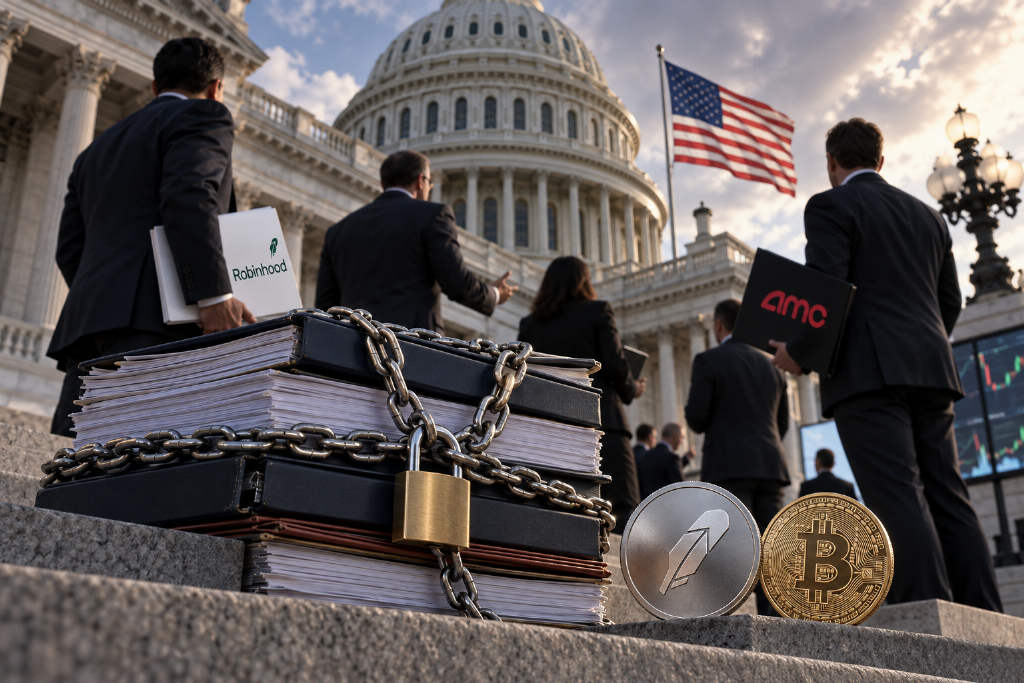
With five days left before a scheduled Senate voting window, the Clarity Act is still tangled in a fight over ethics and conflict-of-interest provisions. At the same time, a public dispute between AMC and Robinhood over offshore tokenized stock products has pulled asset tokenization, market-structure legislation and prediction-market regulation into the same policy conversation in Washington.

The discussion came from CoinDesk’s Policy Protocol, hosted by Renato Mariotti and Rebecca Redig, with Digital Chamber CEO Cody Carbone joining to talk through the latest developments. Their exchange focused on the legal perimeter of offshore tokenized products, the state of the Clarity Act, the tension between federal and state oversight, and the way prediction-market platforms are moving into mainstream culture.
AMC and Robinhood pushed tokenized equities into the open
Redig said one of the most closely watched stories in fintech and securities compliance this week was the public clash on X between AMC management and Robinhood.
The dispute began after AMC CEO Adam Aaron found that an offshore market was offering a tokenized product tied to movements in AMC’s stock price. Aaron responded sharply, calling the offshore tokenized product "despicable and vile" and demanding that a cease-and-desist letter be sent.
Robinhood CEO Vlad Tenev answered in a far calmer tone. Dan Gallagher, the former U.S. Securities and Exchange Commission commissioner who has also served for years as Robinhood’s chief legal officer, then weighed in directly. Gallagher said the company’s compliance team understood the underlying legal and technical structure and signaled that the issuer should not be intimidated by infringement claims.
For the speakers, the significance of the exchange went well beyond one corporate spat. It shoved the subject of asset tokenization out of a specialist corner and into a much broader public arena.
Redig said Tenev later laid out the commercial rationale in a mainstream financial-media interview. The product, he said, is structured outside U.S. jurisdiction and is meant to open a new international shareholder and derivatives audience for listed companies.
When asked whether the tokenized instrument carries dividend rights, Tenev answered yes. Asked whether Robinhood, as the holder of the underlying shares, would exercise shareholder voting rights on behalf of users, he left more room, saying the company has a plan internally but has not disclosed it in full.
That answer goes straight to the core objection from traditional capital markets: if an equity-linked token does not clearly deliver dividend rights and corporate-governance voting rights, where exactly does its financial value sit? And from a litigation and securities-enforcement perspective, how much legal risk is embedded in an offshore tokenized derivative of that kind?
Gallagher’s defense addressed statutory boundaries, not the bigger policy risk
Mariotti, speaking as a litigator and former federal prosecutor, said Gallagher’s decision to publicly push back on what he viewed as inaccurate legal framing was unusual for a senior legal adviser. As a former SEC commissioner, Gallagher knows the boundaries of federal securities law in detail. On a narrow legal reading, Mariotti said, an offshore synthetic derivative of this type is not directly captured by the strict text of current U.S. domestic securities laws.
But that does not remove the broader risk.
He argued that Washington regulators are growing more wary of a world in which large pools of liquidity around the globe trade derivatives linked to U.S. underlying assets while the platforms behind them operate with limited clarity on risk controls, settlement protections and capital safeguards.
For retail investors who are not equipped to parse cross-border legal distinctions, such products can create the impression that they hold lawful exposure to economic and shareholder rights in the underlying stock. Mariotti said business litigation has shown this pattern before: a company may carve out room under a narrow statutory interpretation, then lose ground later in broader legislative review or in the court of public trust.
He also warned about a larger structural issue. In some respects, the notional trading volume of synthetic exposure to U.S. assets on offshore platforms is beginning to exceed the real turnover in the spot market for those underlying securities. He said that mismatch is likely to drive years of policy scrutiny and compliance restructuring.
The Clarity Act remains stuck, and ethics provisions are the main choke point
Beyond the tokenization fight, Mariotti said the other major issue hanging over the industry this week is the actual status of the Clarity Act on Capitol Hill.
He said that in an earlier discussion he had already noted that some lawmakers, in private conversations, were giving a bleak assessment and calling the bill dead. A technical path to revive it during a lame-duck session may still exist, he said, but the main route is badly blocked.
That view spread widely across crypto social media and drew heavy debate. The immediate fact is that the Senate’s voting window is only five days away, and lawmakers have circulated a new draft. The latest version makes a series of targeted fixes to technical sections covering decentralized finance, or DeFi, classification and technology-neutral exemptions. The obstacle that has not moved, though, is the dispute over ethics and conflicts of interest.
According to the discussion, Democrats, the White House and Republican negotiators still have not held a truly substantive conversation on the bill’s provisions covering executive ethics, recusals tied to financial interests and cross-asset disclosure requirements. If they cannot break that political deadlock in a very short period, the bill will not win the 60 votes needed in the Senate to overcome procedural obstruction.
Redig said the current draft still cannot fairly be described as a genuine bipartisan-consensus bill. To become law, it needs meaningful support from core Senate Democrats. Outside sentiment may be gloomy, she said, but senior staff from both parties have not stopped battling over key technical language behind the scenes, with attention centered on standards for DeFi protocol classification and the status of functional tokens.
She also pointed to an argument sometimes heard in the industry: that a full federal market-structure law may not be necessary if agencies can keep the system running through interpretive guidance. In her view, that approach leaves major institutional risk in place.
Startups and mature ecosystems alike still face a gray zone when they raise capital through token structures or deploy liquidity because disclosure standards remain unclear. The more fundamental gap, she said, is that the SEC does not exercise routine direct oversight of the centralized spot secondary market for crypto assets, while the Commodity Futures Trading Commission, or CFTC, lacks broad statutory licensing authority over non-derivatives retail spot markets. Without a dedicated federal statute with clear legal force, the sector remains exposed to discretionary enforcement risk.
Digital Chamber says a last-minute deal is still possible if negotiators stay at the table
To get a closer view from Capitol Hill, the program brought in Cody Carbone, chief executive of the Digital Chamber. Mariotti described Carbone as someone who has been active in bipartisan coordination around digital-asset market-structure legislation.
Carbone said Washington’s legislative logic often works the same way: only when a legal deadline arrives and everyone must put their name on a voting record do the real lines of compromise and resistance come into view.
He said the present impasse is concentrated mainly in the ethics framework. Stablecoin yield provisions and exemptions for decentralized liquidity protocols may still be adjusted around the edges, but if the two parties cannot narrow their differences on financial disclosures and ethics recusals for senior public officials and executive leadership, the Senate’s 60-vote bar will stay out of reach.
According to Carbone, Senators Tillis and Gallego submitted a systematic compromise framework on ethics issues to the White House legal team several weeks ago, but did not receive a clear answer over an extended period. With pressure mounting from the Senate majority leader’s push to move the voting process, the White House Counsel’s Office and the White House crypto policy group need to align final text quickly with core Democratic senators leading the cross-party talks.
Still, he did not write off the effort. As long as neither side has formally walked away, he said, a political deal remains possible at the last minute. The line of communication with the office of the Senate minority leader is still open, which in his view shows that several senior lawmakers still want to leave behind a substantive bipartisan legislative result on digital assets rather than let the issue collapse into endless party combat.
If the bill fails, agencies and smaller legislative vehicles could take over
Asked what comes next if the Senate vote does not succeed next week, Carbone said the industry needs to prepare for multiple institutional paths.
If the current comprehensive effort stalls in the near term, he said, it is not realistic to expect a new Congress to restart the same bill quickly. At that point, several alternatives come into play.
The first is much more aggressive rulemaking by federal agencies. Carbone said current leadership at both the SEC and the CFTC has already signaled that, if Congress cannot produce legislation, regulators will try to absorb as much of the Clarity Act’s core approach as possible through agency rules, conditional no-action relief and innovation exemptions.
The second is legislative disaggregation. In his description, the Clarity Act is really a superstructure assembled from dozens of narrower bills. That means lawmakers could strip out the most urgent components, such as granting the CFTC exclusive authority over digital-asset spot markets or advancing a payments-innovation measure for compliant stablecoin issuance, and attach them as amendments to must-pass legislation such as the National Defense Authorization Act, or NDAA.
Carbone said that route also carries major political difficulty. Even so, if regular congressional lawmaking falls into a vacuum, he expects federal regulators to take over the lead role in shaping the system.
The Illinois lawsuit highlights the risk of 50-state fragmentation
The conversation then shifted to conflicts between federal and state oversight. Mariotti said that without a unified federal structure, a patchwork of laws across all 50 states could become a compliance disaster for the sector.
He pointed to the Digital Chamber’s recent lawsuit in Illinois state court challenging what the discussion described as the first punitive local tax in the U.S. aimed at crypto-asset trading.
Carbone said a strong, uniform federal framework with nationwide force is the best answer for both innovation and compliance. It would lower costs across the industry and settle questions of regulatory jurisdiction.
If each of the 50 states is allowed to build its own barriers based on local politics and fiscal needs, companies will be dragged into endless state-by-state compliance conflict. He said that is one of the core reasons many strong U.S. digital-asset businesses and developer teams have moved toward offshore jurisdictions in recent years.
Using the Illinois case as an example, Carbone argued that the tax measure was adopted through a process that denied industry participants and the public a chance to take part in legislative hearings, amounting to a surprise nighttime vote. In his account, the punitive tax rate attached to specific crypto transactions was designed simply to fill a local budget gap by imposing discriminatory extraction on one emerging industry.
He added that many high-tech member companies in the state have already begun evaluating whether to relocate. The Digital Chamber’s constitutional and administrative challenge is aimed not only at obtaining a preliminary injunction to stop the measure from taking effect, but also at setting a judicial precedent that could discourage other states from copying similar tax policies when under fiscal strain.
For him, that case proves the reverse point as well: if federal legislation keeps missing, the U.S. innovation market becomes easier to carve up into state-level fragments.
BitLicense and old state examples still shape the current argument
Redig said this is not the first time such a pattern has appeared. She pointed to New York’s BitLicense framework, introduced in 2014, as a familiar example. While it was originally intended to establish a high standard for financial compliance, the burden of local approval over the years restricted New York residents’ access to a wider range of digital financial services and pushed many startups and venture investors to neighboring states seen as friendlier.
She said the broader picture extends beyond state friction because the financial infrastructure itself is changing. Alongside crypto-native institutions, companies such as Kalshi, which blend real-world event contracts with prediction markets, are moving deeper into the financial map.
Prediction markets are breaking out through sports and entertainment
The final part of the discussion focused on prediction markets and event-contract platforms moving into mainstream culture.
Redig said one of the most striking commercial and cultural trends this week was the breakout of prediction markets across sports and entertainment. LeBron James, she said, has entered a symbolic brand partnership with Polymarket. Pete Sampras has aligned with Kalshi. Sydney Sweeney has signed a global endorsement agreement with Novig.
For the speakers, that wave of endorsements from top sports and entertainment figures shows that tools built around event prediction and real-world derivative trading are no longer confined to fintech enthusiasts. They are entering mainstream culture, sports and even the everyday language of political competition.
Redig said that, as U.S. states continue litigating over whether these products should be treated as gambling instruments or financial derivatives, the organizational structure of the prediction-contract market could be reshaped over the next two years.
Mariotti added that the judicial endgame is still unresolved. He cited Kalshi’s petition for en banc review at the U.S. Court of Appeals for the Ninth Circuit as a sign that the central question remains open: are these contracts regulated financial derivatives under CFTC authority, or are they subject to state anti-gambling laws? He said the matter could ultimately reach the U.S. Supreme Court.
Even so, the speakers argued that courtroom timing and cultural adoption do not move together. The same logic seen in the AMC tokenized-stock dispute applies here: while legal doctrine is still contested case by case, public familiarity with the products can spread much faster. When globally recognized athletes and entertainers place tokenized contracts and prediction trading in front of massive audiences again and again, the social footing of the products grows regardless of whether Congress or the courts have finished drawing the final legal line.
The vote on the Clarity Act, the scope of federal jurisdiction, the challenge to state tax initiatives and the legal status of prediction markets all remain unsettled. What is clear from this week’s discussion is that asset tokenization, market-structure legislation and prediction trading are now part of the same policy agenda in Washington.