
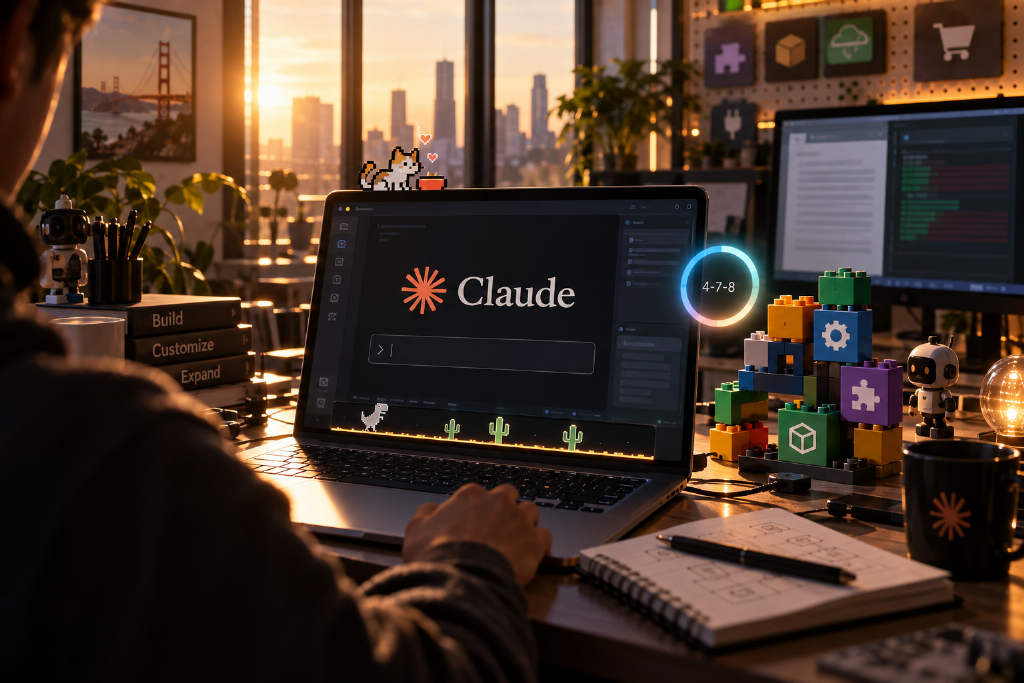
Claude Code has taken on a very different look over the past two weeks.
What was once a terminal-first AI coding tool centered on commands and code edits is now filled with user-made mods: a pixel pet above the input box, a Chrome-style dinosaur game running while Claude writes code in the background, and a 4-7-8 breathing animation that disappears as soon as the answer arrives.
One of the more unusual projects is called Storytime. Its creator inserted a 260,000-parameter model into Claude Code so it can generate a short story in real time based on whatever Claude is doing on screen. In effect, one AI coding tool is running another AI that narrates the session.
The shift started in mid-September, when Claude Code lead Boris Cherny released a mechanism on GitHub called Mods. On Oct. 1 local time, the feature was formally added to the changelog and enabled by default. In a matter of days, developers turned a command-line coding assistant into something closer to a buildable sandbox.
Mods give Claude Code a shared customization layer
At the technical level, a mod in Claude Code is essentially a few TypeScript functions running inside a plugin. The scope is much broader than that description suggests.
Mods can open panels next to a conversation, draw bars above the input field, alter built-in interface elements, intercept commands before Claude executes them, and even route requests to another model. Users who do not write code can still ask Claude to build a mod and install the new feature back into Claude Code.
The community moved quickly. OneWave AI said its team built 10 mods in a single night. Alongside the pixel pet, it made a “launch code” feature that requires a password before destructive commands can run, an “inner monologue” panel that shows Claude’s dry commentary on the session, and an agent-race setup that lets several Claude sessions solve the same problem while a live scoreboard updates on screen.
A separate site, claudemods.ai, has already appeared to categorize these projects by type, including games and dashboards, and to let users vote on them. The top-voted entry so far is the dinosaur game.
That activity could be dismissed as playful hacker culture, but Anthropic disclosed a detail that changes the framing. According to the report, Claude Code’s own /diff change panel and its support for AGENTS.md were not hardcoded product features. The official team built them using the same Mods mechanism, and the source code and tests were published in the repository.
That means Anthropic and outside developers are working with the same modification system. The company is not only allowing cosmetic tweaks. It is using the same building blocks for its own product and then handing those blocks to the community.
The article compares that approach with Minecraft modding culture, with one important distinction: Minecraft’s mod scene began with players breaking things open first and the official platform embracing it later. Claude Code opened the door from the start.
Anthropic assembled the pieces of a plugin ecosystem in 10 days
Viewed beyond the community buzz, Anthropic’s recent product cadence looks unusually dense.
On Sept. 23, the company launched Claude Marketplace and said it already had more than 2,000 plugins and connectors. On Sept. 25, it opened a plugin submission portal where paid developers can submit work through automated validation, security scanning, and human review, then track installation and usage data after launch. On Oct. 1, Mods went live as part of the plugin system and could also be submitted to the directory for sharing.
A store, a review pipeline, a developer backend, and a deep customization layer: within 10 days, Anthropic had assembled the core pieces of an app-store-style ecosystem.
The company also said Claude apps and Claude Code will share a unified plugin entry point in the coming weeks. That places terminal-based mods inside a broader Anthropic platform strategy.
OpenAI offers features; Anthropic is offering tools
The report contrasts Anthropic’s approach with OpenAI’s Codex.
Back in May, Codex introduced a pet mode. Users could type /pet to summon a floating companion that tracked Codex’s progress, and AI could generate custom appearances. Some users even uploaded Microsoft’s Clippy. OpenAI also awarded ChatGPT Pro memberships to the 10 most popular pets.
But those pets were official features. Users could change the skin, not the underlying system. In Claude Code, the pets are written by users through mods. One company ships a feature; the other hands over the toolset.
That openness comes with obvious risk. Anthropic’s documentation says mods have the same machine access permissions as Claude Code itself, and the code is written by publishers rather than Anthropic. Users are told to install only from trusted sources. In theory, a malicious mod can do what a malicious software package can do. The documentation also includes a page for enterprise administrators on how to control mods.
AI coding tools are splitting across a CLI spectrum
The article places Claude Code within a wider industry split.
On one end is Codex. It supports plugins, packaged skills, and MCP connections, but based on public material, it does not currently hand interface rendering or tool-call interception to third parties.
On the other end is DeepSeek’s Harness, open-sourced in August under the MIT license. DeepSeek describes it as a system where “everything is a plugin,” including the agent loop and model adapters. Harness can even call Claude Code and Codex as sub-agents. On the same day Harness was released, DeepSeek-V4-Pro became more expensive, with orchestration free and inference paid.
As the report puts it, Harness can host Claude, but Claude Code cannot host DeepSeek.
Claude Code sits in the middle of that spectrum. Its core reasoning loop is still closed, but outside that core it has opened nearly every permission it can, including the ability to route requests to another model. The result is a controlled form of openness: flexible enough for power users to reshape the tool, but not open enough for them to replace Claude itself.
Each mod a user writes, the article argues, deepens that user’s attachment to the product.
The open question is why developers keep building
The report ends on incentives.
Minecraft’s mod ecosystem has lasted for more than a decade on enthusiasm and community status. Productivity software works differently. Based on public information, Anthropic’s directory system does not yet show a revenue-sharing model. A mod installed by thousands of users appears to give its developer usage data in the backend, but not an obvious direct payout.
Once the first wave of novelty fades, the unresolved question is why developers would keep contributing to a closed platform without a clear economic return.
Anthropic has already dumped the box of building blocks onto the table. How large this code-built world becomes may depend on what the platform ultimately leaves for the people building inside it. The article also notes that in a market where models are updated every week, the bond users form by shaping and decorating their own tools may itself become a source of retention.