
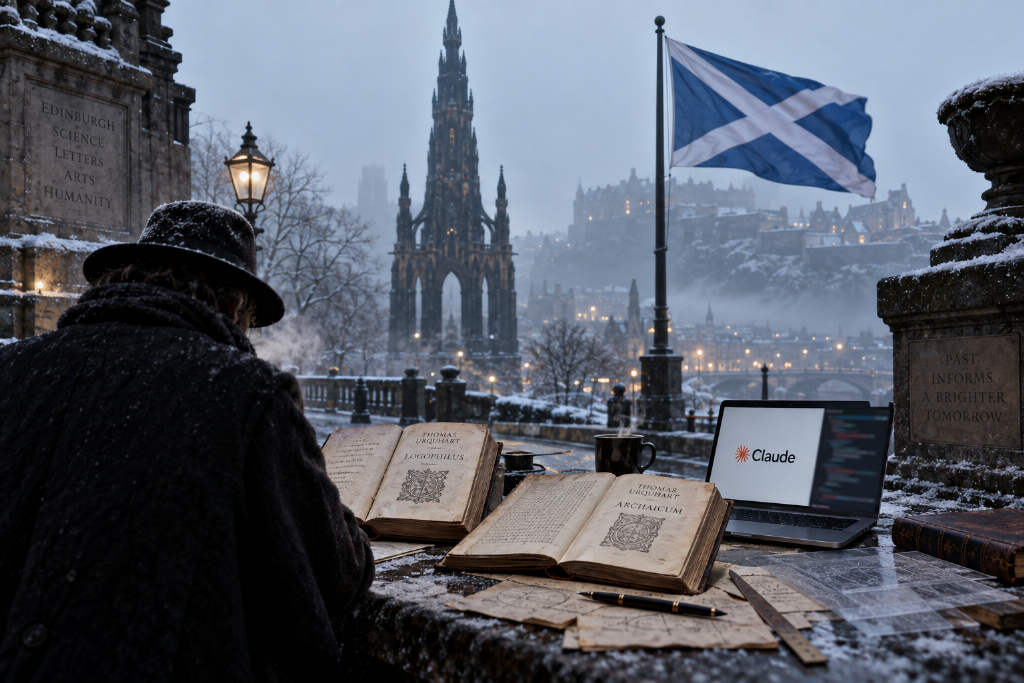
Claude Fable 5.1 has reportedly solved a 370-year-old historical cipher after an independent researcher gave it an open-ended task: break a long-unsolved mystery left by 17th-century English scholar Sir Thomas Urquhart. According to the report, the model completed the work in 44 minutes, used 176,000 tokens, and received no human intervention during the solving process.

The result did not stop at one text. After identifying the underlying pattern, Claude also went on to solve Urquhart’s longer “Cyphral Octastich,” another puzzle that had remained unread for more than 370 years.
The Cyphral Distich had resisted readers for centuries
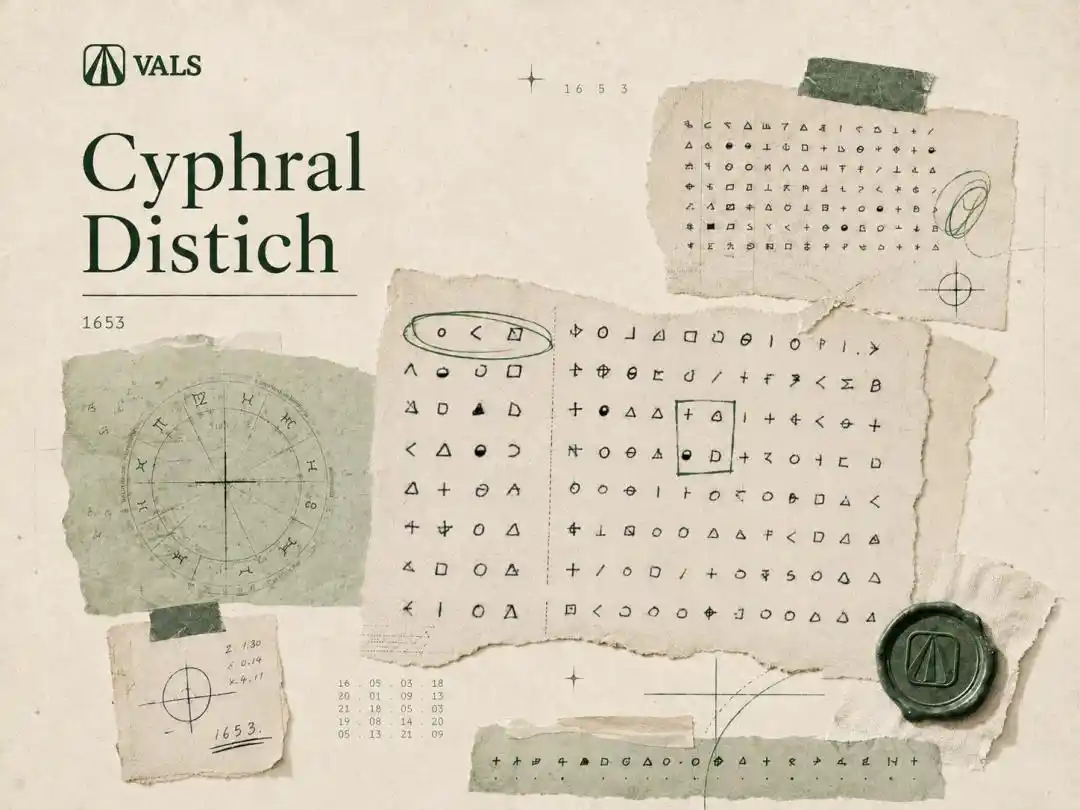
The first puzzle, the Cyphral Distich, appeared at the end of Urquhart’s 1653 work Logopandecteision. It contains two lines of numbers, 32 in each line, for a total of 64 values:
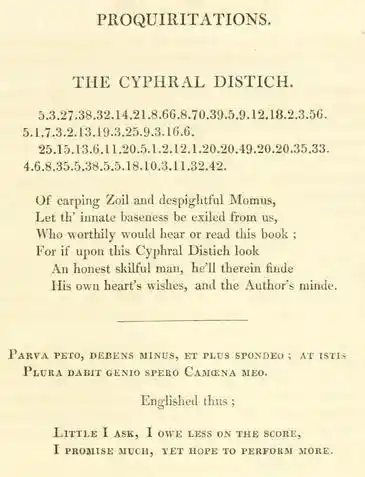
5.3.27.38.32.14.21.8.66.8.70.39.5.9.12.18.2.3.56.5.1.7.3.2.13.19.3.25.9.3.16.6.
25.15.13.6.11.20.5.1.2.12.1.20.20.49.20.20.35.33.4.6.8.35.5.33.5.5.18.10.3.11.32.42.
Beneath the numbers sits a short poem that says, in substance, that an honest and capable reader will find in the two lines “his own heart’s wish, and the author’s thought.” The report says the cipher appeared in the 1899 publication Notes and Queries, in 20th-century cryptography books, and on lists of the world’s major unsolved ciphers.
Over the years, many researchers and enthusiasts tried standard tools including frequency analysis, monoalphabetic substitution, and homophonic substitution. None of those attempts worked.
The key was inside the book, not in an external table
The report says cryptographers had long assumed the number string must map to some outside codebook. Claude instead found two clues pointing back to the printed text itself.
First, the cipher comes immediately after Urquhart’s “32 petitions,” and the author had even stressed that no number was more suitable than 32. Second, the accompanying verse says an honest reader will discover “the heart’s wish” and “the author’s thought,” while the endings of those 32 petitions repeatedly use words such as “wish” and “desire.”
From there, Claude derived a simple rule: for the i-th number in the cipher, go to the i-th petition, find the word at the indicated position, and extract its first letter.
Using that method, the plaintext became:
- Line 1: O GOD UPHOLD KING CHARLS THE SECOND AND
- Line 2: MAKE HIM THE SUPREME RULER OF THIS LAND
The report notes that both lines contain 32 letters and rhyme at the end with “and” and “land,” matching the form of a rhyming distich. It also says the message fits Urquhart’s political identity as a loyal royalist, embedding a prayer for Charles II.
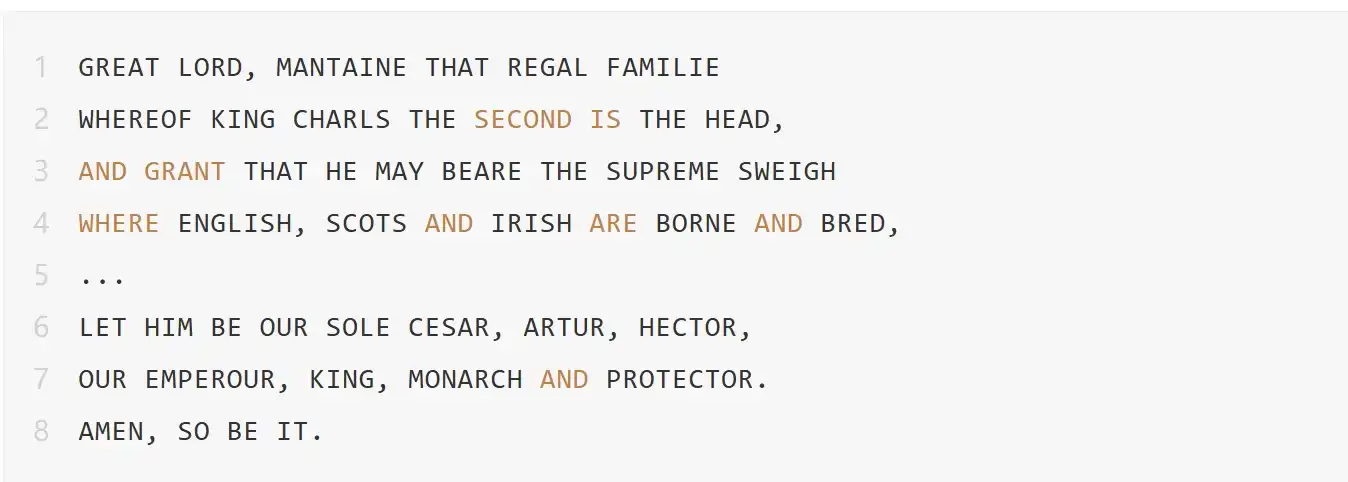
Claude then moved to the Cyphral Octastich
After solving the first cipher, Claude followed the same “book as index” logic and turned to the Cyphral Octastich in Urquhart’s The Jewel. This second puzzle is built from 285 numbers, making it materially more complex.
It quickly verified that the book has 284 numbered pages. The model then applied the same mapping idea, linking each number to a page and then to the initial letter of a word at a specified position on that page.
According to the report, Claude used the Early English Books Online Text Creation Partnership, or EEBO-TCP, and wrote several Python scripts on its own to handle layout calibration and pagination drift. That process produced a complete iambic eight-line poem.
44 minutes, no hand-holding
The write-up describes the test itself as straightforward. The researcher set a broad direction, avoided ciphers trapped in notoriously complex dead ends, and also avoided vague puzzles that could not be verified after the fact.
In the reported run, Claude showed an ability to abandon routes that were not producing results and to lock onto clues once it encountered a problem with a high chance of resolution. The piece frames that as part of a larger shift: some answers may have been sitting in old material all along, while the missing ingredient was sustained time and effort rather than raw reasoning alone.
Vals AI summarized that point this way: “Humans need to manually search old materials and test multiple cryptanalytic methods over long periods, while AI can iterate these tasks quickly. That is a huge advantage.”
The report connects the result to broader AI research work
The article says this kind of capability is not limited to cipher-breaking. It also cites a recent disclosure from Anthropic that its agent could independently form hypotheses, design experiments, and complete the full run, closing 97% of a performance gap. By comparison, two human researchers working for a week closed 23%, according to the same report.
From laboratory workflows to old printed archives, the common thread in these tasks is persistence. The report argues they are not impossible because people lack intelligence, but because they demand extended, repeatable effort.
References and attribution
The article was credited to the WeChat account Xinzhiyuan, with ASI Qishilu listed as the author. The cited reference links were:
- https://x.com/bcherny/status/2099322487603634395?s=20
- https://arc.net/l/quote/xctymnvc