
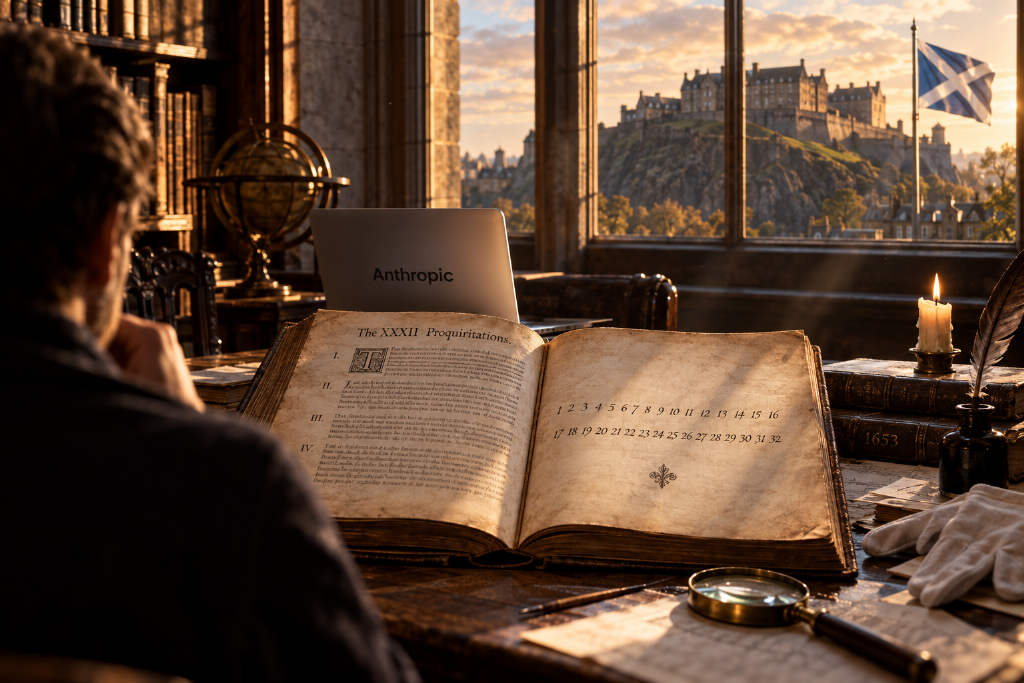
Vals AI said in an official blog post that Anthropic’s Claude Fable 5.1 solved a 373-year-old Scottish cipher in 44 minutes, using 176,000 tokens and no human intervention during the process. The company said the answer concealed a prayer pledging loyalty to Charles II.
The puzzle traces back to 1653, when Scottish nobleman Thomas Urquhart placed two encrypted lines at the end of Logopandecteision. The work became known as the Cyphral Distich. Each line contains 32 numbers, for a total of 64.
The cipher was listed as an open problem by the academic journal Notes and Queries in 1899. It resurfaced several times in 20th-century cryptography literature, and cipher historian Klaus Schmeh later included it in a list of 50 major unsolved ciphers. Formal attempts to solve it, at least those documented in the record, stretch across more than three centuries.
Researchers over the years tried frequency analysis, substitution ciphers and homophonic substitution methods, but none worked. The two number strings cited in the source text are:
5.3.27.38.32.14.21.8.66.8.70.39.5.9.12.18.2.3.56.5.1.7.3.2.13.19.3.25.9.3.16.6.
25.15.13.6.11.20.5.1.2.12.1.20.20.49.20.20.35.33.4.6.8.35.5.33.5.5.18.10.3.11.32.42.
The key, Vals AI said, was inside the book
Most earlier attempts assumed the cipher needed an external key, such as an alphabet table or a codebook that mapped numbers to words. Vals AI said Claude Fable 5.1 arrived at the opposite conclusion: the key was embedded in the book itself.
Urquhart placed 32 short appeals, called Proquiritations, before the cipher and emphasized that there was no number more suitable than 32. The cipher itself has two lines of 32 numbers, and an accompanying verse tells readers they can find their “heart’s desire” there.
Vals AI said those clues point to one decoding rule. The i-th number in the cipher corresponds to the i-th Proquiritation. That number is then treated as the word position inside that passage, and the first letter of that word is extracted. No special cryptographic machinery is required under that reading. The work is in reading the book carefully from start to finish.
The decoded line supports Charles II
Using that method, Vals AI said the message reads:
O GOD UPHOLD KING CHARLS THE SECOND AND MAKE HIM THE SUPREME RULER OF THIS LAND
In Chinese, the source summarized the meaning as a prayer asking God to uphold King Charles II and make him the supreme ruler of the land.
Vals AI argued that the answer carries three layers of self-validation. Each line comes out to exactly 32 letters. The line endings, “and” and “land,” rhyme in a way that fits a distich. Urquhart was also a committed royalist throughout his life, so hiding a prayer in support of Charles II fits his political stance.
The company described the solution as “rather embarrassing for humans,” saying the cipher did not require advanced cryptanalysis, only a clue that most researchers had overlooked.
The same approach was applied to a larger cipher
Vals AI said Claude Fable 5.1 then used the same logic on the Cyphral Octastich, a larger cipher Urquhart left in The Jewel in 1652. That case involved 284 pages of text and 285 numbers. Under Vals AI’s explanation, the k-th number maps to the k-th page, and the first letter is taken from a word on that page. The result was an eight-line loyalist poem followed by “Amen.”
According to the source, the poem also asks that Charles II secure the throne and rule England, Scotland and Ireland.
The claim has not been independently verified
Vals AI also said the method remains a one-sided claim for now and has not been independently reviewed by cipher historians. In that sense, it is a strongly self-validating answer, but not yet one with outside confirmation.
The larger Octastich still has visible holes. Vals AI said that 9 of the 285 positions cannot yet be read cleanly, and that every page number after the 159th entry shifts by exactly one page. The firm suggested two possibilities: one page may have been reused, or the original printing may have duplicated a page marked “5.5.”
There is also a source problem. Vals AI said no public images of the relevant pages from the 1652 original are currently available for checking, and named Google Books, HathiTrust and the Internet Archive as places that do not include the key pages.
Vals AI said it had been steering frontier models toward meaningful unsolved ciphers
Over the past few months, Vals AI said it had been trying to steer different frontier models toward meaningful but still-unsolved ciphers. During that period, the company said no other model produced a solution that passed validation.
Its method was straightforward. It told Fable 5.1 to look at mathematical problems it had solved before as references, encouraged creative exploration, and set two boundaries. The company said it avoided ciphers that already had known solutions or that naturally allowed multiple reasonable readings. It also stayed away from elite unsolved problems that have already been attacked for years by thousands of human solvers and organizations including the Central Intelligence Agency, such as Kryptos K4, which remains unsolved.