

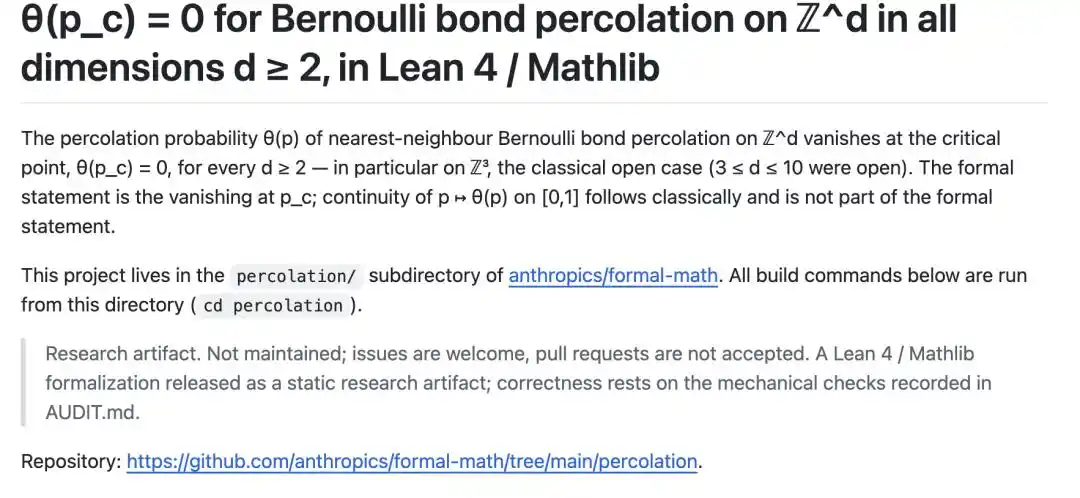
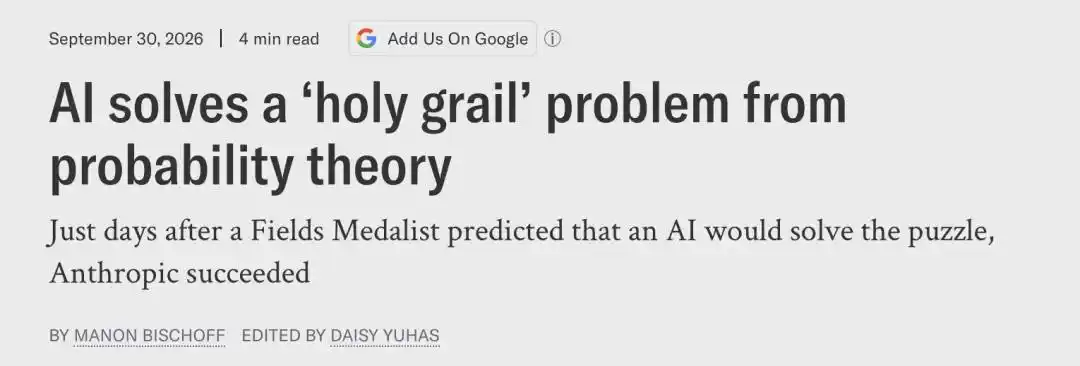
A GitHub repository associated with Anthropic has pushed one of probability theory’s longest-running open problems into a new phase. According to the material described in the repository, Claude generated a formal proof of the continuous phase transition conjecture in percolation theory, and the proof was then checked in Lean, a formal proof assistant.
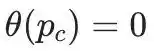
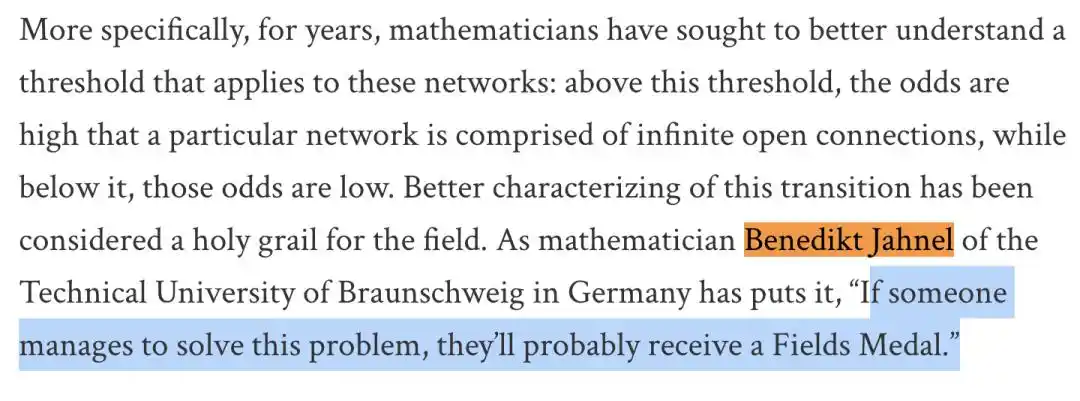
The claim centers on a problem often described as a “holy grail” in probability: whether the percolation probability at the critical threshold is zero, written as θ(p_c)=0. After the repository surfaced, several mathematicians reacted publicly. Benedikt Jahnel of the Technical University of Braunschweig said, 「If a human had proved this conjecture, they would most likely win a Fields Medal. But now AI crossed the finish line.」 Gil Kalai said, 「If verified, this would be an extraordinary breakthrough.」
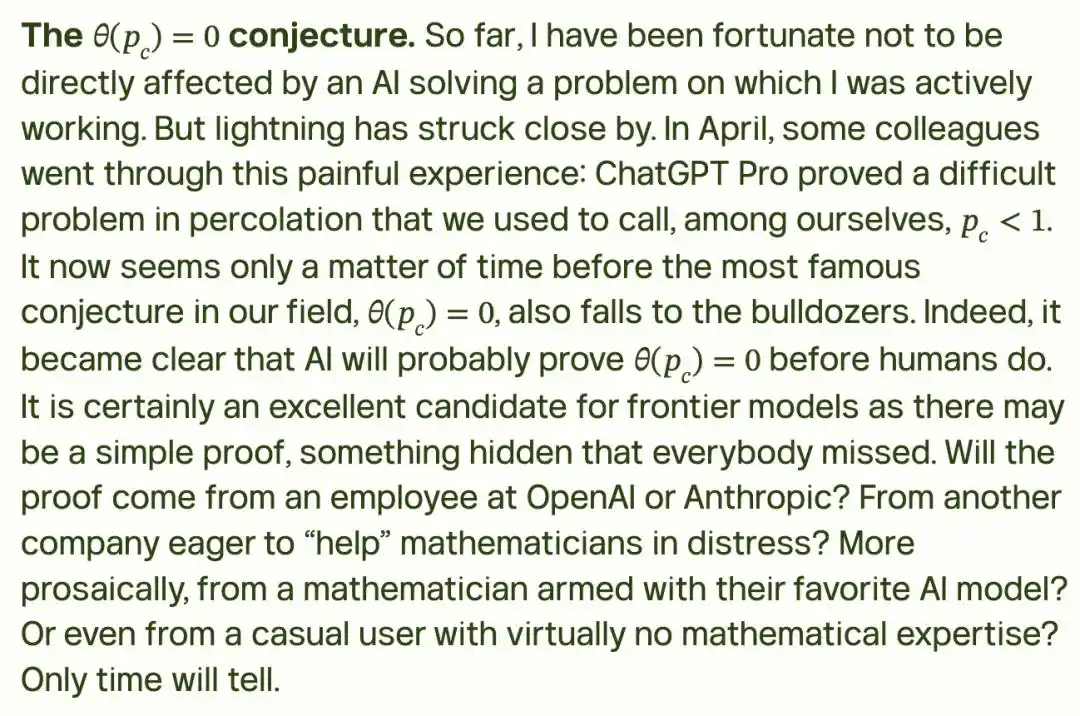
A GitHub commit appeared as Hugo Duminil-Copin reflected on AI
The timeline cited in the report begins on Aug. 30, 2026. On that day, 2022 Fields Medalist Hugo Duminil-Copin wrote in a blog post, 「In our field, it may only be a matter of time before the most famous conjecture falls under the roar of the bulldozer (AI).」 He was referring to the continuous phase transition conjecture in percolation theory.
At nearly the same moment, other researchers noticed a newly submitted GitHub repository from an Anthropic engineer. There was no press conference, no broad promotional campaign, and no official blog post attached to it. But the repository, according to the article, contained a complete code-based proof generated by Claude and rigorously verified in Lean. The problem it addressed was the same percolation conjecture that Duminil-Copin had spent years trying to crack.
Ahmed Bou-Rabee, a mathematician at the University of Pennsylvania, later said Anthropic had proved this Fields-level conjecture.
What the conjecture asks
The continuous phase transition conjecture in percolation theory goes back to 1957, when Simon Broadbent and John Hammersley studied how liquid moves through porous material. One way to picture the setup is as an infinite spatial grid in which neighboring points are connected by tiny channels. Each channel is open with probability p and blocked with probability 1-p.
If p is small, say 0.1, most channels are blocked and a droplet cannot travel far. If p is large, say 0.9, large connected structures emerge and flow can spread through the network. The dividing line between these two regimes is the critical probability.
Below the critical point, the probability of forming an infinite connected cluster is zero. Above it, that probability is positive. The hard question is what happens exactly at the threshold: does the probability remain zero, or does an infinite cluster already appear there? If it stays at zero, the phase transition is continuous. If it is positive, the transition is abrupt.
That is the conjecture summarized as θ(p_c)=0.
Two dimensions were solved, very high dimensions were handled, but 3 through 10 stayed open
Mathematicians have worked on this question for decades. In 1980, Harry Kesten proved that for the two-dimensional square lattice, the critical probability is exactly 1/2 and that θ(p_c)=0. In very high dimensions, especially 11 and above, researchers were able to use mean-field methods and related tools, and those cases had already been shown to have continuous phase transitions as well.
The unresolved range was dimensions 3 through 10. As the article puts it, those cases lack the special geometric symmetry available in two dimensions, while also resisting the smoothing tools that work in sufficiently high dimensions. That middle range became the wall the field could not get past for decades.
Three dimensions correspond to the physical space people live in, and four dimensions are often tied to spacetime in relativity. Yet these central cases remained out of reach.
Duminil-Copin’s long pursuit of the problem
Duminil-Copin has been one of the most visible figures in this area. He won the Fields Medal in 2022 for work on phase transitions in statistical physics, and percolation theory has been a major thread in his research career.
In his Aug. 30 blog post, he wrote, 「A mathematical problem is never just a theorem waiting to be proved. It is not only a lighthouse in the night, but also a guide for the soul. Solving it may not immediately open an entirely new branch of mathematics, but its depth and beauty are enough to captivate generation after generation.」
He also said he had repeatedly tried and failed to settle the continuous phase transition problem in dimensions 3 through 10. Those failed drafts, however, were not wasted. They produced dozens of new ideas that later fed into other work and led to major discoveries.
The article frames that as part of a long-standing mathematical ethos: the process matters, not only the final theorem. New tools and new viewpoints often emerge from unsuccessful attempts.
The 2024 reduction that set up the final step
The report stresses that this was not a brute-force computation. A conjecture about continuity in an infinite setting cannot be settled by simple enumeration.
The key setup came in 2024, when Gady Kozma of the Weizmann Institute of Science and Shahaf Nitzan of the Georgia Institute of Technology published a paper showing that if one specific algebraic inequality could be proved, then the θ(p_c)=0 conjecture for dimensions 3 through 10 would follow automatically.
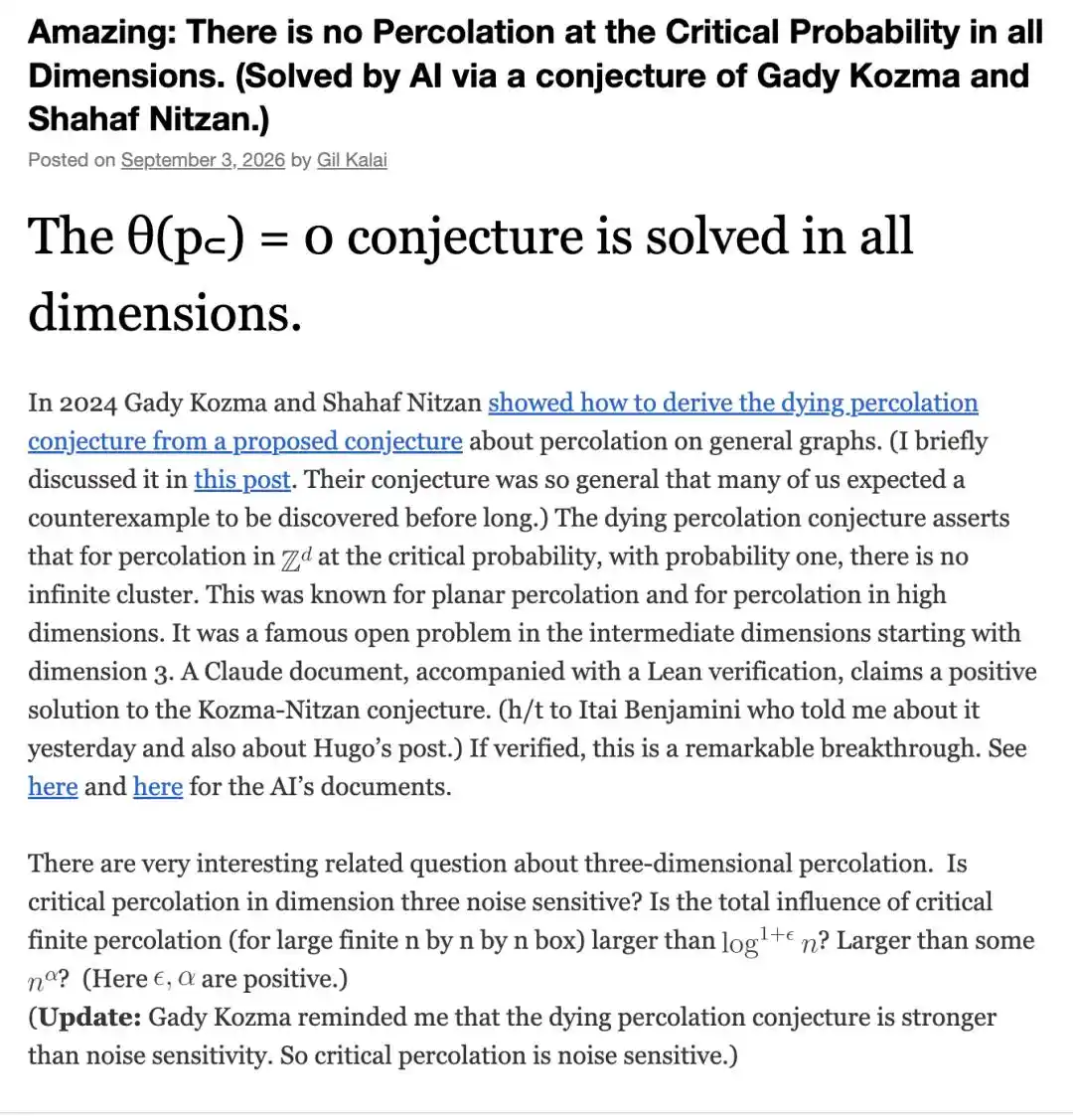
The article links to that paper here: https://arxiv.org/abs/2401.12397 . That result brought the finish line much closer, but the last step remained difficult. Mathematicians tried auxiliary functions and upper and lower bounds, yet the inequality kept breaking down at critical points in the derivation.
According to the article, Anthropic’s model did not start from scratch. It built directly on the bridge Kozma and Nitzan had constructed in 2024. Under Lean’s strict formal constraints, the model used known analytical tools and inequality techniques to assemble a reasoning chain running to thousands of lines of formal code, following a route that human mathematicians had not previously envisioned.
Excitement, caution and requests for a human-readable proof
Initial reactions have not been uniform.
Jahnel said the result left him with deeply mixed feelings. He was glad the conjecture may finally be proved, but he also felt a sense of loss because AI delivered the final step.
Bou-Rabee went further than simply announcing the claim. He said that with large-model assistance, he spent just one day generalizing and modifying Anthropic’s proof code. 「AI let me do things I would not even have dared to imagine before,」 he said. 「Some research projects have taken me eight full years with almost no progress, but with AI’s help I am now only one step away from a complete solution.」
Kozma took a more restrained position. He said, 「I have no comment for now on their claim. We are still waiting for Anthropic to release a version humans can read and explain how they did it.」
Kalai’s view was concise: if the result holds up, it would be an extraordinary breakthrough.
What this could mean for mathematical work
The article places the episode in a broader history of technological shocks. Steam engines changed transport, cameras changed representational art, Deep Blue changed chess, and AlphaGo changed Go. Those fields did not disappear. Their methods changed.
The same argument is applied here to mathematics. Proving theorems is not the whole of the discipline. The deeper value of a conjecture often lies in the tools, structures and new questions that emerge while trying to solve it.
The article points to familiar examples: work around Fermat’s Last Theorem helped drive major developments in algebraic geometry, while attempts to understand the Riemann Hypothesis fueled analytic number theory. Duminil-Copin’s own failed attempts on percolation, by his account, generated dozens of ideas that later proved useful elsewhere.
From that perspective, the role of future mathematicians may shift. Rather than spending decades on long algebraic derivations, they may spend more time choosing the most valuable directions, coordinating large reasoning systems, and explaining machine-produced insights to other humans.
References cited in the article
The source article lists the following references:
- Quanta Magazine updates page: https://www.quantamagazine.org/updates/transformation/
- Scientific American article: https://www.scientificamerican.com/article/ai-solves-a-holy-grail-problem-from-probability-theory/
- Proofs and Prompts post: https://proofsandprompts.com/2026/08/30/care-for-a-little-more-ai/
- Anthropic GitHub repository: https://github.com/anthropics/formal-math/tree/795efb86f191735c5481675763537cfb4ff37e55/percolation
The byline information in the source says the piece originally came from the WeChat account Xinzhiyuan, was written by ASI Qishilu, and edited by David. The MarsBit page shows a publication time of Oct. 7, 2026.