

Claude Opus 5 appears to have surfaced before any formal release, and the first round of user tests is already making the rounds online. The main focus so far is its visual output, especially in 3D scene generation.
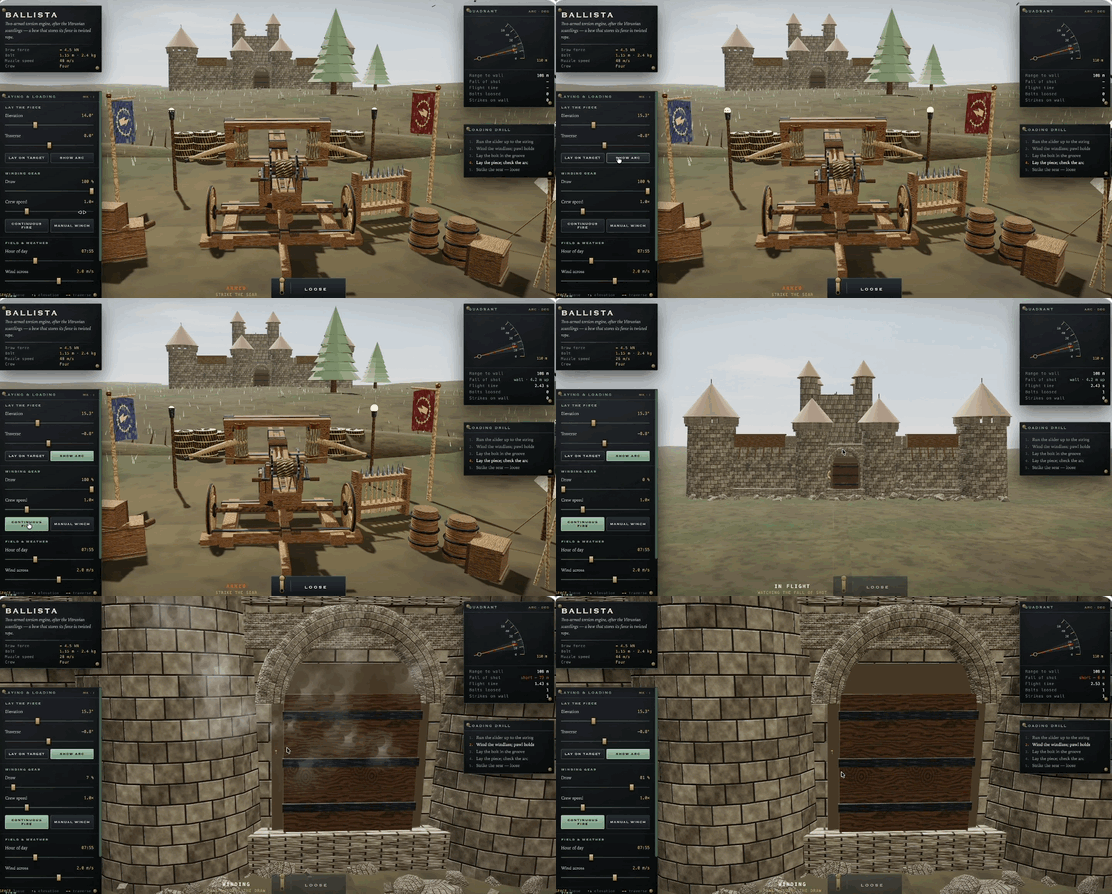
One of the earliest clips shared by @chetaslua showed a slingshot firing stones at a castle wall. On the left side of the frame were parameter cards for items such as ballistic tension and arrow weight, with a level of scene detail he said he had not seen before in a single Opus-generated image. He wrote that even stitching together multiple screenshots would not have produced the same effect.
Similar reactions have kept appearing over the past two days. One user even said they would be willing to call it “fable 6.”
Early demos point to a jump in scene detail
@chetaslua posted more than one example. Later the same day, he shared a weather card interface where lighting shifted over time: sunlight hit a frosted-glass panel in clear conditions, and shadows moved as clouds passed overhead.
He also showed a kitchen scene with refrigerator magnets, grout lines between tiles and a reflective kettle on the stovetop. He summed up the result by saying it was the first time he felt three.js could produce this kind of texture.
Some users argued that Opus 5 was already handling this type of scene better than fable.
@birdabo then ran a head-to-head comparison. He gave the same “slingshot siege” prompt to Opus 5 and to the already available Fable 5. In his comparison, Fable 5 produced a complete scene in one pass, but the tents were flat solid-color planes, the grass lacked surface variation, and the slingshot scene was missing panels for tension and arrow weight. By eye, the detail density was lower.

@xikhar posted a very different test at around the same time: a Minecraft recreation. Rebuilding Minecraft has become a standard challenge for models, and in the demo he showed, both the block-breaking physics and the shadows cast by lighting on surfaces were reproduced with a high degree of fidelity.
He later added an SVG image of a PS5 controller. Reflections and shadows on the analog sticks, touchpad and buttons resembled a product render. His verdict was simple: Opus 5 is strong in both 3D and 2D.
Signs of Opus 5 have been appearing since July 9
The earlier traces of the leak date back to July 9. That day, a codename called Honeycomb EAP appeared in Cursor’s model selector.

The entry sat alongside Opus 4.8 and Sonnet 4.5 and was labeled with a 1M context window and an “extra high effort” tier. A few hours later, it disappeared.
On July 14, another user posted that they had seen an Opus 5 listing in the Google Vertex AI model library. That poster estimated the model could arrive as early as Thursday, while also saying they were concerned Anthropic might use the launch as a reason to remove Fable 5 from the Claude subscription plan.
The next day, another blogger posted the same finding.

Last night, @M1Astra said fresh signs of Opus 5 launch preparation had appeared again. He later added that Opus 5 had already started rolling out across providers. This morning, he posted another update saying some users already had access to Opus 5. In those cases, the interface still showed 4.8, but he said the output gap was obvious.
A screenshot also circulated early today. It appeared to show a suspected Anthropic employee being routed to Opus 5 after triggering a Fable 5 guardrail.
Opus 5 also surfaced by name inside Cursor. The reference appeared in an error dialog containing the string “claude-opus-5-thinking-high,” along with a message saying Max Mode had to be enabled to use it.

Based on those traces, some users believe a public launch is close.
Cheaper than Fable 5? The claim is spreading, but proof is still thin
As excitement around the early demos picked up, another claim started circulating: Opus 5 may already be matching Fable 5 on performance.
The reason that idea has caught attention is pricing. According to the report, Fable 5 costs $10 per million input tokens and $50 per million output tokens, exactly double the Opus tier. If Opus 5 really reaches Fable 5-level capability while staying on Opus pricing, it would look like a substitute at half the price.

That said, no complete benchmark that can be independently verified has been published so far.
And total cost cannot be judged from list price alone. Chetaslua, one of the users cited at the start of the report, said Opus 5 consumed tokens faster than Fable 5 and burned through his allowance in just three prompts.
If token usage is really that heavy, the pricing edge would disappear and the idea of a half-price replacement would fall apart. Opus 5 may not be far from launch, but whether it can truly stand in for fable remains an open question until fuller public testing appears.