
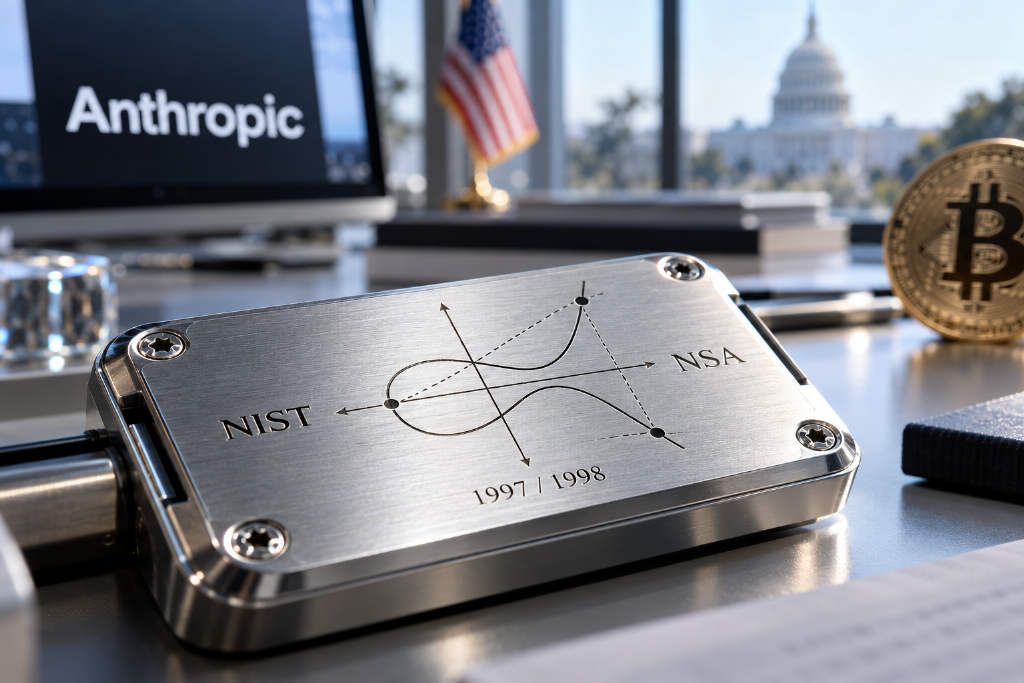
An Anthropic AI model solved a 25-year puzzle in cryptography, tracing a set of unexplained elliptic-curve seeds supplied by the U.S. National Security Agency in the late 1990s to a standard random-number generator seeded with timestamps from 1997 and 1998, according to CoinDesk.
The result came in less than 30 minutes. It covers five unexplained seeds used in NIST elliptic curves and weakens a long-running suspicion that the NSA may have hidden a backdoor in the standards. Anthropic said people using those NIST curves do not need to take action, even though parts of the selection process are still not fully explained.
Bitcoin was never part of that dispute. The cryptocurrency uses secp256k1, a different and simpler curve that leaves little room to conceal a weakness. CoinDesk said the separate quantum-computing risk to Bitcoin remains unchanged.
The mystery dates back to the curve designs the NSA gave to the U.S. National Institute of Standards and Technology, or NIST. In 2000, NIST adopted a set of curves provided by the agency, but the NSA did not explain where some of the numbers used to generate them came from.
An old suspicion around curve design
Elliptic-curve cryptography underpins a large share of internet security and is also part of the mathematics used to protect bitcoin wallets. It allows a person to prove control of a secret key without revealing the key itself.
CoinDesk described the curve as a lock design open to public inspection. Each user has a different secret key, but everyone depends on the lock being hard to break.
The unresolved question was who chose the mathematics that everyone was being asked to trust.
That question became harder to dismiss after the Snowden disclosures linked the NSA to efforts to weaken cryptographic standards. NIST later removed the Dual EC random-number generator from its recommendations.
The starting values, known as seeds, were public from the beginning. What the NSA never explained was how it selected them. That gap drove years of suspicion that the agency may have tested many alternatives and chosen a curve with a weakness only it could exploit. In its most extreme form, the theory held that the NSA had a backdoor into every system using the curves.
Cryptographers Neal Koblitz and Alfred Menezes reviewed the controversy in their 2015 paper, A Riddle Wrapped in an Enigma. Menezes, who helped write the original standard, recalled receiving the seeds from NSA mathematician Jerry Solinas in 1997.
Security researcher Steve Weis spent years trying to explain the numbers, including through public-records requests filed in 2018. NIST said it had no documentation, while the NSA stopped responding. One lead suggested the values might have come from a humorous phrase that Solinas had forgotten, which sent researchers searching through possible word combinations.
In 2023, cryptography engineer Filippo Valsorda and other contributors offered a $12,288 bounty for an answer. That amount would rise to more than $36,000 if the winner donated it to charity. Solinas had died earlier that year, leaving researchers to work only from old recollections and the numbers themselves, without a solution.
How Claude traced the seeds
The breakthrough came after an Anthropic employee asked an internal research model to investigate the problem this month, without giving it the older theory about a forgotten phrase.
In under half an hour, the model traced the five NIST curve seeds to lrand48, a random-number generator used in older C software libraries.
Claude also reconstructed the sequence behind P-256, one of the most widely used curves, and found an exact match for its published seed at the 1,842nd candidate.
In the recorded reasoning cited by CoinDesk, the model wrote, “This is astonishing: it solves the 25-year-old mystery,” before briefly questioning whether it might be operating inside a simulated test. It then added: “Hmm, is it plausible in reality? As of my knowledge … the bounty was unsolved. … All top bits clear—20 bits, chance 1e-6. So indeed real-world.”
Anyone can now rerun the program and reproduce the numbers the NSA supplied. Anthropic said that makes a hidden weakness much less likely, though it still cannot explain why some usable candidates were skipped or how other parts of the curves were selected.
The report drew a clear distinction between public curve seeds and private-key generation. If a wallet secret key were generated with lrand48, someone who could estimate when it was created might be able to reconstruct the key and drain the funds.
That is not what happened here. The NSA’s seeds were public from the start, so there was never a hidden secret for an attacker to steal.
Why Bitcoin is not in scope
Bitcoin wallets use secp256k1, not the NIST curves involved in the seed mystery. The curve is built from a simpler equation.
CoinDesk said Bitcoin’s version is defined by two small fixed numbers, leaving almost nothing to tune, while P-256 includes a 77-digit number derived from the NSA’s unexplained seed.
With so few adjustable elements, cryptographers have long argued there is far less room to quietly embed a weakness in Bitcoin’s curve. That has been one point in its favor.
Satoshi Nakamoto never publicly explained why that curve was chosen. Before Bitcoin made it widely known, it saw little use. Ethereum later adopted it as well, and Bitcoin kept it when the 2021 Taproot upgrade introduced a newer signature style.
Quantum risk remains a separate issue
A sufficiently powerful quantum computer would pose a different threat. CoinDesk said such a machine could work backward from a public key visible on Bitcoin’s blockchain to the private key behind it, regardless of how the curve was chosen.
Hardware progress continues to narrow the gap between theory and practice. Google said this week that its Willow chip reduced errors by about 40-fold in one of the most expensive steps required for such a machine.
Even so, no one has built a quantum computer anywhere near large or reliable enough to crack a bitcoin key, and there is still no clear timeline for when that might happen.
Anthropic said in a blog post that users of the NIST curves do not need to change anything. After decades of uncertainty around the seeds, the path from the random-number program to the published values can now be reproduced directly.
The bounty tied to the search will go to the Internet Security Research Group, the nonprofit behind Let’s Encrypt, which provides free security certificates to websites. The final amount is $36,864.



