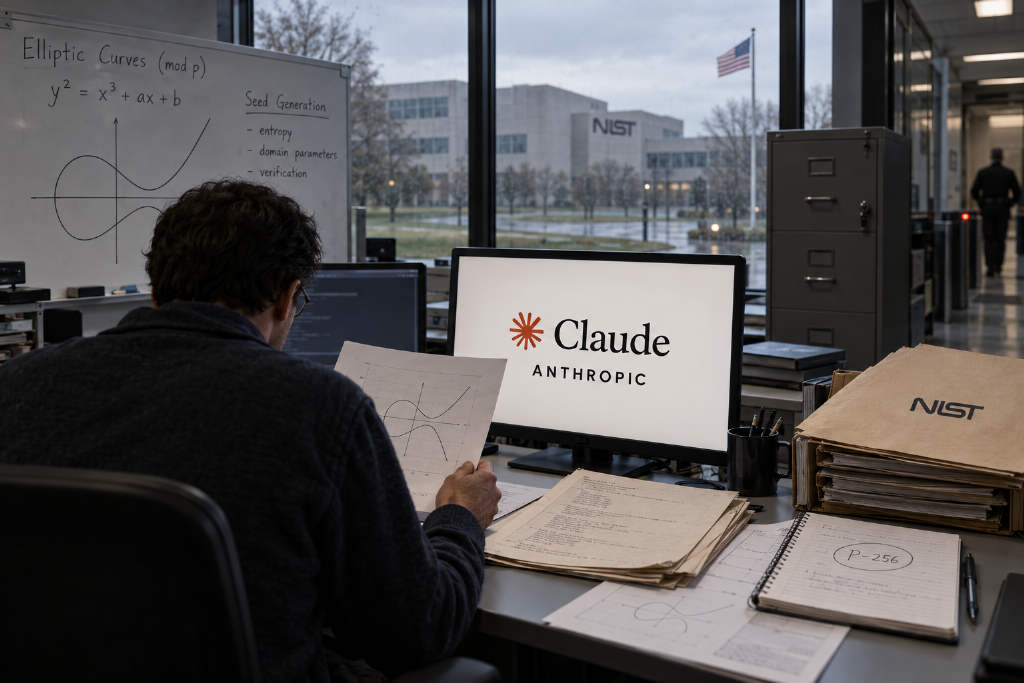
Anthropic said its AI model Claude solved a cryptography puzzle that had lingered for about 25 years, tracing the origin of elliptic curve seeds adopted by the National Institute of Standards and Technology, or NIST, in 2000. According to the report, Claude linked five NIST elliptic curve seeds to the lrand48 random number generator in an older C software library used in 1997 and 1998. It then found a value that exactly matched the widely used P-256 curve seed at candidate No. 1842, allowing the generation process to be reproduced.
The finding addresses a long-standing concern around whether the National Security Agency, or NSA, may have embedded weaknesses in those parameters, since the agency had never fully explained their origin. Anthropic said the result sharply reduces the likelihood that the parameters were deliberately backdoored and that current users of NIST elliptic curves do not need to take extra action. The company also noted that Bitcoin is unaffected because it uses a different elliptic curve, secp256k1. A $36,864 research bounty tied to the work will be donated to Internet Security Research Group, the nonprofit organization behind Let's Encrypt.
Claude, an AI model from Anthropic, solved a cryptography mystery tied to U.S. National Security Agency elliptic curve parameters in less than 30 minutes, according to Odaily.
The result traced the elliptic curve seeds adopted by the National Institute of Standards and Technology in 2000 back to an older random number generation program used in 1997 and 1998. Claude linked five NIST elliptic curve seeds to the lrand48 random number generator in an older C-language software library, and found a value at the 1,842nd candidate that exactly matched the seed for the widely used P-256 curve, reproducing how it was generated.
For years, the lack of a public explanation from the NSA over the source of those parameters had fueled suspicions that a cryptographic backdoor might have been inserted. Anthropic said the new finding greatly reduces the likelihood that the parameters were intentionally weakened, and that existing users of NIST elliptic curves do not need to take additional steps.
Bitcoin is not affected because it uses a different elliptic curve, secp256k1. A $36,864 bounty related to the research will be donated to Internet Security Research Group, the nonprofit behind Let's Encrypt.
This article was originally published by Bit.Fan. For more cryptocurrency news and market insights, visit www.bit.fan. Disclaimer:
The market information, project data, and third-party content displayed on this platform are for industry information sharing only and do not constitute any form of investment advice or return commitment.
Cryptocurrency trading carries high risks. Users should fully assess their risk tolerance and make independent decisions. All profits, losses, and legal responsibilities are borne by the users themselves.