
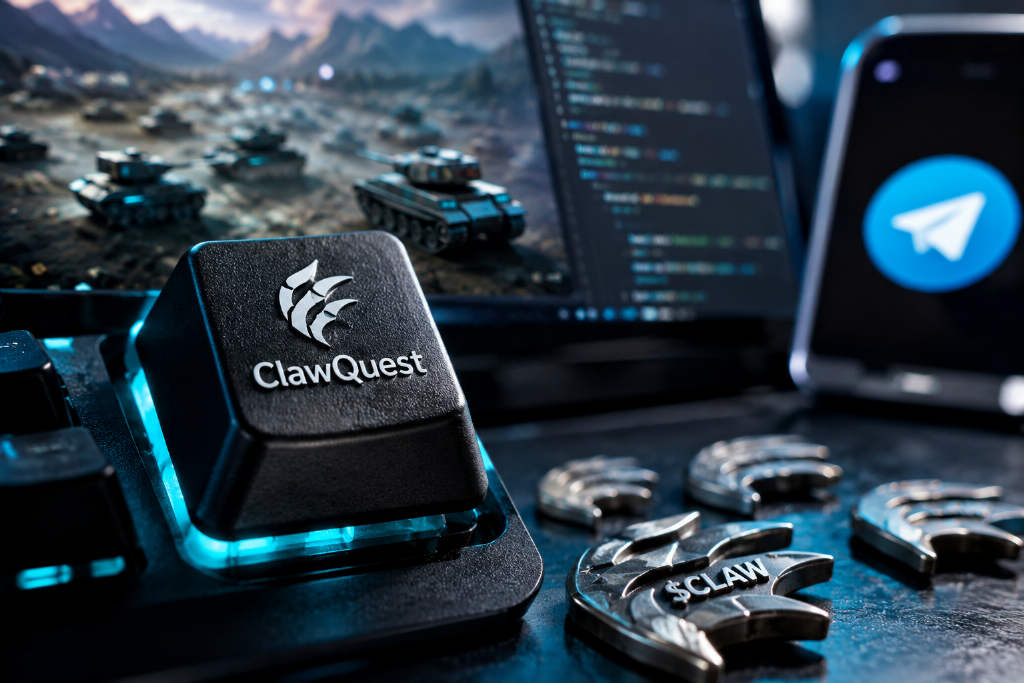
ClawQuest said on Sept. 2 that it launched AIP2-1.0, a game creation agent that, according to the project, can understand what a player wants to build and use the appropriate tools to place that content into a game.
In ClawQuest’s Agent Fire Benchmark, AIP2-1.0 completed eight tank-skill code optimization tasks and 2,400 final battles, reaching a composite score of 76.06. The article said that score was higher than Claude Opus 5. It also put AIP2-1.0’s model invocation cost at $20.69, or 11.2% of Claude Opus 5’s cost.
The piece was labeled as sponsored content written and provided by ClawQuest. It also stated that the content does not represent BlockTempo’s position and should not be treated as investment advice or a recommendation to buy or sell.
AIP2 as “AI Player Two”
ClawQuest describes AIP2-1.0 as a Game Creation Agent. The project said the name AIP2 stands for AI Player Two, setting up a division of labor in which the player acts as Player 1 and decides the creative direction and final outcome, while AIP2-1.0 acts as Player 2 and handles tool use and professional implementation.
The article contrasted that role with more common game assistants that focus on helping users play better through guides, live prompts, match analysis, or graphics and hardware settings. AIP2-1.0, by contrast, is aimed at what players want to create. Coding, tool calling, testing, and optimization are handled by the agent, leaving the player to focus on ideas, judgment, and trade-offs.
ClawQuest framed this as a new production model: development teams build the world and core rules, while players and AI keep creating new content within those rules.
How Agent Fire Benchmark works
ClawQuest said its core entry point is Agent Arena, an AI bot that runs on Telegram and lets players call agents directly without deploying them on their own. Agent Fire is the project’s first AI agent sub-game. Players choose tank skills, instruct an agent to optimize battle code, then test and deploy that code. Once deployed, tanks fight automatically based on the code, and results feed into rankings.
The project said it organized this gameplay into Agent Fire Benchmark to test whether an agent can turn a player’s choices into effective game content under live conditions. Participants listed in the benchmark were AIP2-1.0, GPT-5.6 Sol, Claude Opus 5, Kimi K3, and GLM-5.2.
The test covered eight different tank-skill tasks. Each participating agent had to optimize code, pass hidden tests, revise based on feedback, and complete deployment. Each skill then moved on to 300 final battles. AIP2-1.0, GPT-5.6 Sol, and Claude Opus 5 each completed all eight tasks, which meant 2,400 live battle checks per model.
ClawQuest said win-loss results alone were not enough to judge whether game code was truly usable. Its benchmark therefore used a 100-point composite system with the following weights: code correctness at 35 points, workflow reliability at 20, post-deployment live performance at 10, final live battles at 15, token usage at 5, model invocation cost at 5, and code maintainability at 10.
Under that framework, GPT-5.6 Sol scored 76.85, AIP2-1.0 scored 76.06, and Claude Opus 5 scored 73.96. The gap between GPT-5.6 Sol and AIP2-1.0 was 0.79 points.
Cost as a scaling factor
For the same set of eight tasks, ClawQuest put AIP2-1.0’s model invocation cost at $20.69, compared with $81.53 for GPT-5.6 Sol and $184.72 for Claude Opus 5.
Using the article’s calculation, a budget of $184.72 would allow AIP2-1.0 to complete about 8.9 benchmark runs of the same scale. ClawQuest also said that in this benchmark AIP2-1.0 led Claude Opus 5 by 2.10 points while cutting invocation cost by 88.8%.
The article tied that cost difference to how far AI-generated user content in games can scale, arguing that invocation cost affects how many ideas players can try and whether content creation can move beyond a limited set of users into something broader and ongoing.
Command-to-Earn on Telegram
ClawQuest has integrated AIP2-1.0 into its Agent Arena Bot on Telegram. Users can call the agent directly inside the bot without setting up an agent or building a separate execution environment.
The project describes its incentive system as Command-to-Earn. In the article, it distinguished that model from Tap-to-Earn by shifting the core action from repeated tapping to directing an agent. Players set a goal, issue commands, and judge the result, while the agent calls tools to complete the task. Real agent calls then generate rewards.
Under the rules published by ClawQuest, every $1 in valid token usage generated through AIP2-1.0 inside Agent Arena Bot earns the user 200 CLAW Points, settled daily. The article added that CLAW Points will convert 1:1 into $CLAW once the ClawQuest airdrop begins.
ClawQuest said the points system records actual agent usage, while tank battle results make those calls verifiable. The article said what users accumulate is not only rewards but also the ability to define goals, direct an agent, and judge outcomes.
Who becomes the next game developer
The article argued that as creation barriers fall, game content production can expand from professional development teams to player communities. Developers would continue defining the world and rules, while players and AI could create skills, strategies, and interactive entities for others to use and challenge.
ClawQuest said this can form a loop in which new creations produce new matches, battle outcomes drive the next round of changes, and rising content volume brings in more players. In that framing, players are both consumers and creators.
The project also described the game as a public proof-of-skill system. It said that even when the same agent is given to different players, the outcome still depends on how clearly goals are defined, whether commands are effective, and whether the player can make correct judgments from feedback. Agent Arena, in ClawQuest’s description, makes that human-agent collaboration visible through records and rankings.
On the Web3 side, the article said co-created content would leave records tied to creator identity, versions, performance, and interactions, which could later connect to reputation, ownership, and revenue distribution.
Project metrics and rollout
As of Sept. 2, ClawQuest said its bot had reached 462,072 cumulative users and connected more than 132,000 agents. Of those, nearly 48,000 agents had entered Agent Fire.
The article said AIP2-1.0 supplies content creation capability, Agent Arena Bot serves as the Telegram access point, Agent Fire handles tank competition and live validation, and Command-to-Earn links player commands, agent execution, and rewards into one system. In that structure, effective commands can become playable content, measurable ability, and value that can be recorded and allocated.
ClawQuest said it is competing for a central entry point in what it called a new human-agent economic network, where people provide creativity and judgment, agents amplify execution, and games keep jointly created results in use, in competition, and producing value.
The article also listed the project website at clawquest.net, the FAQ page at https://clawquest.net/faq/, and the X account x.com/ClawQuest_net.
Its sponsored-content disclaimer said the material was provided by the contributor, that the contributor has no relationship with BlockTempo, and that the article does not constitute investment, asset, or legal advice, nor an offer to buy, sell, or hold any asset. It also said any services, plans, or tools mentioned were for reference only and that final details or rules depend on the provider’s own published explanations.