
A Federal Reserve Bank of Cleveland study found that crypto ownership is closely tied to investors’ subjective expectations for future returns and risk, with stronger explanatory power than demographic traits such as age, income, and gender. The paper also offers one explanation for crypto’s persistent volatility: investors hold sharply different views about the asset class, and rising prices can reinforce optimistic expectations.
Study examines crypto in household finance
The paper, titled Do You Even Crypto, Bro? Cryptocurrencies in Household Finance, was co-authored by Michael Weber, Bernardo Candia, Olivier Coibion, and Yuriy Gorodnichenko. The research team used multiple large-scale surveys to study crypto investment behavior among U.S. households, with as many as 25,000 households covered in each round.
The study found clear demographic differences in crypto ownership. After controlling for other factors, respondents under age 40 were about 13 percentage points more likely to hold crypto than those over 60. Men were also about 4 percentage points more likely than women to hold crypto, while higher-income and higher-wealth households were more likely to participate as well.
Beliefs about returns matter more than age or income
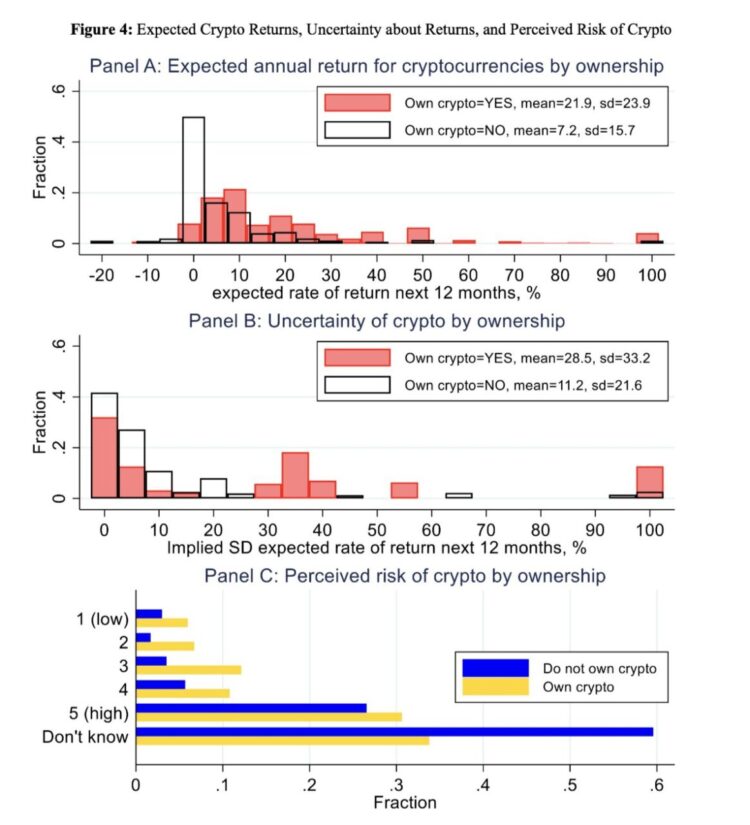
Relative to demographic characteristics, the researchers found that investors’ beliefs about future crypto performance carried more explanatory weight. Among respondents willing to provide a forecast, crypto holders on average expected a 22% return over the next year. People who did not own crypto expected roughly 7%, a gap of 15 percentage points.
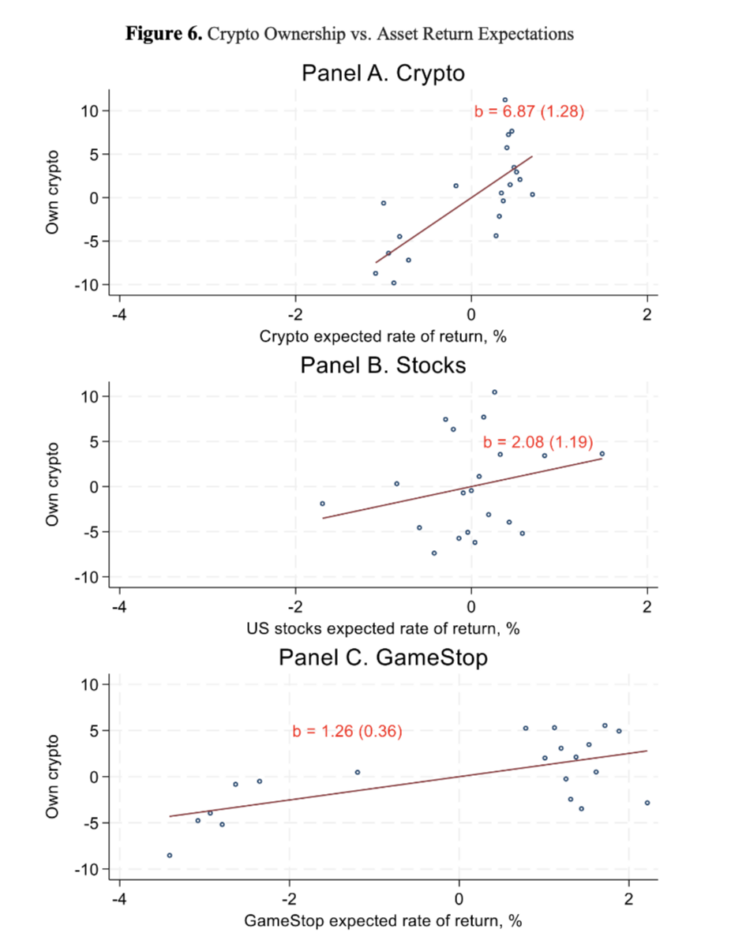
The paper said that for every 1 percentage point increase in a person’s expected crypto return, the probability of holding crypto rose by about 0.8 percentage points. Taken together, subjective views on returns and risk explained differences in ownership more strongly than age, income, and gender.
The study also showed that many people were unable to estimate likely crypto returns. In a 2021 survey, 87% of non-holders said they did not know what return to expect over the next year. Even among people who already held crypto, 54% could not answer that question.
Bitcoin performance data changed allocation preferences
In 2025, the researchers ran a randomized information experiment that split households into groups and provided different information about Bitcoin (BTC), stocks, GameStop, or inflation. Respondents who were shown Bitcoin’s return over the previous 12 months displayed a noticeable change in their willingness to invest in crypto.
After receiving information on Bitcoin’s historical returns, respondents increased the share of their portfolio they wanted to allocate to crypto by about 2 percentage points on average. The control group had originally wanted to allocate about 4.3%, which implies an increase in investment willingness of about 47%.
The effect showed up in actual trading behavior as well. Respondents who saw recent Bitcoin return information were about 2.5 percentage points more likely to later buy crypto. The response was strongest among people who had previously stayed out of the market because of what the study described as insufficient information. Those who had already concluded that crypto was a bad investment were less affected by the historical return data.
Researchers compare crypto gains to windfall income
The researchers said this may create a feedback loop specific to the crypto market. When prices rise and generate strong historical returns, new investors who see that information may lift their return expectations and buy crypto, and the additional inflows may push prices higher and attract more market participants.
The study also examined household spending after gains in crypto wealth. If Bitcoin’s price were to double, a household with all financial assets allocated to crypto would be about 1.4 percentage points more likely to buy durable goods, equal to an increase of about 7% from the original purchase probability.
That wealth effect did not clearly extend to ordinary day-to-day consumption. The researchers therefore compared crypto gains to gambling income or lottery winnings, arguing that investors are more likely to treat a sudden increase in asset value as a one-off gain rather than as a stable and permanent increase in household wealth.
The paper said the crypto market lacks a shared information base and common pricing beliefs. Investors differ widely in their views on future returns and risk, while historical price performance can directly shift expectations and buying behavior for part of the market. That combination of beliefs, information gaps, and return-chasing may help keep volatility as a defining feature of crypto markets.