
On Sept. 28, the U.S. Commodity Futures Trading Commission approved Coinbase’s plan to establish a derivatives clearing organization, or DCO. Coinbase said the approval completes the last missing piece of its end-to-end derivatives infrastructure.
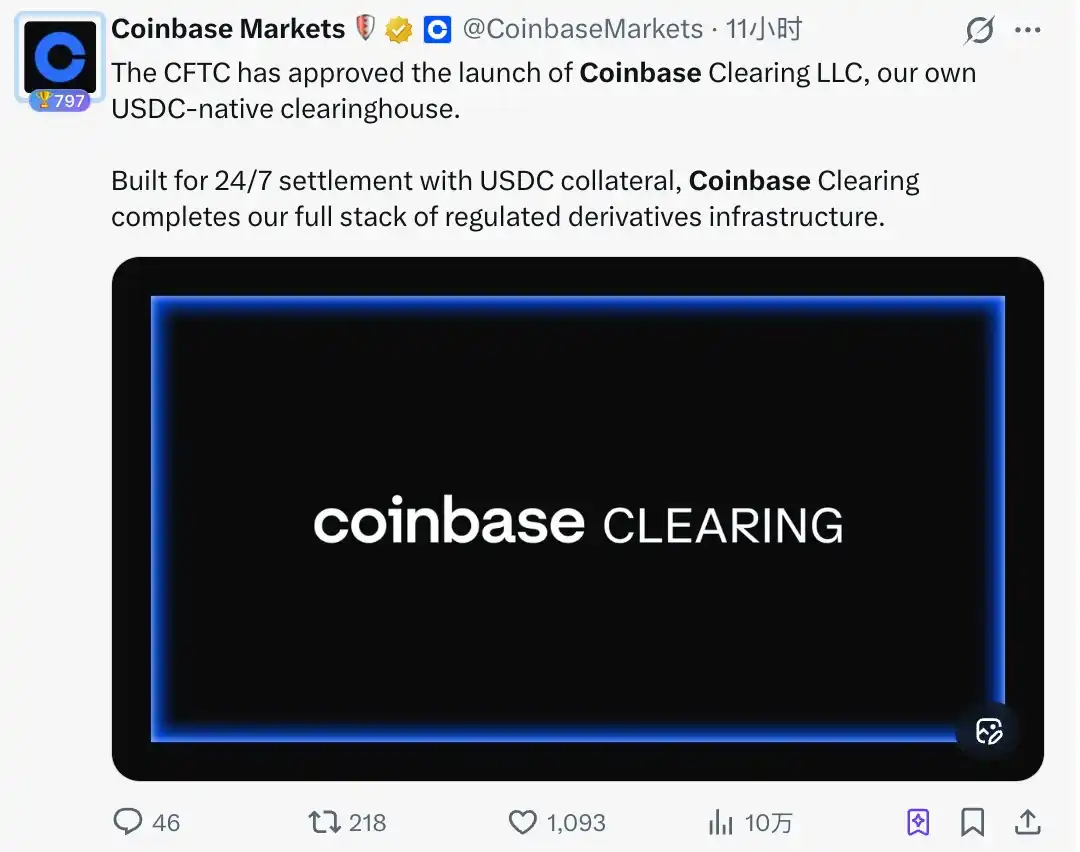
That headline looked significant on paper, but the market barely reacted. On the day of the announcement, COIN shares slipped 1.70%. BTC was down as well, and so were shares of Circle, the issuer of USDC.
The muted response points to a gap between regulatory progress and what traders see as immediately monetizable. Even so, the report says the structure of the U.S. crypto derivatives market is shifting underneath that quiet price action.
The license matters, but its limits are clear
The CFTC approval is narrowly defined. Coinbase’s DCO license allows the company to clear only fully collateralized futures, options, and swaps.
That leaves out the high-leverage margin products most familiar to retail traders and still central to market liquidity. In practical terms, the report says the approval does not change much for short-term traders using the app right now. Fees are unchanged. Leverage is unchanged. Leveraged derivatives still rely on outside clearing partners.
The article frames the CFTC’s position as straightforward: regulators are willing to let crypto-native firms enter clearing, but only through fully collateralized products that do not require a default fund and use a simpler risk model. Clearing authority for leveraged products remains outside the gate.
USDC moves closer to regulated settlement infrastructure
If the near-term revenue impact on Coinbase is limited, the strategic value for USDC may be larger than the market is pricing in.
The report describes this as the first regulated clearinghouse presented as USDC-native. In the past, institutions clearing derivatives often had to convert assets into fiat currency and work within traditional banking hours. Under this setup, USDC can be used directly as a regulated clearing and settlement asset, with 24/7 settlement support.
That changes USDC’s role. It is no longer only a trading-pair medium on-chain. In this framework, it becomes collateral embedded in a layer of financial infrastructure recognized by U.S. regulation.
The alignment also tightens the relationship between Coinbase and USDC. Coinbase is already a core distribution network for the stablecoin, and now it also becomes an entry point for its clearing use case. The article argues that this widens USDC’s lead over rivals in regulated settings.
At the same time, the report flags a structural risk. If collateral at a clearinghouse becomes heavily concentrated in a single stablecoin, any future USDC depeg event or disruption in banking channels could transmit stress directly into derivatives clearing.
Two routes are taking shape in the U.S. market
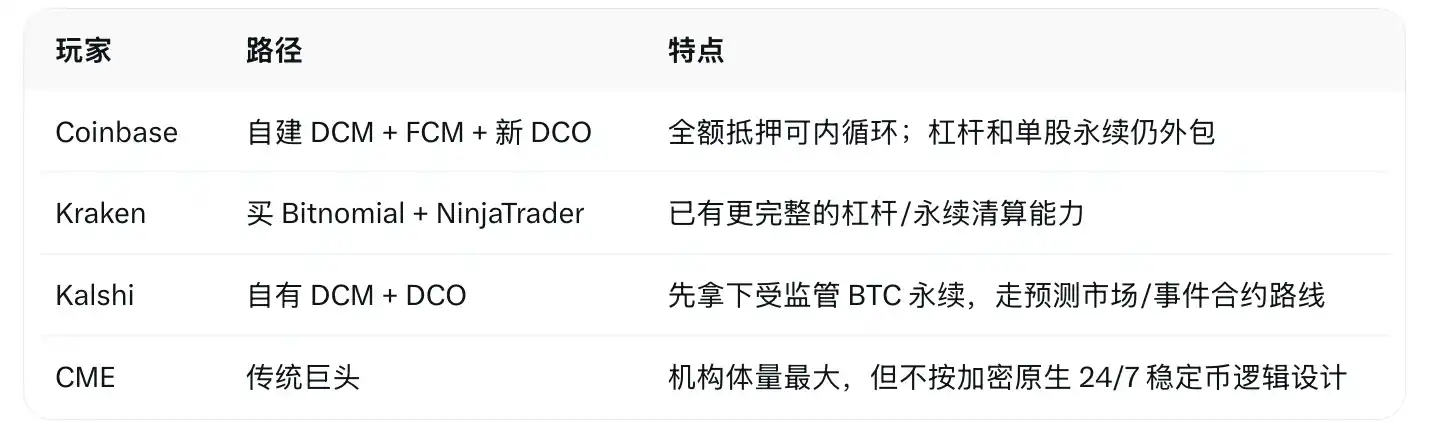
Across the broader U.S. crypto derivatives market, internalizing clearing has become a central competitive issue. The article says two distinct approaches have emerged.
One is the acquisition route. Citing Cointelegraph, the report notes that Kraken acquired Bitnomial in May this year, gaining a stack that includes exchange, brokerage, and clearing licenses, along with leveraged clearing capability.
The other is the build-it-yourself route Coinbase has chosen. The company now has its own full-stack piece in place, but on clearing permissions for high-leverage products, a newly built license still trails older licenses obtained through acquisition.
Whoever controls clearing can shape the types of collateral accepted, the pace of settlement, and the speed at which new products come to market. In that reading, what Coinbase secured here is less a weapon for taking share from incumbents such as CME right away, and more a claim on future product design and the settlement clock.
For now, this is a compliance milestone rather than a trading trigger
For ordinary investors, the report does not present the news as a reason to chase COIN higher. It describes the development as a compliance landing for infrastructure, the kind of step that helps validate strategic completeness in a company filing rather than instantly changing market behavior.
For the industry, though, the direction is becoming easier to read. The U.S. is gradually moving crypto matching, brokerage, clearing, and collateral into regulated channels. Fully collateralized products are only the opening step. If Coinbase eventually expands this DCO authority into leveraged or margin business, that is when the valuation impact and the challenge to traditional financial clearing systems would become more substantial.