
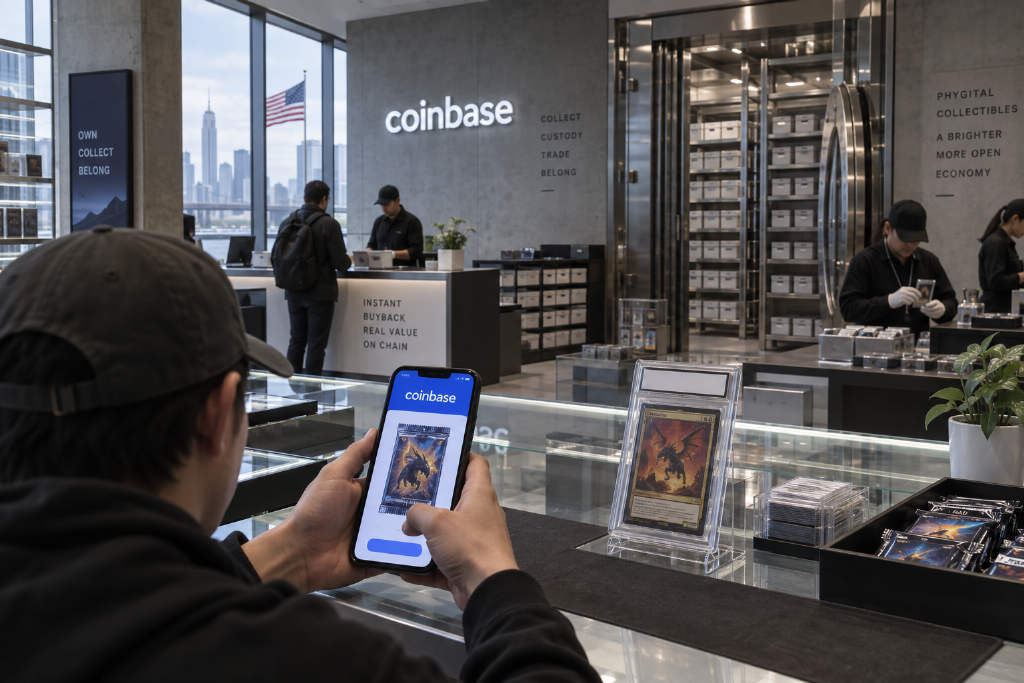
Coinbase has previewed a new Trading Card Game, or TCG, product that would let users open packs on mobile devices. Each card drawn is tied to a real-world collectible, and users can keep the item in custody for trading or redeem the physical card.
The PANews article says TCG has moved beyond a niche on-chain collectibles theme and is starting to stand on its own as a separate track. With a platform the size of Coinbase stepping in, the segment is drawing fresh attention across crypto.
Why TCG found product-market fit in crypto
Viewed only through a crypto lens, TCG can look like another version of real-world asset tokenization: put a Pokémon card into storage, then mint a token against it.
The article argues that this framing misses the larger point. Crypto did not create demand for trading cards. It connected itself to a market that was already mature. In the author’s description, the so-called “goods economy” around collectibles is built on intellectual property, scarcity, and community identity, with limited editions, hidden variants, and blind draws feeding secondary market activity. TCG fits on-chain rails more easily than many other collectibles because it already has clear editions, rarity tiers, grading standards, and historical transaction prices.
That foundation existed long before crypto platforms arrived. PSA, BGS, and CGC handle grading. eBay and Cardmarket handle trading. Vault operators handle custody. On-chain platforms are not recreating that infrastructure from scratch. They are digitizing ownership for physical cards that have already been graded and stored.
The article uses Courtyard as an example. Users can place graded cards into a vault, while ownership changes hands on-chain. A card can move through multiple owners without leaving storage, and only the final holder who actually wants possession needs to redeem it.
PANews compares that setup to an upgraded second-hand marketplace. Traditional resale platforms focus on authenticity checks and transaction trust. On-chain TCG separates movement of the physical item from movement of ownership. In that sense, TCG is well suited to blockchain because grading, pricing, and secondary trading were already established, while crypto mainly improves the speed of ownership transfer.
Why Gacha changed the economics
If TCG were only tokenized, the business would still be low frequency. One card would move from one person to another, and the platform would collect a fee once, which is not very different from a standard marketplace model.
The article says Gacha changed that by increasing how often users spend. A user might pay 50 USDT or 100 USDT for one draw, keep a card they like, then sell an unwanted card back to the platform and use those funds for another attempt.
The card bought back by the platform can then go back into the prize pool and be sold to the next user. PANews describes this as a mix of blind-box sales and second-hand recycling: randomness encourages repeated participation, and instant buybacks reduce the cost of exiting each draw.
The article gives a simple example. A user starts with 100 USDT, sells the first draw back for 90 USDT, then uses that 90 USDT for another draw. The user’s capital has not increased, but transaction volume can keep building. The same physical card can also cycle through “draw, buyback, re-enter prize pool” and be sold repeatedly.
That helps explain why the volume figures in this segment can look unusually large. Citing Blockworks, the article says the top five platforms recorded about $284 million in Gacha activity in July 2026, with roughly $249 million flowing back to users through buybacks.
Rather than treating Gacha as a simple on-chain capsule machine, PANews frames it as a business built on random consumption, instant repurchase, and repeated inventory turnover.
Projects now operating in on-chain TCG
The article says the basic structure across the market is starting to converge: custody for physical cards, digitized ownership, Gacha, instant buyback, and a secondary marketplace. What differs is where users come from, what kinds of cards are listed, how deep inventory runs, and whether the platform ultimately wants to be a crypto product or a broader collectibles venue.
Collector Crypt
Collector Crypt ranks 2335 on XHunt and, according to the article, is the largest project in the tokenized physical card segment by trading scale. It operates mainly on Solana and covers Pokémon, One Piece, and sports cards.
Its main product is Gacha, with prize pools at different price points offering about 85% to 93% instant buyback. PANews says its edge comes from a closed loop that already links sourcing, vaulting, random sales, secondary trading, repurchases, and physical fulfillment.
As of Sept. 29, 2026, DefiLlama data cited in the piece showed about $128.26 million in trading volume over the previous 30 days and about $11.03 million in protocol revenue over the same period, the highest among comparable projects.
Collector Crypt has already issued the $CARDS token and still runs quarterly airdrops. The team has said the remaining community allocation will be used to reward platform users, though it has not published a detailed formula. The article says users can build eligibility by taking part in Gacha, trading, and normal platform activity.
Courtyard
Courtyard ranks 3464 on XHunt and operates as a broader physical collectibles platform. It started with graded cards and has expanded into sports cards, Pokémon items, comics, coins, watches, and sneakers.
Users can buy fixed-price Vending Machine packs for a random physical asset or trade specific items directly on the secondary market.
The company has raised a cumulative $37 million, according to the article, and has built its own dedicated storage facility for collectibles. That reduces dependence on third-party custody and makes it easier to expand from cards into higher-value categories such as watches, coins, and sneakers. PANews says Courtyard has posted about $98.29 million in trading volume over the past 30 days, second only to Collector Crypt.
Courtyard has not launched a token. Users can earn points through daily check-ins, opening Vending Machine packs, weekly quests, and referrals. Those points can be exchanged for pack credits and leaderboard rewards, giving the system more of a membership-points structure.
Phygitals
Phygitals ranks 2823 on XHunt and is a Solana-based platform for physical collectibles trading, focusing on graded Pokémon, One Piece, sports cards, and Yu-Gi-Oh cards.
The article describes it as a lighter-asset TCG platform. Rather than rebuilding a full storage network, it connects to existing warehouses run by PSA, Fanatics, and Alt. Each card won corresponds to a real graded card held in professional custody, while users trade the digital ownership interest. They can list the item on the marketplace, sell it back at roughly 85% to 90% of fair market value, or request shipping for the physical card.
Beyond random pack openings and a digital claw-machine format, Phygitals also includes game features such as Duels and Drafts. Each draw uses public VRF, making the probabilities verifiable. After drawing a card, users can continue custody, list it on the secondary market, redeem the physical asset, or sell it back to the platform at about 85% to 90% based on Alt’s real-time market valuation.
Phygitals has not issued a token, and the team has not confirmed a token airdrop. For now, each purchase earns points and feeds into weekly rankings and rewards.
Renaiss
Renaiss ranks 7257 on XHunt and runs on BNB Chain. At this stage it is mainly focused on graded Pokémon and One Piece cards.
PANews says Renaiss is trying to do more than build a Gacha product. It wants to turn the process of putting physical cards on-chain into infrastructure. Its core system is called Vault OS. Partner card shops or custodians verify and hold the physical cards, while Renaiss maps the associated card information and ownership to the blockchain. Once in the system, the cards can be used in Gacha, peer-to-peer trading, or redeemed in physical form.
The platform is also moving into collectibles finance products tied to price indexes, APIs, and lending. Based on data previously disclosed by Renaiss, after the beta launch the platform had locked more than 6,140 cards representing more than $1.1 million in on-chain assets, with more than 231,000 registered users. Its cumulative scale stood at about $14.31 million, including about $12.16 million related to Gacha and about $2.15 million in P2P activity.
Deadstock
Deadstock ranks 145790 on XHunt and is a premium TCG platform launched by ATH Labs on Arbitrum. In September 2026, it closed a $2.5 million seed round led by Bullish Capital.
Its main distinction, according to the article, is that it only handles PSA 10 cards and has built its supply side directly in Japan. The project reached an exclusive tokenization partnership with Japanese card dealer JTCC, which provides an ongoing inventory of Pokémon cards. After each physical card enters a professional vault, a 1:1 digital twin is issued on-chain.
Users can buy random packs, then continue custody, list cards on a P2P market, accept a platform buyback, or redeem the physical item.
PANews’ closing view on the segment
The article places TCG inside a wider shift in crypto. In that view, the market is moving away from creating only native on-chain assets and toward bringing existing off-chain assets onto blockchains.
Along that path, PANews says TCG could become one of the next asset classes to gain traction after tokenized U.S. equities. The logic is that cards already have mature pricing, trading, and collecting demand, while on-chain ownership can improve liquidity and trading efficiency.
The article also cites DefiLlama figures to argue that leading physical TCG projects are already generating meaningful revenue. Collector Crypt posted about $10.33 million in protocol revenue over the past 30 days, Courtyard about $2.17 million, and Beezie was nearing the $1 million range.
The author ends by saying the market may see a TCG-driven run by the end of this year or early next year.