
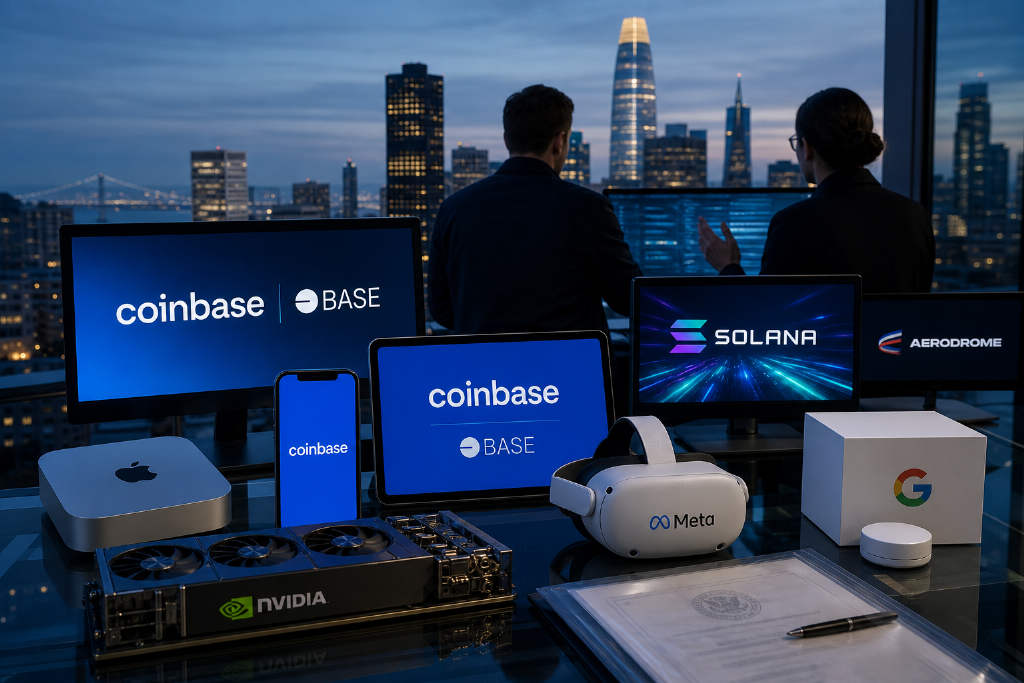
Coinbase brings tokenized stocks to Base
Coinbase announced on Aug. 25 that its first tokenized U.S. stocks had launched natively on Base. The initial list includes Apple, Nvidia, Meta and Alphabet. The products use B20, a native token standard introduced through Base’s Beryl network upgrade. The underlying shares are held one for one by regulated custodian Alpaca.
Eligible non-U.S. users can trade the tokens around the clock on Aerodrome. Access is limited to people outside the United States whose jurisdictions meet the product’s requirements.
At roughly the same time, Solana began preparing for Alpenglow, a planned consensus upgrade aimed at reducing the time required for a transaction to reach final status. The schedule published in August calls for Agave 4.3 adoption to expand across the mainnet during September. The related functions are tentatively set for activation at the end of September, while the full transition could continue into the fourth quarter. The timetable remains subject to change.
The two developments address different parts of the same tokenized-asset process. B20 standardizes issuance, management and application access for tokenized stocks and other assets. Alpenglow is designed to shorten the gap between an initial confirmation and final settlement. A functioning connection between issuance, trading and settlement is needed before real-world assets can move beyond passive holding into trading, collateral and financing.
What Beryl changes on Base
B20 is best understood through the wider Beryl upgrade. Beryl is Base’s second network-level upgrade after Azul and is already operating on the mainnet. It contains three major changes.
The first is the addition of the B20 native token standard. Stablecoins, stocks and other real-world assets can use issuance and management functions built into Base’s node software. Previously, issuers generally relied on third-party real-world-asset protocols and smart contracts for issuance, permission control and lifecycle management. B20 moves those functions into the network layer.
The second change reduces the usual withdrawal waiting period for moving assets from Base to Ethereum mainnet from seven days to five. The third upgrades the node software to Reth V2, reducing data-storage pressure and leaving room for future increases in network processing capacity.
Taken together, Beryl is a network-wide infrastructure change. B20 addresses the supply and management of assets, the shorter withdrawal period addresses capital movement, and Reth V2 addresses storage and future scaling. The structure gives Base tools for supporting more extensive on-chain financial activity.
B20 is a standard, not a separate investment token
B20 is a native token standard that establishes common rules for issuing and managing assets. It does not have its own price, supply or investment return. There is no separate market for buying and selling B20 itself.
An issuer can use the format to create a stablecoin, tokenized stock, fund share or another on-chain asset. B20 is fully compatible with common Ethereum token interfaces, allowing existing wallets, trading venues, data tools and decentralized finance protocols to recognize and call the assets.
The main difference from an ordinary token lies in how the rules operate. Conventional tokens normally place their rules in a separately deployed smart contract. B20 puts the core logic into Base’s node software, where the network executes it directly.
This structure can reduce the cost of repeatedly developing compliance-related modules for each issuer. It can also reduce compatibility problems created when different assets use separate rule sets. B20 includes role permissions, minting and burning, trading pauses, transfer restrictions, freezing and disposal functions, and transfer notes. It comes in general-asset and stablecoin versions.
For regulated stocks and funds, those features can be used for identity requirements, judicial freezes, redemptions and corporate actions.
Four U.S. stocks enter on-chain trading
Coinbase’s first tokenized-stock product puts the standard into a live business setting. Coinbase handles issuance, institutional market makers buy the corresponding shares, and Alpaca holds the underlying stock in a regulated structure separated from Coinbase’s assets. The custody ratio is one to one.
Token holders receive direct beneficial rights to the underlying shares. After completing the required identity checks and meeting the relevant ownership conditions, they can also exercise shareholder rights such as voting and redemption. Dividends and stock splits are handled through on-chain multiplier adjustments, so wallet balances do not need to be repeatedly changed for each corporate action.
The initial four stocks are Apple, Nvidia, Meta and Alphabet. Users can hold the tokens in self-custody wallets and trade them around the clock through Aerodrome and other on-chain venues.
B20 transfers do not use a wallet whitelist. As a result, a user may not need to complete Coinbase’s KYC process before trading in the secondary market. Users who have not passed the identity and eligibility checks can only hold and transfer the tokens. They receive economic exposure linked to the performance of the underlying stock, but cannot exercise voting or redemption rights.
Coinbase plans to add more stocks and other real-world-asset products over time. Because B20 is compatible with existing wallets and DeFi protocols, tokenized stocks can also be used in lending, collateral and automated investment strategies. A user could buy a tokenized stock, post it as collateral, borrow stablecoins and deploy the borrowed funds into another on-chain product. That creates a possible connection between trading, financing and portfolio allocation.
Technical compatibility does not mean that these stocks can immediately become collateral on protocols such as Aave. Aave V4’s deployment on Base remains under governance discussion. Each stock still needs review of its legal rights, price source, trading depth and liquidation risk.
The ease of redemption, continued full custody of the underlying shares and timeliness of price updates will also affect collateral limits and borrowing costs. B20 addresses the absence of a common issuance standard. The next test is whether the number of stock products, secondary-market liquidity, lending volume and real revenue can grow together.
Alpenglow targets faster Solana settlement
Alpenglow is Solana’s planned next-generation consensus mechanism. It is intended to coordinate validators as they reach agreement on transaction state and to determine when a transaction becomes effective and reaches final confirmation. Its first phase, Votor, is designed to handle validator voting and transaction finality across the Solana network.
Tokenized stocks require fast execution, predictable settlement and efficient capital turnover, making them a prominent use case for the upgrade. Alpenglow has not yet reached formal deployment and remains in testing and preparation.
The mechanism entered community-cluster testing in May. Some prerequisite functions were enabled in July, and the Agave 4.3 client containing the related functions entered testnet and development-network testing during August.
Under the current plan, a mainnet candidate version will be released in September, followed by a gradual increase in Agave 4.3 adoption among validator nodes. The related functions are tentatively scheduled for deployment to Solana’s existing mainnet at the end of September. A complete transition could continue into the fourth quarter.
From 12.8 seconds to a 150-millisecond target
Solana can usually provide an initial transaction confirmation in roughly 350 to 400 milliseconds. Reaching a final state that is nearly impossible to reverse still takes about 12.8 seconds. Votor is designed to let validators pass votes directly and aggregate large numbers of votes into a unified proof. Its target is final confirmation in about 150 milliseconds.
For a tokenized-stock market, the first effects would be felt in market making, hedging and capital turnover. After completing an on-chain trade, a market maker generally still needs to establish an opposite position in the traditional market. The longer final confirmation takes, the longer the market maker faces price movement, hedging mismatch and margin-utilization risks.
A shorter finality period would allow market makers to adjust inventory, release margin and quote the next round more quickly. Bid-ask spreads could also narrow. Tokenized stocks and stablecoins could settle together in one transaction, keeping asset delivery and payment synchronized and reducing the risk that one side completes its obligation before the other side pays.
The restrictions on token holders, transfer pauses, administrative permissions and synchronized settlement are mainly delivered through Solana’s token extensions and issuer-side applications. Alpenglow addresses confirmation and final-settlement time. Even together, the two systems do not replace off-chain rules and compliance processes for custody, legal rights and issuance review.
Trading has grown faster than asset utilization
As of the date covered by the source material, RWA.xyz data showed about $4.05 billion in non-stablecoin real-world assets on Solana, held by roughly 370,000 addresses. In the second quarter, Solana accounted for about 95% of global tokenized-stock trading volume, with cumulative trading value surpassing $10 billion in June.
Asset use remains more limited. Only about 9% of tokenized real-world assets had entered liquidity pools or been used for lending collateral. Excluding uncirculated reserves held by issuers, the ratio was about 16%.
The improvement in settlement speed will create practical value only if tokenized stocks reach markets such as Jupiter and Kamino and generate recurring demand for buying, selling, collateral and financing. Faster settlement can support stablecoin inflows and protocol revenue only after liquidity and applications expand together.
Market attention is not yet recurring revenue
After Coinbase introduced tokenized U.S. stocks, projects in the Base ecosystem, including Aerodrome, received early market attention. As Solana’s real-world-asset base expanded and Alpenglow moved closer to mainnet deployment, related trading and lending applications also returned to investors’ focus.
Secondary markets have started to reflect expectations for asset tokenization and more efficient settlement. The broader recovery in crypto markets is also part of that picture. Attention can rise quickly, while trading demand and protocol revenue take longer to accumulate.
Solana’s second-quarter tokenized-stock volume grew rapidly, but trading activity has not yet fully become ecosystem revenue. Base’s related products also lack a sufficiently long and continuous data record. Assessing whether the market can continue will require monitoring product count, market depth, collateral ratios, stablecoin borrowing and actual protocol fees.
The infrastructure will have translated into operating growth only when a larger asset supply produces continuing trade, and those trades generate lending demand and protocol revenue.
Supply remains concentrated
RWA.xyz data put the total value of the global tokenized-stock assets it tracks at about $2.56 billion, up from approximately $1.89 billion at the end of July, a gain of about 35.4%. The figures show that issuance and on-chain deployment are accelerating.
The supply is still concentrated among a small group of issuance platforms, large U.S. technology stocks and major index funds. Its coverage remains far narrower than that of traditional equity markets. Even a tenfold increase from the current level, to about $25.6 billion, would remain limited relative to the global pool of traditional securities that could be tokenized. The sector is still at an early stage.
Expansion will depend on regulatory rules and traditional-market infrastructure developing together. The U.S. Securities and Exchange Commission’s Project Crypto regulatory program has entered rule interpretation and pilot work. In March 2026, the SEC approved Nasdaq’s trading of tokenized securities under a tokenization pilot framework involving DTC, a subsidiary of DTCC. The framework would allow eligible Russell 1000 constituents and major index ETFs to trade in tokenized form on existing order books.
The New York Stock Exchange has also established related pilot rules and is developing a platform for around-the-clock trading of U.S. stocks and ETFs, stablecoin funding and instant on-chain settlement. DTCC’s tokenization service remains in preparation for launch. The SEC’s innovation exemption for open-chain trading and the NYSE’s independent platform have not fully gone live.
As legal rights, custody, subscription and redemption, and professional market-making mechanisms develop, stocks, ETFs and bonds could support a wider set of trading, custody and lending services.
The key test is the capital loop
The value of tokenized stocks for crypto markets cannot be judged by asset size alone. Their broader function is to bring traditional assets and outside capital on-chain and create demand for stablecoin settlement, secondary trading, custody and collateralized lending.
Issuance growth becomes a durable capital loop only when trading volume, liquidity depth, collateral ratios, stablecoin borrowing and protocol revenue rise together. If new assets mainly remain in issuer or user wallets, their contribution to on-chain liquidity and ecosystem revenue will remain limited.
The next phase first depends on further growth in supply and real liquidity. Coinbase needs to expand beyond its initial four stocks into more equities, index funds and bonds. Solana needs to consolidate its existing share of tokenized-stock trading and attract more products that meet regulatory requirements. Legal ownership rights, independent custody, reliable redemption and professional market making also need to mature at the same time.
The combination of tokenized stocks and lending markets could provide another route for growth. A user could purchase a tokenized stock with stablecoins, use the stock as collateral to borrow stablecoins, and deploy the loan in another trade or investment. That cycle links assets, credit and protocol revenue, moving the stock token from a holding instrument toward an asset used in on-chain finance.
The path of value transmission differs by network. Base has no native network token, so new value may first flow to Aave, Morpho, stablecoin infrastructure and oracle services. Higher usage of Solana is more directly connected to SOL and related ecosystem applications. Asset issuance, protocol revenue and ecosystem-token value therefore need to be assessed separately.
B20 adds standardized issuance and asset-management functions. If Alpenglow launches according to plan, it should reduce the wait for final settlement. The two developments raise the possibility that tokenized stocks could become a market catalyst, but infrastructure improvements alone cannot create sustained activity.
The central question is whether real-world assets can continue to bring outside capital on-chain and generate recurring trading, collateral and credit demand. Rising collateral ratios, stablecoin borrowing and actual protocol revenue would shift the market’s valuation of tokenized stocks from technical expectations toward measurable financial activity. If most assets remain in wallets without trading, lending or capital circulation, their price performance will remain driven largely by market sentiment.