

Every bear market silently rewrites the listing logic of centralized exchanges. When liquidity tightens and retail enthusiasm fades, every listing decision becomes more cautious, and therefore more signal-rich. We systematically tracked new spot listings on Coinbase, Binance Spot, ByBit, OKX, Bithumb, and Upbit, along with Binance Perpetual contracts, from early 2026 through mid-May. The dataset consists of 207 listing records covering 92 unique tokens. The numbers reveal a highly structured pathway of verification and liquidity transmission.
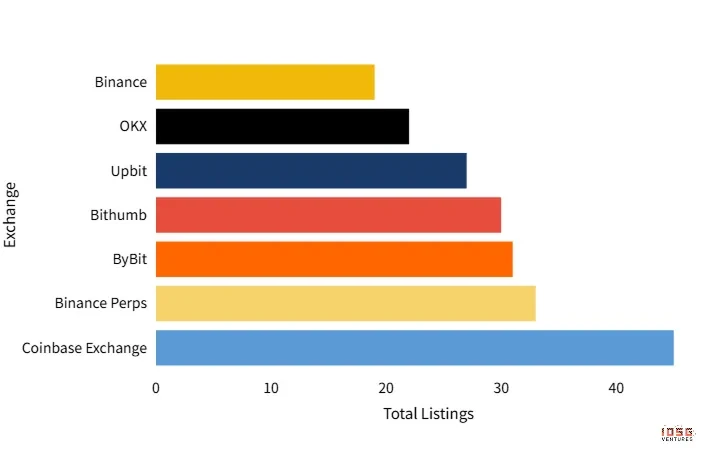
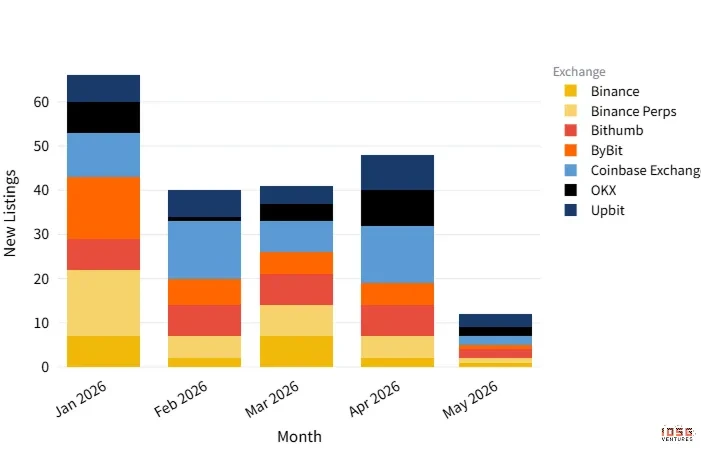
By volume, Coinbase led with 45 new listings, followed by Binance Perps (33), ByBit (31), Bithumb (30), Upbit (27), OKX (22), and Binance Spot with the fewest at 19. January was the year's peak, with Binance Perps listing 15 tokens and ByBit 14 in a single month. From February onward the pace cooled, with monthly averages falling to 5–8. Coinbase, however, displayed a distinct rhythm, staging two concentrated waves in February and April, each with 13 new listings.
Sequential Roles: First Movers vs. Followers
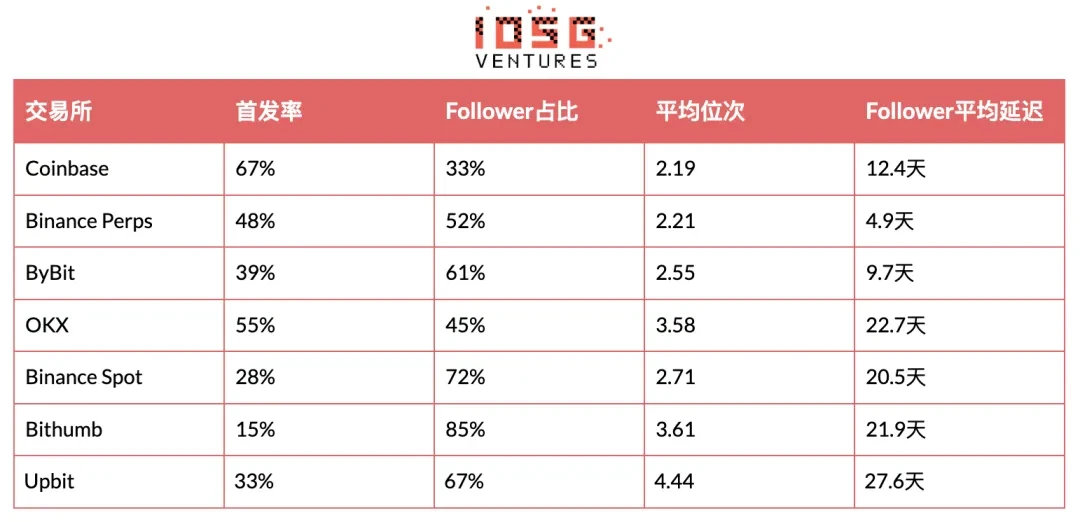
We define the exchange that lists a token first within our tracking window as the “first lister,” and the rest as “followers.” Coinbase is the dominant first mover in 2026, serving as the first lister for 67% of the tokens it lists and acting as the market's primary price-discovery venue. ByBit (39% first-listing rate) and Binance Perps (48%) also maintain high initiative, often listing the same tokens within the same week, forming the first tier. Korean exchanges, by contrast, systematically sit at the end of the chain: Bithumb has an 85% follower ratio, Upbit’s average ranking is 4.44, and they typically list 28 days after the first lister. Internally, Binance operates a clear funnel: Binance Perps actively initiates roughly half the time and follows spot listings with an average lag of just 4.9 days—the fastest response across all exchanges—using the derivatives market to test liquidity and demand. Binance Spot, with only 19 listings and a 28% first-listing rate, clearly waits for sufficient market validation. OKX demonstrates strong independent selection capability (55% first-listing rate) but remains restrained in volume (22 listings) with an average rank of 3.58, reflecting a high screening bar and a prudent strategy.
A 28-Day Bag‑Holding Route
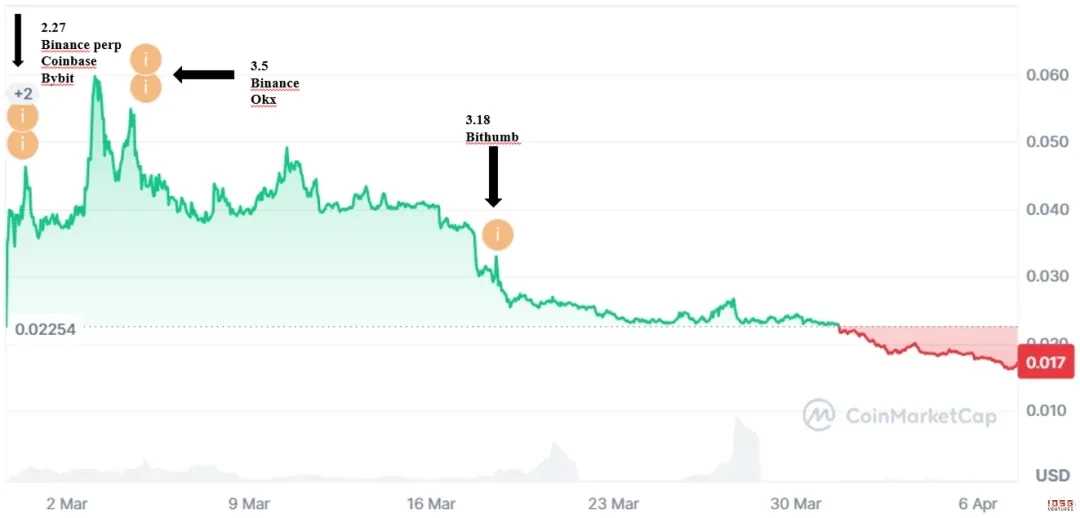
Consider ROBO. Listed on Binance Spot on March 5 at $0.0493, that price proved to be the cycle high. When OKX entered, the price was already below Binance Spot’s level. On March 18, Bithumb listed the token at $0.0303—a brief spike followed by a continuous decline that pushed the price below the first listing’s opening level. In just about 20 days, ROBO completed the archetypal 2026 listing path: Binance Perps, Coinbase, and ByBit first → OKX and Binance Spot confirm at the peak → Korean exchanges take over at the end. Among tokens listed on three or more exchanges in the first five months of 2026, the same tiered pattern held for all 28 cases, making the overall path highly stable and predictable.
Binance Perps Screening Logic
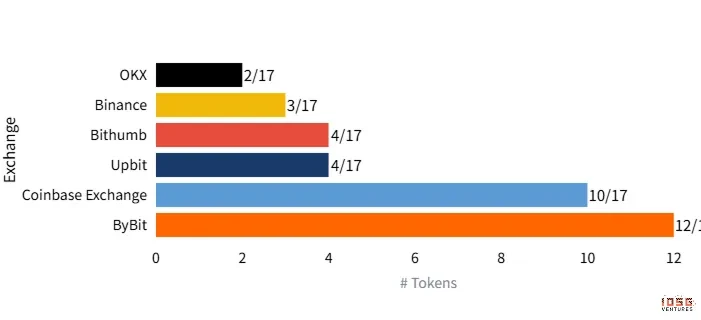
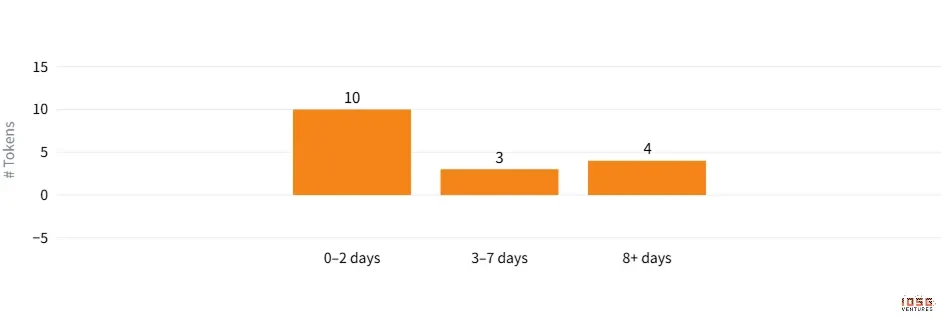
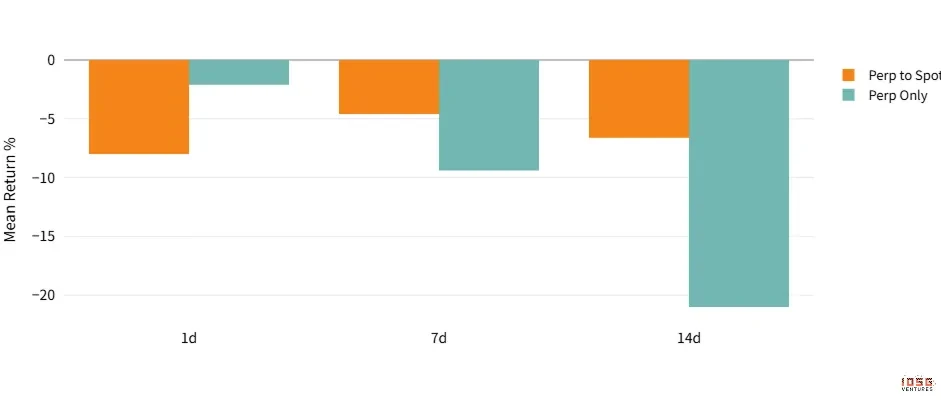
Of the 33 tokens that entered Binance Perps, 17 were listed on other spot exchanges first. Coinbase and ByBit serve as the strongest leading signals: 75% of tokens listed on Coinbase eventually entered Perps, as did 70% of ByBit listings. When a token is supported by both Coinbase and ByBit and shows relatively stable price action, it has a high probability of landing on Binance Perps within a week. The real differentiator is post-listing price performance. Tokens that later converted to Binance Spot (the “Converted” group) posted an average 7-day return of -4.6% and 14-day return of -6.6% after Perps listing. Those that remained Perp‑Only suffered -9.4% and -21.0%, respectively. Although both groups recorded negative returns in the bear market, the Converted cohort’s price maintenance was significantly stronger, indicating that Binance already weighs sustainability at the Perps stage.
Price Levels and Return Divergence
Price discovery concentrates in the first-listing window. As a follower, Binance Perps arrives at an average premium of 11.5% over the first lister, but its 4.9‑day lag keeps it in an early position. Binance Spot tends to list after a 10% retracement, offering users a better entry price. Korean exchanges face the most unfavorable position: Bithumb averages a 19.4% premium, Upbit 27.4%, with a typical delay of more than three weeks. Under the bearish conditions of 2026, 30-day mean returns are negative across every exchange, deepening from 7‑day to 30‑day horizons. Listings primarily serve as exit windows for early holders.
Peak returns tell a different story. First-listing exchanges hold an absolute edge: ByBit’s average peak is +86%, and Binance Perps’ median peak is +49%, creating ample liquidity premiums for early participants. Late-stage followers see their peaks capped around 35%, with OKX at just 25%, squeezed by profit-taking from earlier rounds.
When entry price, peak potential, and final return are combined, users on different exchanges confront radically different risk-reward profiles. First-lister users enjoy the lowest entry prices (-10% to -5.9%) and the highest peak space (average above +70%), so even with negative final returns their absolute losses are manageable. Korean exchange users face the double burden of high entry premiums and limited upside, resulting in the deepest 30-day drawdowns. Binance Spot, despite a -24.6% 30-day return, enters after a 10% price decline, meaning the actual capital loss is milder than the headline figure suggests. In the 2026 environment of zero-sum liquidity, “where you list” matters far more than “what you list.”
The 2026 bear market has shifted CEX listing logic from “traffic‑driven” to “verification‑driven.” Through clear role segmentation, exchanges have built a structured screening and liquidity-release pathway: Coinbase and ByBit act as early discoverers, Binance Perps provide rapid verification and liquidity testing, Binance Spot serves as the final confirmation gate, and Korean exchanges supply exit liquidity at the end. This chain is both a stepping stone for quality projects and a staged exit window for early investors. For traders, understanding the temporal position differences along this path is perhaps the most actionable alpha in 2026.
Based on 207 listing records and 92 unique tokens through mid-May 2026, the average price advantage of first-listing exchanges is as high as -5.6%, while mid-path verification platforms such as Binance Perps absorb liquidity with a mere 4.9-day response time. Trailing followers on Korean exchanges face an average 28-day delay and a 27.4% entry premium. No exchange posts a positive 30-day average return in this bear market, yet first-mover users can still contain absolute losses thanks to low entry and high peak elasticity, while late-stage entrants absorb the deepest drawdowns. In an environment lacking fresh inflows, listing events have become a redistribution game among existing holders, and the divergence driven by “which exchange” far outweighs the token selection itself.