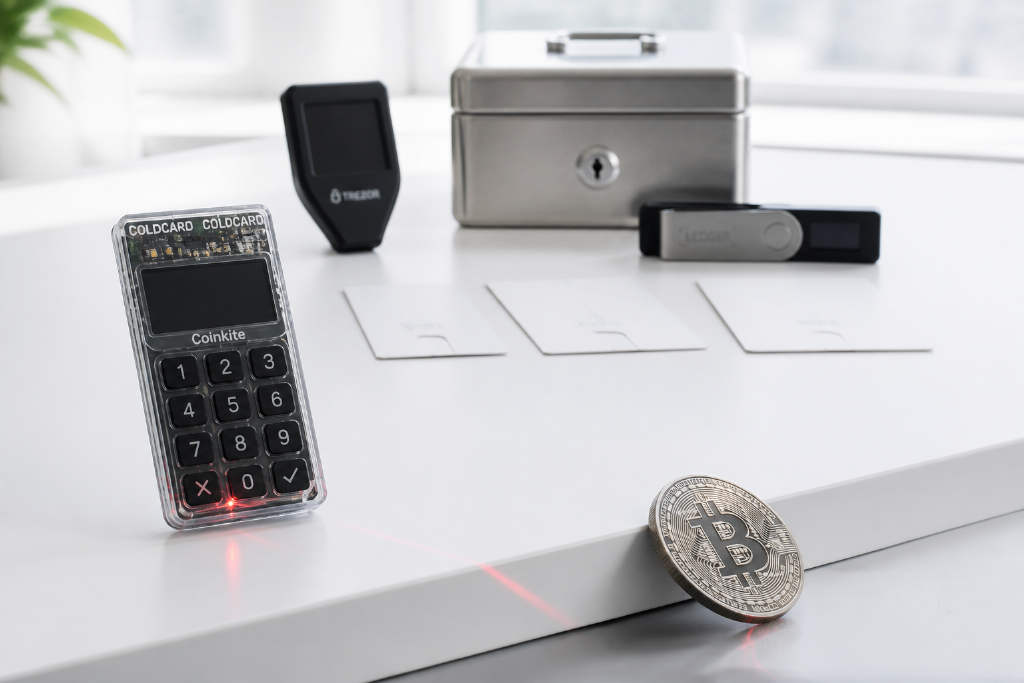
Coldcard, the hardware wallet brand owned by Coinkite, has been linked to a serious entropy flaw that reportedly went undetected since 2021 and led to more than $100 million worth of Bitcoin being stolen. According to the report, most victims were users relying on single-seed-phrase wallets, where weak entropy made it possible for attackers to guess private keys through customized methods. The incident has pushed the Bitcoin community to revisit the reliability of single-signature self-custody setups. In that context, multi-vendor multisignature arrangements are being presented as a new baseline for long-term holders. The model uses keys from different wallet makers to reduce dependence on any one hardware provider, with one example combining Trezor Safe 7, Ledger Nano and a Casa recovery key in a 2-of-3 setup. The report also notes that multisig can help defend against wrench attacks and has supported services such as BTC-denominated Bitcoin insurance from firms including AnchorWatch. At the same time, it adds operational overhead because users must keep threshold keys safe and also retain a copy of the multisig script or template for independent recovery if wallet services go offline.
ChainCatcher reported that Coldcard, the hardware wallet brand under Coinkite, has been exposed for a serious entropy flaw. The issue allegedly went unnoticed since 2021 and has resulted in more than $100 million in stolen Bitcoin, with most victims described as users of single-seed-phrase wallets.
The report said weak entropy allowed attackers to guess private keys through customized methods. That has prompted the Bitcoin community to reassess the reliability of single-signature self-custody.
Multi-vendor multisig moves into focus
Against that backdrop, multi-vendor multisig is being recommended as a new custody baseline for long-term holders. The approach requires users to build a multisignature address with keys sourced from different wallet vendors, reducing trust dependence on any single hardware maker.
One example cited in the report combines Trezor Safe 7, Ledger Nano and a Casa recovery key in a 2-of-3 multisig arrangement.
Benefits and trade-offs
Beyond reducing single-vendor risk, multisig can also defend against wrench attacks. The model has also led to Bitcoin insurance services priced in BTC, including offerings from AnchorWatch.
Still, the setup carries added complexity. Users need to safeguard enough keys to meet the signing threshold, while also preserving a copy of the multisig script or template so funds can be recovered independently if wallet services go offline.
This article was originally published by Bit.Fan. For more cryptocurrency news and market insights, visit www.bit.fan. Disclaimer:
The market information, project data, and third-party content displayed on this platform are for industry information sharing only and do not constitute any form of investment advice or return commitment.
Cryptocurrency trading carries high risks. Users should fully assess their risk tolerance and make independent decisions. All profits, losses, and legal responsibilities are borne by the users themselves.