
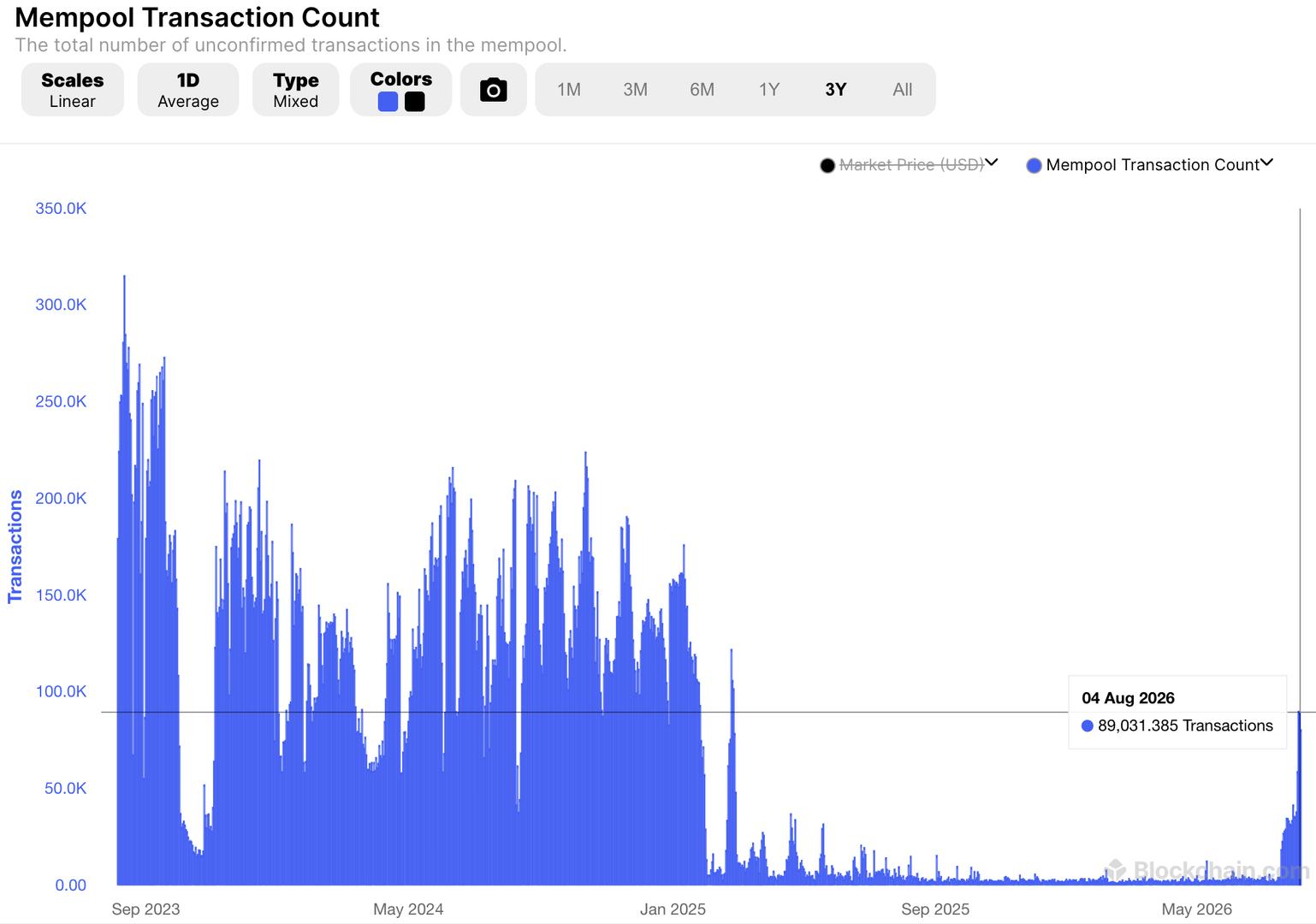
A $120 million hack tied to hardware wallet provider Coldcard has pushed Bitcoin network activity sharply higher, with mempool transactions reaching their highest level since February 2025. The attack began on July 30 and was still ongoing as of Aug. 5, according to CoinDesk’s Daybook newsletter.
CoinDesk said the episode has exposed two sides of the self-custody trade. It has raised fresh questions about the safety of holding coins directly in hardware wallets for the long term, a strategy that became more popular after the collapse of FTX in 2022. At the same time, it has prompted holders to move funds across exchanges and multiple wallets, increasing traffic on the Bitcoin network.
Bitcoin mempool swells after Coldcard attack
The most visible sign of that shift is in Bitcoin’s memory pool, where transactions wait for miner confirmation. Data from Blockchain.com cited in the report shows the count has climbed since late July and reached 89,031 on Tuesday, the highest level since February 2025.
CoinDesk framed the development as a byproduct of reshuffling. Holders have been moving bitcoin to exchanges and splitting funds across additional wallets, and that repositioning has shown up across several on-chain indicators.
Santiment data tells the same story. The number of active addresses rose to a three-month high of 712,000, while whale transactions, defined in the article as transfers from large holders, climbed to a five-month high of 61,800.
Price holds its recent range
Stronger network activity is often viewed as supportive for the valuation of a blockchain’s native asset. Even so, bitcoin has not broken out in either direction. CoinDesk said BTC remains boxed in a recent $62,000 to $65,000 range, and the newsletter listed the token at $64,055.06.
The article said analysts are still focused on two near-term market drivers. One is the fate of the CLARITY Act, which they described as the immediate catalyst. The other is the level of longer-duration government bond yields, which they see as a broader and more durable macro force.
Marex points to a narrow Senate window
Marex analysts said policy remains front and center. “CLARITY is still the immediate policy binary. The Senate has a three-day window before its August 10 recess, while the implied probability of passage by year end has fallen to 23% from around 75% in mid-May. A push to attach prediction-market restrictions adds another process risk,” they said.
That leaves the bill as a live short-term variable, even as market expectations around passage have cooled materially from the levels seen in mid-May.
Bitfinex flags the 2.5% real-yield line
Bitfinex focused on rates. The exchange said bitcoin’s bullish macro case could break down if the real, or inflation-adjusted, yield on the U.S. 10-year Treasury note moves above 2.5%.
“The 10-year real yield has not stayed above 2.5% since before Bitcoin existed, so there is no price history above that line. It is now at 2.41%, nine basis points below,” Bitfinex said.
That leaves the market watching a threshold the exchange sees as unusually important for bitcoin’s macro setup.
Whether the spike lasts is still unclear
The chart in the newsletter tracks the daily number of transactions waiting for miner approval in the Bitcoin blockchain’s mempool. The tally moved above 89,000 on Tuesday, the highest since February 2025, extending the pickup in activity that started in late July.
CoinDesk said it remains unclear how long the spike will last.
Looking at the broader trend, the report said activity has slowed sharply since spot Bitcoin ETFs were introduced in early 2024. It added that ETFs may have strengthened BTC’s appeal as digital gold and a store-of-value asset rather than as a payments network.
Other items highlighted in CoinDesk’s trending section
The newsletter also listed several stories drawing attention across markets:
- A new Ethereum proposal would cut issuance to zero if staked ETH reaches $112 billion. CoinDesk said the proposal would gradually burn more validator rewards as staking rises. The burn rate would reach 100% once roughly half of ether’s supply is staked, pushing net issuance to zero and potentially strengthening ETH’s long-term scarcity and valuation.
- Another CoinDesk analysis argued that the S&P 500-to-bitcoin ratio chart suggests bitcoin’s edge over stocks and other assets may be fading.
- CNBC reported that SpaceX shares fell 10% on Wednesday after a surge in AI spending unsettled investors, even though the quarter beat expectations.
- Reuters reported that oil prices settled more than 5% lower and hit their lowest level in three weeks after U.S. comments raised hopes for progress in U.S.-Iran talks, which could improve flows through the Strait of Hormuz if the Iran war is resolved.
Additional articles listed in the Daybook excerpt
CoinDesk also included a ranking of related stories and timestamps in the newsletter:
- 1Circle shares jump as earnings beat offsets revenue miss, Arc blockchain gains Wall Street backing — 25 minutes ago;
- Bitcoin, broader market fail to keep pace as global equities hit record highs — 37 minutes ago;
- Coldcard hack sparks a self-custody security overhaul: Cory Klippsten — 1 hour ago;
- Why bitcoin’s ‘500-day rule’ faces its biggest test yet — 2 hours ago;
- Live updates: An AI credit bubble could set up bitcoin’s path to $1 million — 2 hours ago;
- The worst chart for bitcoin bulls right now — 3 hours ago;
- New Ethereum proposal would cut issuance to zero if staked ETH reaches $112 billion — 5 hours ago;
- “You stole, please return some.” Coldcard hacker’s wallet becomes a graffiti wall of pleas and hustles — 6 hours ago;
- Bitcoin flat at $64,000 as stocks print records and Hormuz deal nears — 7 hours ago;
- SpaceX tops Wall Street revenue forecast, posts $540 million loss on bitcoin holdings — 15 hours ago.
Binance case study mentioned at the end
The Daybook excerpt closed by referencing a separate piece titled “The Evolution of the Crypto CEX Landscape: A Case Study on Binance.” It said Binance remains the leading crypto exchange and has expanded beyond spot and derivatives into RWAs, payments, savings, yield products and broader financial services.
The excerpt ended with the prompt “Why it matters:” and did not provide additional detail after that line.