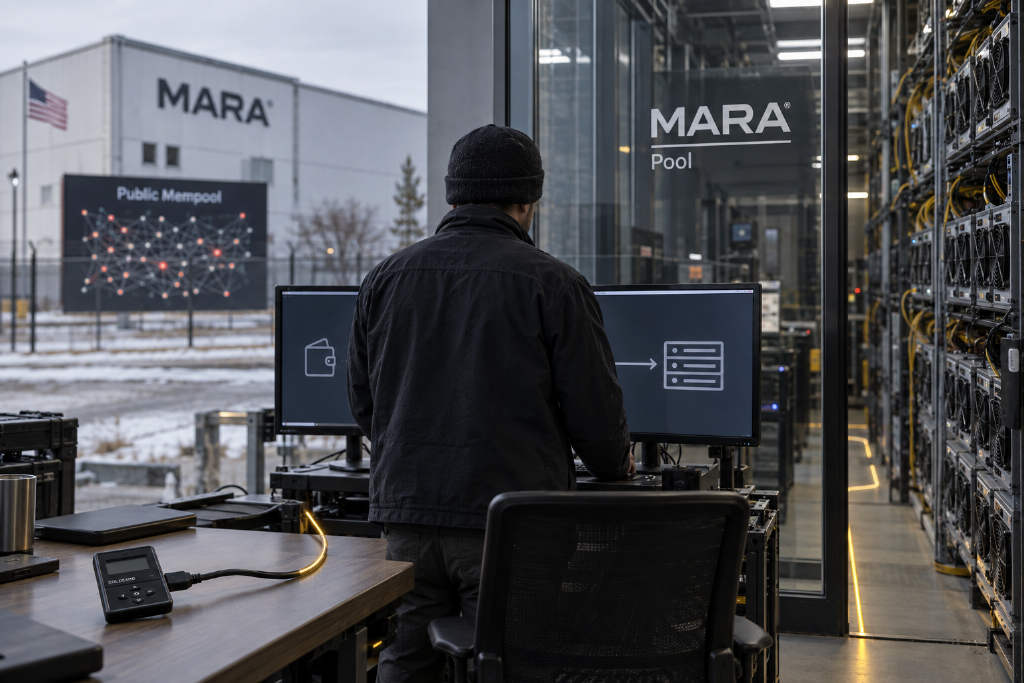
Peter Todd2026-10-01 18:01:44Peter Todd joins MARA Foundation to lead private mempool service SlipstreamBitcoin developer Peter Todd has joined the MARA Foundation as lead maintainer of Slipstream, a private Bitcoin mempool service tied to MARA Pool. The foundation announced the move on Thursday, saying Todd will oversee both development and operations for the service. Slipstream allows users to send Bitcoin transactions directly to MARA’s mining pool instead of broadcasting them across Bitcoin’s public peer-to-peer network. That design keeps transactions private until they are confirmed in a block, which can help limit the exposure of public keys before confirmation. Bitcoin Magazine said the service proved useful after hackers exploited Coldcard hardware wallets in July, an incident that led to more than $115 million in stolen user funds. Slipstream first drew wider attention in 2024 when MARA used it to publish large Ordinals inscriptions. It has also been used in research efforts including Quantum Safe Bitcoin and Binohash, which is described as a way to emulate covenants without a soft fork. Todd, a longtime Bitcoin Core contributor, previously co-authored BIP 125, created OpenTimestamps, and launched Libre Relay in 2024.110
ChainFeeds2026-09-21 12:33:00ChainFeeds PRO reviews encrypted mempool design, Frame Transactions, and a Lightning-based "Bitcoin dollar"ChainFeeds’ latest PRO issue pulls together a wide set of research threads across Bitcoin, Ethereum, MEV, and academic work, with several pieces standing out. One is Ethereum Foundation researcher Gottfried Herold’s proposal for an encrypted mempool design that drops the need for batch threshold decryption and instead uses threshold identity-based encryption tied to block hashes and ticket ordering. Another is lightclient’s case for EIP-8141 Frame Transactions as a more general transaction format for Ethereum accounts, covering use cases such as key rotation, gas sponsorship, privacy-pool withdrawals, transaction assertions, full-balance transfers, and signature aggregation. The issue also highlights BTCPay Server founder Nicolas Dorier’s idea of creating a "Bitcoin dollar" through Lightning channels by adjusting expected balances rather than issuing a dollar liability, alongside updates from Bitcoin Optech Newsletter #423 on mining pool vardiff behavior, Utreexo sync optimization, and a proposed unspendable Taproot internal key. On the Ethereum side, it covers atoranzo’s attempt to remove relayer dependence in EVM shielded pools and K1-R1’s RawVentures concept, which would route part of ETH staking rewards into an on-chain venture fund governed through prediction markets. The MEV section summarizes Flashbots’ The MEV Letter #153, and the paper roundup includes XSplicer, a system that reportedly achieved a 92.5% recovery rate in reconstructing cross-chain transaction correspondences across heterogeneous blockchains.380
ChainFeeds2026-09-14 16:18:44ChainFeeds PRO Tracks MATCHA, Gas Sponsorship Limits, and Faster Payload PropagationChainFeeds Research’s latest PRO issue spans Ethereum mempool design, Bitcoin wallet infrastructure, MEV, and academic research, with three topics standing out. The first is MATCHA, a proposal from Ethereum researcher soispoke.eth that ties concurrent public-mempool capacity to an address’s historical gas consumption in finalized blocks, aiming to curb Sybil and DoS abuse once keyed nonces allow multiple parallel transactions from the same sender. The second is Daniil Ankushin’s argument that permissionless public-mempool gas sponsorship cannot avoid one of three requirements: escrow, a slashable bond, or offchain trust. In his framing, the constraint comes from the economics of mempool validation itself, not from a specific account-abstraction design flaw. The third is cskiraly’s work on segmenting execution payloads so nodes can verify and forward chunks before downloading an entire payload, cutting the median full-receipt time for a 1 MiB payload from about 4.9 seconds to 0.73 seconds in testing. The report also covers collaboration among Specter DIY, SeedSigner, and Krux on shared Bitcoin signing-device infrastructure, Adam Gibson’s Babilonia privacy design, Silent Payments client improvements discussed by Rob Segers, Flashbots’ recap of 16 Agentic MEV Day talks, and a paper on continuation-aware auditing of PPO trading policies.940
Ethereum2026-09-05 23:23:50Vitalik: Ethereum Transaction Research Clarifies 'Actions' and 'Dependencies', EIP-8141 Moves Toward Universal Call ListsVitalik Buterin has shared insights on recent research into Ethereum transaction formats, clarifying the distinction between 'actions' and 'dependencies' within transactions. According to Buterin, actions such as sending ETH can be optimized separately from dependencies like signatures, UTXO Merkle proofs, and ZK-SNARKs/STARKs. Dependencies can be processed in parallel, with state-dependent ones handled by the mempool and pure dependencies potentially replaced by STARK proofs, reducing execution and data processing overhead. Buterin noted that over 90% of Ethereum's activity does not require dynamic flexibility, suggesting that a clear separation between dynamic and statically analyzable parts is key to scaling. The evolving EIP-8141 transaction type is moving toward a generic, minimal call list, alongside new state types, recursive STARK mempools, and keyed nonces, all aimed at optimizing efficiency.910
Ethereum2026-09-05 23:23:08Vitalik: EIP-8141 Transaction Type to Prepare Ethereum for Decentralized Scaling in Coming YearsVitalik Buterin posted on X that recent research on transaction formats has given Ethereum a clearer understanding of 'actions' and 'dependencies,' which can be optimized separately. Dependencies, including signatures, Merkle proofs, and ZK-SNARKs/STARKs, can be processed in parallel; over 90% of Ethereum activity does not require dynamic flexibility. EIP-8141 aims toward a generic, minimal call list, with new state types, recursive STARK mempools, and keyed nonces also part of this direction.890
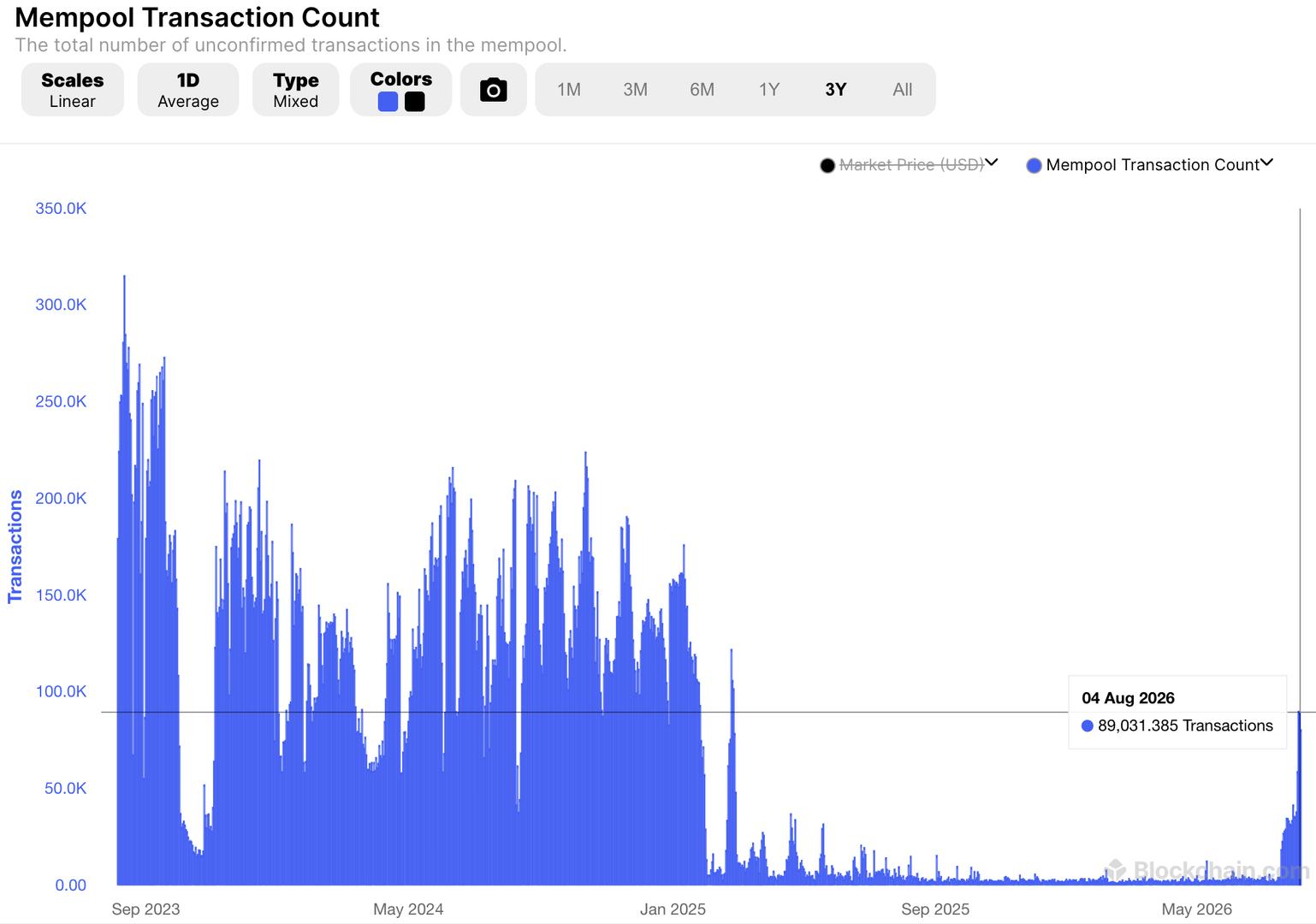
Bitcoin2026-08-05 11:20:58$120M Coldcard hack drives Bitcoin mempool activity to its highest level since February 2025A $120 million hack targeting hardware wallet maker Coldcard, which began on July 30 and was still unfolding as of Aug. 5, has become a fresh driver of Bitcoin network activity, according to CoinDesk’s Daybook. The incident has reopened debate over the safety of direct self-custody in hardware wallets, a practice that gained traction after the 2022 collapse of FTX. At the same time, it has pushed holders to move coins between exchanges and multiple wallets, lifting on-chain metrics. Blockchain.com data cited by CoinDesk shows the number of Bitcoin transactions waiting in the mempool rose to 89,031 on Tuesday, the highest reading since February 2025. Santiment data points in the same direction: active addresses climbed to a three-month high of 712,000, while whale transactions reached a five-month high of 61,800. Despite the pickup in network activity, bitcoin has remained stuck in a recent $62,000-$65,000 range, with the article listing BTC at $64,055.06. Analysts highlighted two immediate market watchpoints: the path of the CLARITY Act in the U.S. Senate and the level of the U.S. 10-year real Treasury yield. Marex said the Senate has a three-day window before its Aug. 10 recess and that implied odds of passage by year-end have dropped to 23% from about 75% in mid-May. Bitfinex said bitcoin’s bullish macro case could break down if the 10-year real yield rises above 2.5%.1840
MARA2026-08-03 16:53:00MARA opens Slipstream as a permissionless public service without client softwareMARA’s Bitcoin transaction relay service, Slipstream, is now available as a permissionless public service and no longer requires client software, according to a post from Bitcoin News on X cited by Odaily. The change matters in particular for users moving funds out of vulnerable COLDCARD wallets. In those cases, a multisig spend can reveal all public keys and spending conditions. If that transaction reaches the public mempool, an attacker can immediately compare the exposed keys against a precomputed database of weak COLDCARD private keys and, if a majority of keys is under control, broadcast a higher-fee double-spend before the original transaction confirms. Slipstream is designed to avoid that path by sending transactions directly to miners so they do not enter the public mempool before being mined. MARA also advised users to choose conservative fees to reduce the risk of transactions getting stuck. The service is currently free aside from standard Bitcoin network fees.1960
Bitcoin2026-08-03 04:32:48Solo Bitcoin miner lands block 960804 and earns 3.157 BTCA solo Bitcoin miner successfully mined block 960804 at 10:11:00 on Aug. 3, according to mempool data cited by BlockBeats. The miner collected a total block reward of 3.157 BTC. Based on the figures in the report, that payout was worth about $199,300 at the time of publication. The update was published as a brief market report by BlockBeats.1700