
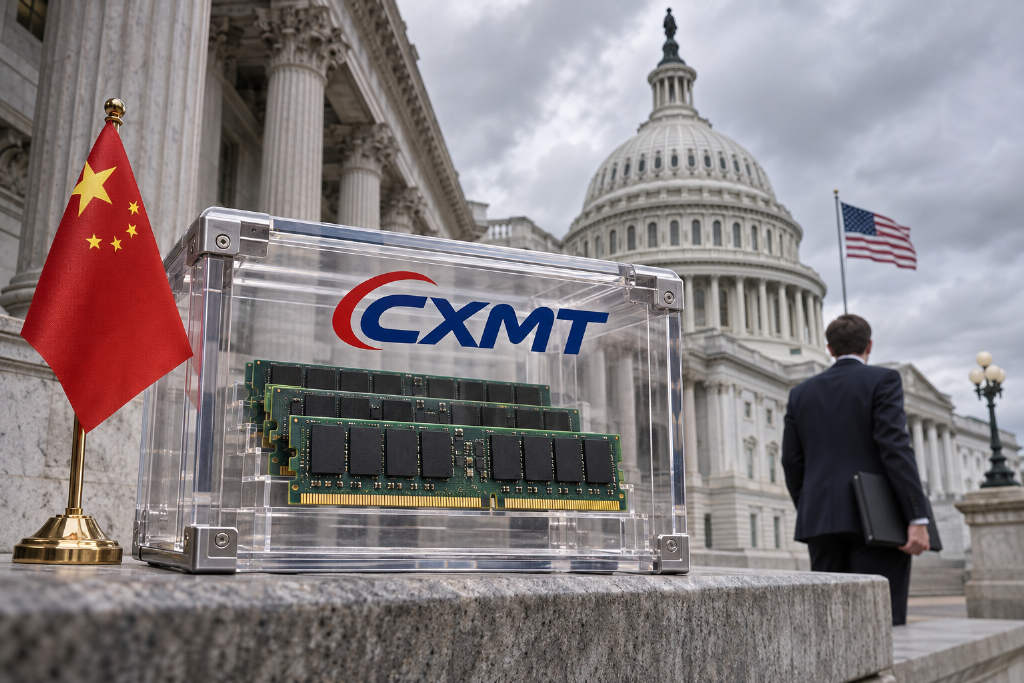
Republican Senator Tom Cotton has asked Commerce Secretary Howard Lutnick to put Chinese memory-chip maker ChangXin Memory Technologies (CXMT) on the US Commerce Department’s Entity List and examine a ban on sales of its products in the United States.
In a November 12 letter, Cotton called for cutting off CXMT’s access to US technology and semiconductor equipment. He described the company as one of China’s national memory-chip leaders and said it posed 「a growing risk to our economic prosperity and military advantage」. The United States, he wrote, must stop CXMT from gaining a firmer foothold in the global market.
Cotton had just been reelected chair of the Senate Republican Conference on November 10.
Two requests for the Commerce Department
Cotton asked the department to add CXMT to the Entity List and prohibit it from receiving US technology and technical support. His request covers semiconductor manufacturing equipment and tools needed by the company’s chip factories.
He also asked the department to use the authority of its Information and Communications Technology and Services (ICTS) office to examine a ban on US sales of CXMT products, particularly where technology from the United States and its allies is available.
The letter listed steps already taken against CXMT. The War Department placed the company on the Section 1260H list of Chinese military companies. The Commerce Department’s Bureau of Industry and Security (BIS) has used end-use controls to restrict exports of several advanced technologies to some CXMT factories. Congress also limited continued government purchases of CXMT products in the fiscal 2023 National Defense Authorization Act.
DRAM share rises as CXMT pursues HBM3E
CNBC cited research firm Counterpoint’s figures showing that CXMT is the world’s fourth-largest maker of dynamic random-access memory (DRAM). Its share of DRAM revenue rose from 4% in the second quarter of 2025 to 10% in the second quarter of 2026.
CXMT listed in China in July. Its shares surged, and it was briefly the country’s most valuable listed company.
Cotton said in his letter that CXMT is about to begin producing HBM3E high-bandwidth memory, though its performance trails that of competitors and its yield is only about 20%. CNBC cited a Reuters report putting the yield between 20% and 30%.
High-bandwidth memory (HBM) is used in artificial intelligence (AI) chips from Nvidia, Google and Amazon. Samsung, SK hynix and Micron currently account for most production. ABMedia previously reported on the yield and performance challenges CXMT faces as it pushes toward mass production of HBM3E.
Cotton wrote that the company’s decision to proceed despite unfavorable conditions 「highlights China’s urgent demand for chips and its manufacturing difficulties without advanced equipment and technology」.
Brookings researcher on the effect of a listing
Kyle Chan, a Brookings Institution researcher who studies Chinese technology development, told CNBC that an Entity List designation 「basically means US companies cannot do business with the company, and the company cannot obtain US technology」.
Although CXMT is already on the Section 1260H list, Chan said that list places few substantive restrictions on dealings between US companies and the Chinese firms named on it.
CNBC noted that The Wall Street Journal reported on August 9 that Apple had considered using CXMT memory in iPhones and Macs as AI-driven demand contributed to a memory shortage. An Entity List designation could change those plans.
Chan said the US government is concerned that even buying CXMT products as a customer would help the company expand its capacity, 「or even help China go further in HBM」. The Commerce Department and CXMT did not immediately respond to CNBC’s requests for comment.



