
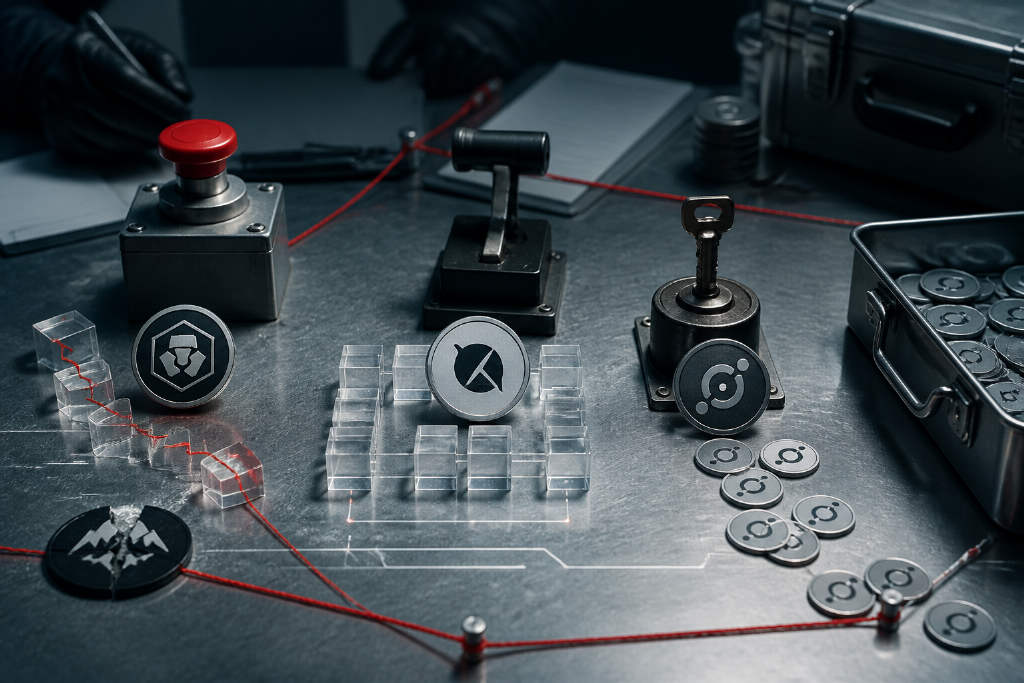
Three blockchain networks — Cronos, Ontology, and ICON — stopped producing blocks within four days. Each incident exposed a different layer of emergency authority: who can order a shutdown, whether confirmed state can be rewritten, and how much control remains once assets move across chains or into centralized custody.
The three networks did not use the same playbook. Cronos shut down after the Tectonic exploit and restored the chain to a state before the attack. Ontology paused block production before it had confirmed malicious activity, then later said no user assets were harmed. ICON first suspended the affected contract and later halted the full network, but the foundation said most of the stolen ICX had already been transferred into exchange custody by then.
Cronos: from network halt to rewritten chain state
Cronos described its response as a “validator consensus emergency action.” In a restart notice dated Aug. 31, the network said block production resumed at 23:49:01 UTC on Aug. 30 from block height 90,896,189, with chain state restored to a point before the Tectonic exploit took place.
That was more than a halt. It was a state rewrite. Every transaction and state change after the recovery point, whether related to the exploit or not, ceased to exist on the restarted canonical chain. Normal activity during that interval was erased alongside the exploit-linked state.
The restart notice did not include a transaction list, validator counts, voting-weight thresholds, or the identities of participating validators. Cronos said it would publish a post-incident report explaining the response process and the technical scope of the intervention.
Even the amount of value actually protected remains unsettled. TRM Labs estimated that roughly $75 million was borrowed after TONIC token prices were manipulated, with about $6 million flowing to Ethereum and about $68.7 million rolled back on Cronos. Bitquery published a higher outbound figure, saying about $8.3 million moved to Ethereum and that 10,961 blocks were discarded.
The two estimates measure different things, and Tectonic has not yet published final loss figures. One point is already clear: Cronos could only restore state that remained within its own chain environment. Assets that had already reached Ethereum were outside its control.
Tectonic’s asset-handling plan also leaves open accounting questions for users. The protocol said it would prioritize withdrawals and loan repayments while pausing deposits and new borrowing. That gives users a route to exit positions and reduce leverage, but the protocol has not confirmed whether liquidity providers will be able to redeem in full. Its pending post-mortem still needs to address the exploit mechanism, total outflows, bad debt, recovered assets, and any remaining liabilities.
Infrastructure recovery also did not move in lockstep with chain restart. Cronos said protocols, bridges, block explorers, and RPC services would need more time to recover. Alchemy logged the outage and restoration separately on its status page. A chain can declare itself live again while the services built on top of it are still catching up.
Ontology: downtime to buy time, not to reverse transactions
Ontology took a different route. The network said its core development team found a potential security risk during routine inspection and immediately paused block production, handing the matter to the technical team and validators for a full review. At that point, malicious activity had not yet been confirmed.
In an update on Sept. 1, Ontology said the review confirmed malicious attack activity and that the mainnet would remain halted while the team carried out a fix and network upgrade. The same notice said no user assets had been affected.
Unlike Cronos, Ontology did not roll back chain state. The halt preserved all previously confirmed state and only stopped the confirmation and settlement of new transactions. The notice did not define a recovery point and did not identify any set of transactions to be invalidated.
What Ontology disclosed about decision-making authority was incomplete. The notice said the core development team, technical team, and validators were involved, but it did not say who held final binding authority or what numerical threshold would trigger an emergency action. Ontology’s VBFT documentation describes standard consensus operations, including block confirmation and management-contract updates to the validator set, but it does not cover the emergency pause rule used on Aug. 31.
Even without asset losses, downtime carries a real cost. Ontology told users that on-chain transactions could not be processed during the halt and advised against time-sensitive operations. Restoration would depend on patching, upgrades, and testing. For users, the immediate risk was service interruption and the inability to move positions or settle transfers, not a booked asset loss or a chain rollback.
Ontology said it was aiming to restore normal operations within 24 hours, provided that security checks, patching, upgrades, and tests were completed successfully. It did not say who would determine that those conditions had been met or what threshold would trigger the restart. That leaves governance questions unresolved: the parties involved in the review are named, but the party with final restart authority is not.
ICON: by the time the chain stopped, most assets were already outside chain control
ICON offers the clearest timeline from alert to response to loss of chain-side control.
According to the foundation’s post-incident review, an attacker replayed two historically valid signed withdrawal messages 1,492 times between 02:01:02 and 02:21:12 UTC on Aug. 27. Because of a precision flaw, 1,490 of those calls succeeded, moving 119.866 million ICX and 531,600 bnUSD out of the foundation asset pool.
The monitoring system triggered an alert at 02:08, but technical staff only began investigating later. The affected contract was paused at 03:53. Exchanges then began suspending ICX deposits and withdrawals at 05:54, and the full network halt took effect at 06:18:54. ICON restarted around 07:51 on Aug. 28, roughly 25 hours later, with the underlying flaw patched.
The foundation said in its review that the main failure was incident response, not detection. The alert fired within seven minutes, but this category of alert was often mixed in with unrelated RPC anomalies, and the system did not notify on-call staff. Technical investigation only began around 03:40, shortly before the contract was suspended.
By the time the network was halted, most of the affected ICX had already entered exchange custody. At that stage, on-chain controls could no longer stop exchanges from moving or converting the assets they held. The foundation was left relying on exchange freezes, preservation notices, lawyers, and law enforcement.
Custody boundaries also determined who bore the loss. ICON said all affected assets belonged to the foundation, while ordinary users’ deposits, balances, and positions were untouched. The review said 531,600 bnUSD and 1.366 million SODA had been fully recovered. Of 113,634 USDC that had been borrowed out, 82,430 had been recovered. Confirmed net losses stood at about 150.2 ETH plus 31,204 USDC. Most of the ICX involved had only been frozen or tracked at exchanges, not fully recovered.
ICON’s control structure also differed from the other two cases. The review said the network was under foundation control during the token migration period. Migration guidance documents said consensus was operating in maintenance mode with only seven core nodes. The shutdown therefore relied on a special operating structure explicitly controlled by the foundation.
What the three incidents actually show
Set side by side, the three shutdowns do not point to one single kind of risk. They show three different places where risk can end up.
- Cronos rewrote canonical chain history. That protected assets still within chain jurisdiction, but it also invalidated unrelated activity after the checkpoint and could do nothing for funds already on Ethereum.
- Ontology converted risk into time costs and service unavailability. Transactions could not settle during the halt, but there was no confirmed user asset loss and no reversal of settled history.
- ICON isolated the contract and then the network only after assets had moved outside chain custody. Confirmed losses were assigned to the foundation, while any recovery of frozen ICX depended on exchanges, legal procedures, and law enforcement.
As outlined in the source comparison, Cronos shut down after the Tectonic exploit and restored chain state, but did not disclose vote counts or threshold details in the restart notice; Ontology paused block production preventively and did not roll back state, though it also did not disclose the emergency trigger threshold; ICON paused the migration contract first and then halted the network, with the foundation controlling the chain during migration and carrying the losses, while any recovery of ICX held at exchanges depended on custodians, legal process, and enforcement agencies.
That is why a single decentralization score says little about what users actually face in an emergency. The more practical questions are whether emergency rules are public, what threshold triggers them, whether the intervention only stops new blocks or rewrites confirmed state, who controls assets once they leave the chain’s domain, and who commits to absorb the residual loss.
Cronos and Tectonic still have fuller post-incident reports to publish. Ontology still needs to disclose the attack details, the emergency authorization rule, and whether the conditions for upgrade and restart have been satisfied. The sharper comparison is not abstract decentralization. It is the risk boundary each network draws: which history can be changed, which time window can be frozen, and which funds stop being recoverable once they leave chain-side control.
