ICON

Cronos
2026-09-02 07:33:39

Three chain shutdowns in four days show the hard limits of on-chain emergency powers

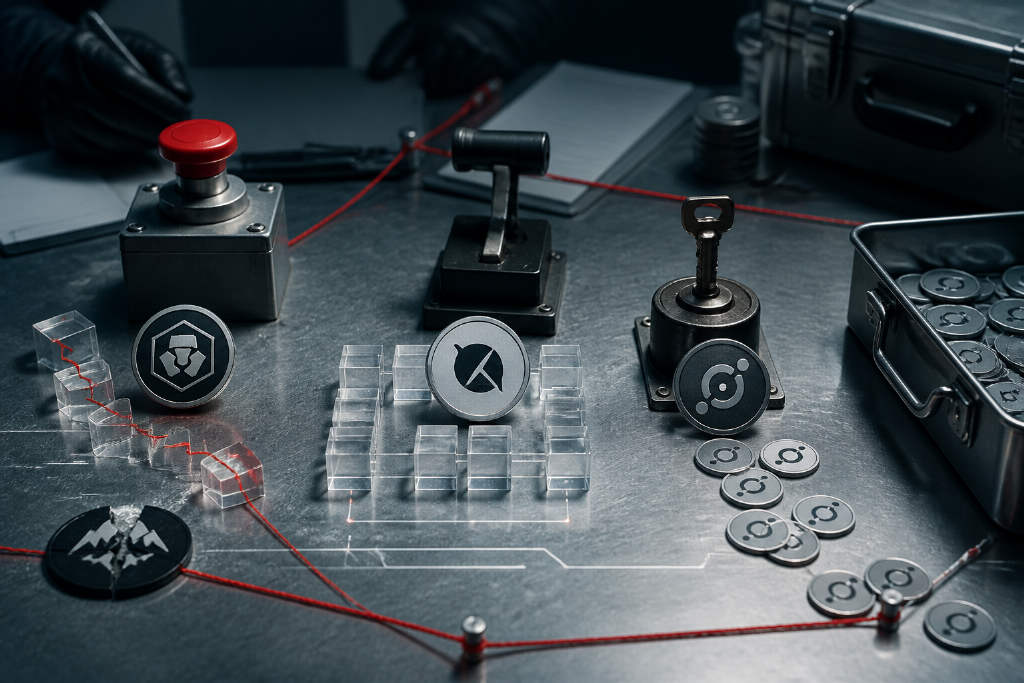
Three public blockchains halted block production within four days, but the emergency powers used in each case were not the same. Cronos responded to the Tectonic exploit by restoring the network to a pre-attack state and resuming from block height 90,896,189, effectively voiding all transactions and state changes after that checkpoint. Ontology took a preventive route, pausing block production before confirming malicious activity and later saying no user assets were lost. ICON suspended the affected contract first and then shut down the network, but by that point the foundation said most of the stolen ICX had already moved into exchange custody. Taken together, the three incidents show that a chain halt is only the first layer of control. The more important questions are who can trigger an emergency response, whether confirmed chain history can be rewritten, and what happens once funds move across chains or into centralized custodians. In Cronos’ case, rollback power only applied to assets that remained on-chain. In ICON’s case, on-chain controls arrived after the assets had largely left the chain’s sphere of control. Ontology, by contrast, used downtime to buy time for inspection, patching, and testing rather than to reverse settled transactions.

40
Three chain shutdowns in four days show the hard limits of on-chain emergency powers
Cronos
2026-09-02 07:17:09

Cronos, Ontology and ICON took three very different paths in emergency shutdowns

Three blockchain networks — Cronos, Ontology and ICON — halted block production within four days, but their emergency responses exposed sharply different governance powers and recovery limits. Cronos rolled its chain state back to before the Tectonic exploit and resumed production from block 90,896,189, wiping out all transactions and state changes after that checkpoint. Ontology paused block production before confirming malicious activity, kept confirmed state intact, and said no user assets were lost. ICON, by contrast, halted contracts and then the network only after most of the affected ICX had already moved into exchange custody, leaving recovery dependent on custodians, legal action and law enforcement. The three cases point to the same fault line: who can stop a network, whether confirmed state can be rewritten, and what happens once funds move across chains or into centralized custody. For users, the key distinction is not simply whether a chain stopped, but where each network drew the boundary of controllable loss.

30
Cronos, Ontology and ICON took three very different paths in emergency shutdowns
Policy Regula
2026-09-02 05:18:09

Stocks and bonds fell together on the first trading day of September as 30-year Treasury yields climbed back above pre-intervention levels

Wall Street opened September with a broad risk-off move as escalating Middle East tensions, a sharp jump in oil prices and another selloff in long-dated government bonds hit multiple asset classes at once. U.S. equities closed lower across the board, with the Dow Jones Industrial Average down 0.79%, the S&P 500 off 0.71% and the Nasdaq Composite falling 1.03%, while the VIX rose 9.52% to 16.34. In commodities, October WTI crude settled up 5.20% at $90.22 a barrel and Brent gained 4.6% to $94.65, with diesel prices surging even more sharply. Treasury yields also pushed higher, led by the 30-year yield, which touched 5.29%, its highest level since the Aug. 19 bond-market intervention cited in the report. The move in rates weighed heavily on long-duration assets, including software, semiconductors and AI-related shares, while energy stocks outperformed. Markets are now looking ahead to U.S. oil inventory data, the Federal Reserve’s Beige Book, Broadcom earnings and Tesla’s Cybercab event for the next catalysts.

110
Stocks and bonds fell together on the first trading day of September as 30-year Treasury yields climbed back above pre-intervention levels
Micron
2026-09-02 02:51:42

Micron says it will pay record performance bonuses as Taiwan union prepares strike

Micron Technology is facing rising labor pressure in Taiwan as union members at its Taoyuan and Taichung plants prepare for a possible strike, with reported support from as many as 80% of employees. In response, the company said in a Sept. 1 statement that it will issue the highest performance bonus in its history this year, with details of its Incentive Pay Plan, or IPP, to be announced in October. The labor dispute comes as demand for DRAM and high-bandwidth memory, or HBM, keeps climbing on the back of AI infrastructure spending. The report said workers have complained that profit-sharing and bonus levels lag those offered by rivals including Samsung Electronics and SK Hynix. A day later, Micron CEO Sanjay Mehrotra appeared by pre-recorded video at SEMICON Taiwan 2026 and reiterated the company’s long-term commitment to the island. He said Micron Taiwan has grown from a small office 30 years ago into one of the company’s largest and most advanced manufacturing bases worldwide, employing more than 15,000 people and focusing on HBM research and production. Mehrotra also said Micron will keep building the memory capacity the world needs in Taiwan.

20
Micron says it will pay record performance bonuses as Taiwan union prepares strike
Samsung Elect
2026-09-01 09:22:21

Samsung unveils CUBE 3D memory roadmap with HBM5, zHBM and zNAND-O for AI systems

Samsung Electronics used the Memory Executive Summit ahead of SEMICON Taiwan 2026 to lay out a new memory strategy called CUBE, built around a 3D vertical stacking approach. Choi Jang-seok, a vice president in the company’s memory product planning division, said the plan is meant to address rising AI demand for capacity, bandwidth and power efficiency. CUBE stands for Capacity, Utilization, Bandwidth and Efficiency, and Samsung framed it as a way to move past printed circuit board size limits by stacking chips vertically. The company also detailed a three-part roadmap covering HBM5, zHBM and zNAND-O. Samsung said HBM5 is being developed with targets of 2x the performance of HBM4E, a 20% gain in performance per watt and a 20% reduction in thermal resistance. zHBM, first shown last month at FMS 2026 in California, would place HBM directly on top of logic processors such as GPUs or CPUs. Samsung said that design aims for 8x the performance of HBM4E, up to 3x performance per watt and a 75% to 90% drop in thermal resistance. zNAND-O, aimed at large language model storage needs, is designed to stack four or eight layers of V-NAND with TSV and is scheduled to begin sampling in 2028.

20
Samsung unveils CUBE 3D memory roadmap with HBM5, zHBM and zNAND-O for AI systems
Policy and Re
2026-09-01 05:00:00

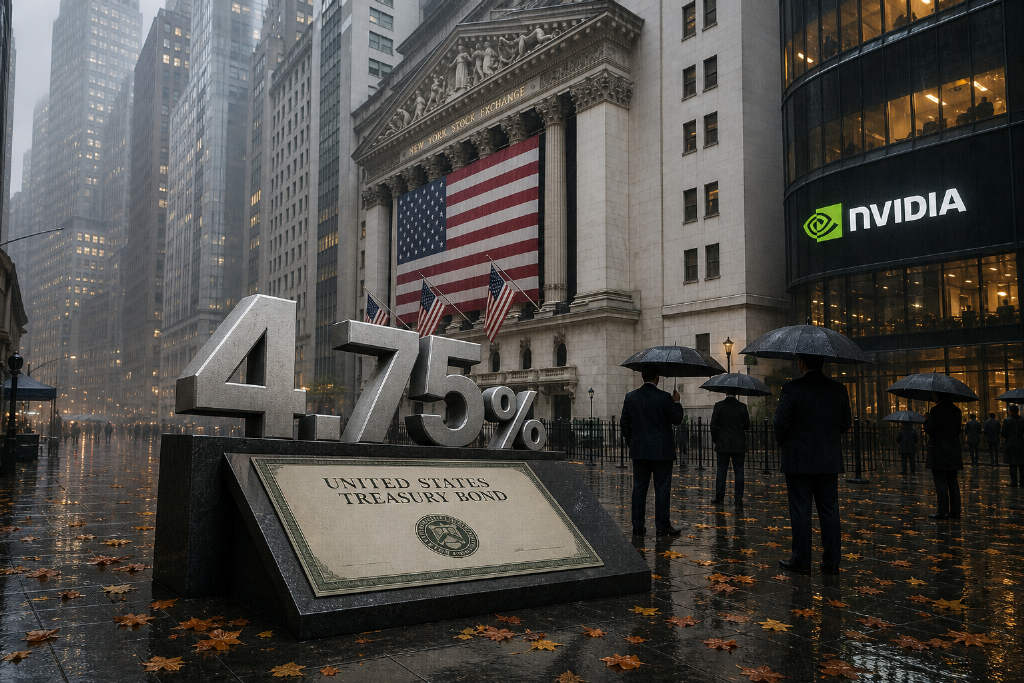
Treasury yields break past 4.75% as September seasonality meets the AI compute trade

U.S. stocks closed lower Monday as investors weighed renewed Middle East tension, rising oil prices and a fresh jump in Treasury yields, with the 10-year yield climbing past the closely watched 4.75% level. The Dow Jones Industrial Average fell 0.70%, the S&P 500 dropped 0.33%, and the Nasdaq Composite lost 0.12%, even though all three major indexes still posted gains for August. According to PANews, Wall Street is turning more cautious heading into what has historically been the weakest month for the S&P 500 over the past 30 years, with an average decline of 0.8% in September. JPMorgan lowered its equity stance from bullish to “tactically cautious/neutral,” while Dakota Wealth Management and Franklin Templeton flagged 4.75% and 5% on the 10-year Treasury as key thresholds for risk assets. At the same time, the AI infrastructure trade remained active. Anthropic signed a $35 billion cloud computing agreement with Nvidia-backed Lambda, with data centers built by Hut 8 and leases held by Nvidia. Nvidia also announced a $3.5 billion convertible bond investment in MediaTek to jointly build AI factories. Storage, semiconductor and crypto-related stocks outperformed, while utilities sold off sharply and large-cap tech names turned mixed as higher rates pressured long-duration valuations.

80
Treasury yields break past 4.75% as September seasonality meets the AI compute trade
AMEC
2026-08-31 12:11:14

AMEC’s rise in etching tools puts China chip equipment makers under a brighter global spotlight

A long-form report carried by MarsBit and credited to WeChat account HSTL8888 traces how Advanced Micro-Fabrication Equipment Inc. China, or AMEC, moved from a startup backed by local government funding in Shanghai to a supplier validated by Taiwan Semiconductor Manufacturing Co. The piece opens with a Reuters report from early August saying Samsung Electronics and SK Hynix were evaluating AMEC chipmaking tools for use in their fabs in China, and that testing of the company’s etching tools may have started about two years ago. Samsung later denied it had ever considered the move, while SK Hynix declined to comment. The report then broadens into a history of China’s semiconductor equipment industry, covering AMEC, Piotech-related deposition efforts, Hwatsing for CMP, Skyverse for wafer inspection, ACM Research Shanghai for cleaning tools, and NAURA as a platform-style equipment company built through acquisitions. It argues that tightening U.S. export controls, support from domestic fabs such as Semiconductor Manufacturing International Corp. and funding through the National Integrated Circuit Industry Investment Fund together accelerated localization. Citing industry and official figures, the article says China’s overall localization rate in semiconductor equipment rose from under 5% to about 20% by 2025, while major foundries kept capacity utilization above 90% in the first seven months of this year.

60
AMEC’s rise in etching tools puts China chip equipment makers under a brighter global spotlight
Bitcoin
2026-08-31 09:43:13

Bitcoin stalls below its 50-week average as traders weigh September pullback risk

Bitcoin held near $78,000 during the Asian session on the last trading day of August even as macro pressure built, with oil prices rising on an escalation in the Iran situation and hawkish remarks from Waller reviving bets on a September rate hike. From its roughly $62,900 close at the end of July, BTC was still up more than 24%, but attention has shifted to the 50-week moving average near $81,000, a level that has historically marked either the end of a bear market or the point where rallies failed and rolled over. Traders cited $76,800 to $77,000 as key support, with downside targets around $75,500 and $74,300 if that band breaks. Resistance is clustered at $78,400, $79,400 to $80,800, while a move back above $82,000 to $83,000 is seen as necessary to reopen upside. Several market commentators flagged historical seasonality and technical signals as reasons for caution in September, while others argued Bitcoin may already be in a “soft bull market.” The report also tracked spot ETF inflows, token unlocks, U.S. equity moves, weakness in crypto-linked stocks and miners, and a packed macro and earnings calendar heading into early September.

100
Bitcoin stalls below its 50-week average as traders weigh September pullback risk