

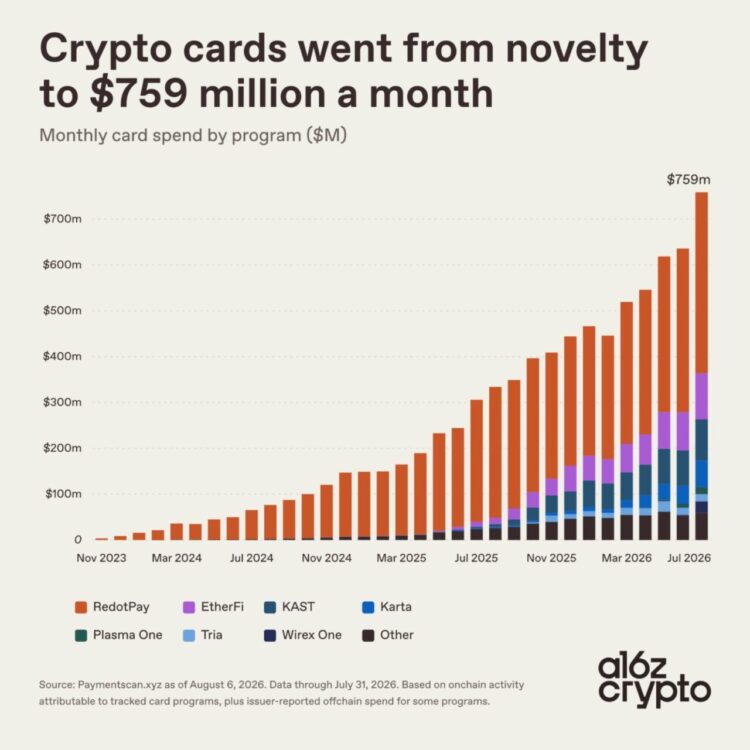
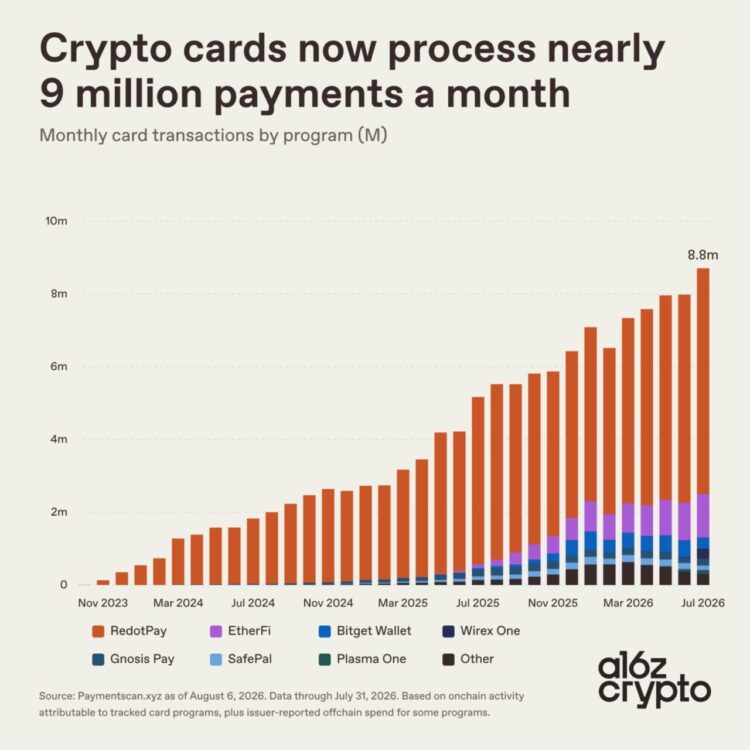
Crypto card spending in the Paymentscan-tracked market reached about $759 million in July, more than tripling from a year earlier, with monthly transaction count surpassing 10 million. The figures point to stablecoins moving beyond on-chain transfers and value storage into everyday payment use.
USDC and USDT made up more than 70% of July spending
Paymentscan data cited in the report showed USDC accounted for about 50.8% of crypto card spending in July, while USDT represented 20.3%. Combined, the two dollar stablecoins made up more than 70% of the total.
A year earlier, their shares were about 48% for USDC and 7% for USDT, indicating that dollar-backed stablecoins are taking a larger role in the crypto card market.
Use cases are shifting toward routine consumer spending
The report said spending is no longer centered only on turning crypto holdings into usable cash. More of it is now showing up in daily purchases.
In Brazil, Oobit active users average about 20 transactions per month and spend around $400, with grocery stores accounting for roughly 35% of regional transaction activity. In Argentina, 72% of Oobit payments use USDT, and food purchases account for about 41% of transaction volume.
Binance has also seen continued growth in crypto card users in Brazil, with ride-hailing, food delivery, groceries, restaurants and online subscriptions listed as major spending categories.
Visa says more than 160 stablecoin-linked card programs are live or in development
For now, most stablecoin payment growth still relies on existing credit and debit card rails. Crypto cards usually convert stablecoins or other digital assets into local fiat at checkout, while merchants receive payment through established networks and keep using their current acceptance infrastructure.
Visa said in June that more than 160 stablecoin-linked card programs were already operating or under development worldwide.
StraitsX, which works with Visa to help crypto companies issue payment cards, said transaction volume across related infrastructure rose about 40x from the fourth quarter of 2024 to the fourth quarter of 2025.
StraitsX data also showed that from March 2025 to February 2026, total crypto card transaction value in low-GDP markets grew about 600%, compared with roughly 150% in high-GDP markets over the same period. Food and retail were the leading spending categories.
Volume remains concentrated among a few providers
Paymentscan said RedotPay handled about $395 million in July transactions, EtherFi about $100 million, and KAST about $89.6 million. Together, the three accounted for about 77% of tracked transaction volume.
The report added that some of the data comes from company self-reporting, so the broader market size still needs to be assessed alongside figures from more payment platforms.
AI agents are opening a second market for stablecoin payments
Another payments market is taking shape between AI agents. These agents can search for information, call APIs, use compute resources and buy digital services on their own, tasks that often involve very small but highly frequent machine-to-machine payments.
Coinbase's x402 protocol is one example highlighted in the report. It uses the web standard "402 Payment Required" so an AI agent can receive a quote, pay directly, and access the requested data or service after payment verification. The process can be completed by software without creating a conventional account or manually entering card details.
Coinbase said x402 has processed more than 165 million payments with total volume of about $50 million. Coinbase AI product lead Lincoln Murr estimated that about 99% of those payments used USDC. Based on the public figures cited, average payment size comes to roughly $0.3, with most usage tied to APIs, data, AI inference, compute resources and online tools.
The report noted that x402 is still far smaller than traditional payment networks. In July this year, x402 processed about $24 million over 30 days, roughly equal to one minute of Visa transaction volume. Even so, this machine-to-machine category gives stablecoins access to a market that conventional card rails are less suited to handle.
Visa, Mastercard, Circle, Cloudflare and MoonPay are all building for agent payments
Demand from AI agents is drawing in both crypto-native and traditional finance companies. The report said stablecoins are well suited to API calls and data purchases worth only a few cents because they can operate around the clock, move globally and support low-value transfers.
Traditional card payments usually involve merchant acquiring costs of about 2% to 4%. Once fixed processing fees are added, transactions below $1 become harder to support under a workable business model.
Circle is testing USDC Nanopayments, which batch many small payments before settling them on-chain. Cloudflare has launched Wallets and cloudflare.pay, allowing users to set budgets, approve merchants and cap per-transaction spending for AI agents. MoonPay's PayBox links credit cards and crypto wallets so AI agents can pay through x402 or Visa rails depending on the use case.
Large payment companies are also building their own frameworks. Mastercard has introduced Agent Pay for Machines, which lets users predefine what an agent can buy, how much it can spend and where it can transact. Visa is testing with financial institutions how AI agents can use existing credit and debit cards for shopping and travel purchases.
The report said the two payment models are developing along different lines. Stablecoins fit high-frequency, low-value transactions involving APIs, data, compute and AI inference, while card networks retain advantages in larger purchases, refunds, dispute handling and access to credit.
From groceries, ride-hailing and subscription services paid with crypto cards to AI agents using USDC to buy digital resources on their own, the range of stablecoin payment use cases is extending across both consumer spending and machine commerce.