
Funding activity slows, but capital still flows into trading and AI infrastructure
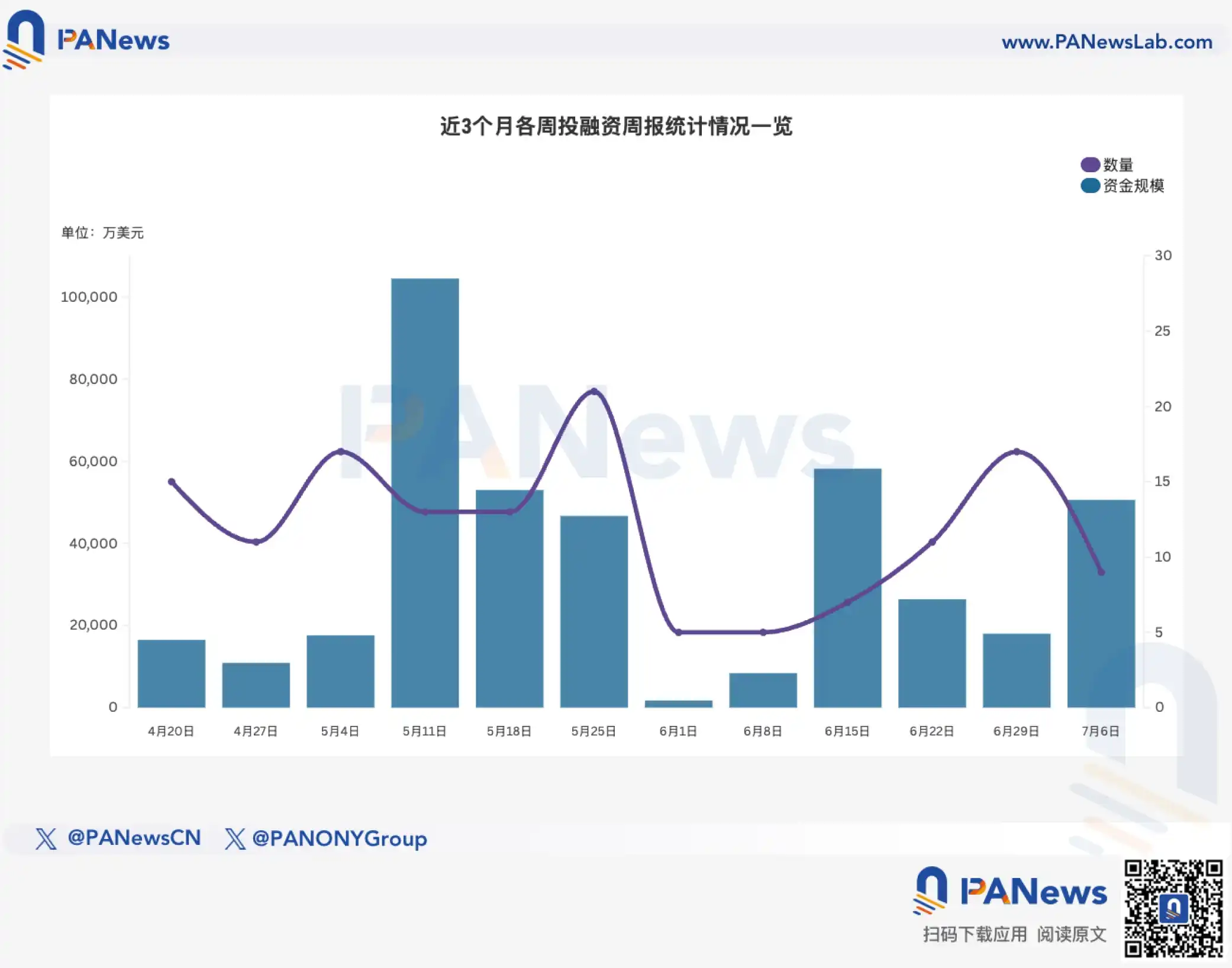
Global blockchain funding activity cooled somewhat last week, but capital continued to concentrate around on-chain trading infrastructure and Web3-AI projects. According to a partial tally referenced in the report, the market recorded nine disclosed financing or investment events between June 29 and July 5, with total announced funding exceeding $506 million. DeFi and Web3+AI each accounted for three transactions, while prediction markets, centralized finance, and other categories each logged one event.
The largest named venture round was Venice AI’s $65 million Series A, which valued the company at $1 billion post-money. By sheer capital raised, however, one of the biggest transactions of the week was Ionic Digital’s roughly $400 million private placement ahead of a planned Nasdaq debut. Together, the week’s deals showed that investors are still backing infrastructure tied to derivatives, tokenized assets, AI compute, and new forms of market data, even as overall first-market momentum appears softer than in prior weeks.
DeFi: Extended, Techdollar, and Arcus highlight trading and credit themes
In DeFi, the report highlighted three transactions. On-chain perpetual exchange Extended completed a $12.5 million strategic financing led by digital broker eToro, with Jump Crypto and Alber Blanc also participating. eToro said it plans to integrate Extended’s perpetual trading engine directly into Zengo, the self-custodial wallet it acquired earlier for $70 million. The move is designed to let users trade on-chain derivatives while keeping control of their own assets, and it may serve as a bridge for broader DeFi products to enter eToro’s core offering.
Extended is led by former Revolut crypto executive Ruslan Fakhrutdinov. As of June, the platform had processed more than $245 billion in volume, supported over 100 perpetual markets, and outlined plans to expand into spot trading, tokenized real-world assets, and multi-asset collateral. The strategic investment suggests eToro is moving beyond passive wallet ownership and pushing deeper into integrated self-custody plus trading infrastructure.
Blockchain-based private credit platform Techdollar also raised capital, closing a $3 million Pre-Seed round from NoLimit Holdings, Reforge VC, and angel investors including Newmichwill, RoyLearner, and Ansem. The company aims to let founders, employees, venture investors, and family offices borrow against equity in private technology companies instead of selling those holdings outright.
According to the project description, Techdollar uses a stablecoin-like issuance structure and plugs into on-chain liquidity infrastructure to speed up capital access, while still preserving off-chain private custody and compliant underwriting processes. That positioning places it between traditional private credit and crypto-native issuance mechanics, with a focus on unlocking liquidity from otherwise illiquid venture-backed equity stakes.
The third DeFi-related development came from Arcus, a decentralized exchange developed by the dYdX team. Arcus officially launched on Robinhood Chain and also received backing from Robinhood Crypto. The platform now offers 24/7 trading in 95 tokenized stocks and perpetual contracts with zero fees. It supports tokenized exposure to equities, commodities, indices, and crypto assets, while the tokenized stocks are issued on Robinhood Chain, redeemable, self-custodied, and designed to interoperate with DeFi rails.
Arcus said it plans to allow tokenized stocks and crypto assets to be used as collateral for perpetual trading in the future, and it also intends to offer Pre-IPO trading in popular private companies such as OpenAI. That roadmap underscores a wider trend: tokenized securities and derivatives are increasingly being packaged as always-on, self-custodied trading products inside new chain-based financial stacks.
Web3+AI: Venice AI posts the week’s marquee venture round
Web3 and AI also produced three transactions. The standout was Venice AI, which announced a $65 million Series A led by Dragonfly, with Coinbase Ventures and others participating. The round valued the privacy-first AI platform at $1 billion post-money. Founded two years ago, Venice AI provides access to more than 200 open and closed models and markets itself around “uncensored” usage, client-side encryption, and a no-data-retention model.
The company disclosed several operating metrics that help explain investor interest. Venice AI said it now has more than 3 million monthly active users, handles around 1.7 million API calls per day, generates annualized revenue of more than $70 million, and is already profitable. Management said the new capital will be used to purchase GPUs and build proprietary data centers, reducing reliance on rented compute and potentially improving gross margins. That funding plan reflects a familiar AI-market dynamic: model access may scale quickly, but compute ownership increasingly shapes unit economics.
Another Web3-AI transaction came from THEA, a predictive behavioral AI network focused on risk markets. The company raised $8 million to build its Solana-based coordination layer and expand AI infrastructure. The round was led by Maven11 Capital, Spartan Group, ManifoldTrading, HackVC, and Fisher8 Capital. Founded in 2024 and headquartered in the Cayman Islands, THEA says its models are trained on more than 35 billion real-world decision data points and are built to deliver predictive behavioral intelligence for risk-oriented markets.
THEA plans to launch the THEA Network, a coordination layer that routes inference requests while settling transactions on Solana and keeping large-scale data processing off-chain. The company also intends to introduce a utility token that would tokenize access to its autonomous systems. The design mirrors a broader architecture pattern in crypto-AI: blockchains are increasingly used for settlement, access control, and coordination, while computation-heavy tasks remain off-chain.
Meanwhile, Solana ecosystem AI data marketplace Kled AI secured a $3 million investment from The Data Foundation, bringing its total funding to $14 million. Kled AI is building what it describes as a human data marketplace, where users contribute information by uploading files through consumer-facing apps. The platform says it has already gathered more than 12,000 structured datasets, spanning categories such as egocentric data, healthcare data, and urban travel data, which can then be purchased by AI labs and enterprises for model training.
Prediction markets and CeFi add smaller but notable deals
In prediction-market infrastructure, Adjacent completed a $2.5 million Pre-Seed round backed by Night Capital, VanEck, UFO Holdings, Maven11, and DCG. Adjacent positions itself as an independent third-party provider of event contracts and prediction-market indexes. It has already launched its U.S. election index products, RED and BLUE, and said it is moving quickly to expand into global elections, finance, and economics.
In centralized finance, Nasdaq-listed Lion Group Holding Ltd. proposed an investment of up to $12 million into Indonesian fintech company PT Nusantara Bumi Sangkara through Meili Capital Management Ltd. The transaction would be structured through the issuance of ordinary shares or equity-linked securities in exchange for a 10% indirect economic interest, with no cash payment involved.
PT Nusantara Bumi Sangkara is developing the Indonesian rupiah stablecoin NIDR, designed to be backed by reserves and pegged 1:1 to the rupiah. The stated goal is to lower cross-border payment costs and support blockchain-based financial services. According to the report, the company has already received regulatory approval or confirmation from Indonesia’s financial services authority, which could position it among the country’s first compliant stablecoin issuers. The deal points to continued institutional interest in local-currency stablecoin infrastructure across Southeast Asia.
Ionic Digital raises roughly $400 million; Sunscreen exits to Fhenix
Outside the venture-style rounds, Bitcoin mining company Ionic Digital completed a private placement worth roughly $400 million before a planned direct listing on Nasdaq under the ticker IOND. The financing was led by Attestor, Oaktree Capital Management, and Sachem Head Capital Management. Ionic sold about 7.55 million shares of Series A convertible preferred stock at $53 per share, and attached three tranches of warrants.
Each warrant tranche can be used to purchase roughly 1.01 million shares of Class A common stock, with exercise prices of $63.60, $74.20, and $87.45. The preferred stock will automatically convert into Class A common stock once Nasdaq listing or another qualified public trading event is completed. Investors also agreed that, for six months after listing, they would not transfer the preferred shares, the converted common stock, or related warrants and warrant shares at prices below $70 per share, except in limited circumstances.
The week also included an acquisition in privacy technology. Sunscreen, a privacy-computing project, said it is being acquired by Fhenix. Sunscreen said it spent the past four years focused on applied cryptography and believes the Fhenix team is better positioned to bring production-grade fully homomorphic encryption, or FHE, infrastructure to market. After the acquisition, the Sunscreen team will join Fhenix, and its codebase will continue to be made available under the AGPL open-source license.