

Artificial intelligence is turning into a measurable operating expense across the crypto industry, and the numbers now range from a few hundred dollars a month for individual workers to millions for the largest firms.
That shift sits at the center of a Foresight News report that draws on interviews with Bitget AI business lead Will, CertiK head of AI research Xue Yue, and a Foresight News developer known as Guangguang. Their daily routines point to the same change: work that once had to be done manually is being pushed to AI systems, while the authority to make the final call is becoming more concentrated.
Xue Yue said the first thing he does every morning is check whether the tasks he assigned to AI before going to sleep have finished running. On a busy day, he may have five or six AI agents working in parallel. Will, meanwhile, said he approved and checked an AI bill of more than $600,000 for Bitget last month, while also focusing much of his time on getting more than 2,000 employees to use AI tools more effectively.
From personal subscriptions to enterprise budgets
Over the past two years, spending on AI in crypto has moved from slogan to line item.
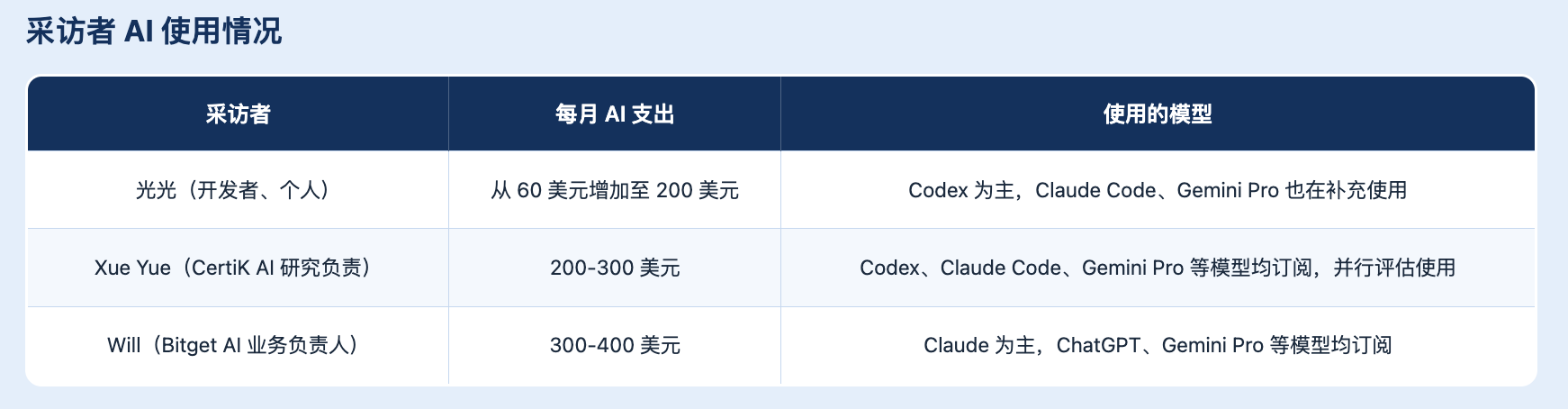
At the individual level, Guangguang, a front-line developer at Foresight News, said his AI bill went through an upgrade cycle. He initially subscribed to the basic versions of Codex, Claude Code and Google Gemini Pro at the same time, spending about $60 a month. After trying them more broadly, he narrowed that down to a professional-tier Codex subscription, bringing his monthly bill to about $200.
Xue Yue said he spends $200 to $300 a month on model subscriptions. Will put his own monthly outlay at $300 to $400.
All three figures sit in roughly the same $200-$400 range. The gap between a front-line developer and a manager with broader responsibilities is not large in dollar terms, but the structure is different. Developers tend to concentrate spending on one premium tool, while managers keep several subscriptions running at once so they can test, compare and evaluate them.
At the company level, the numbers move across several orders of magnitude.
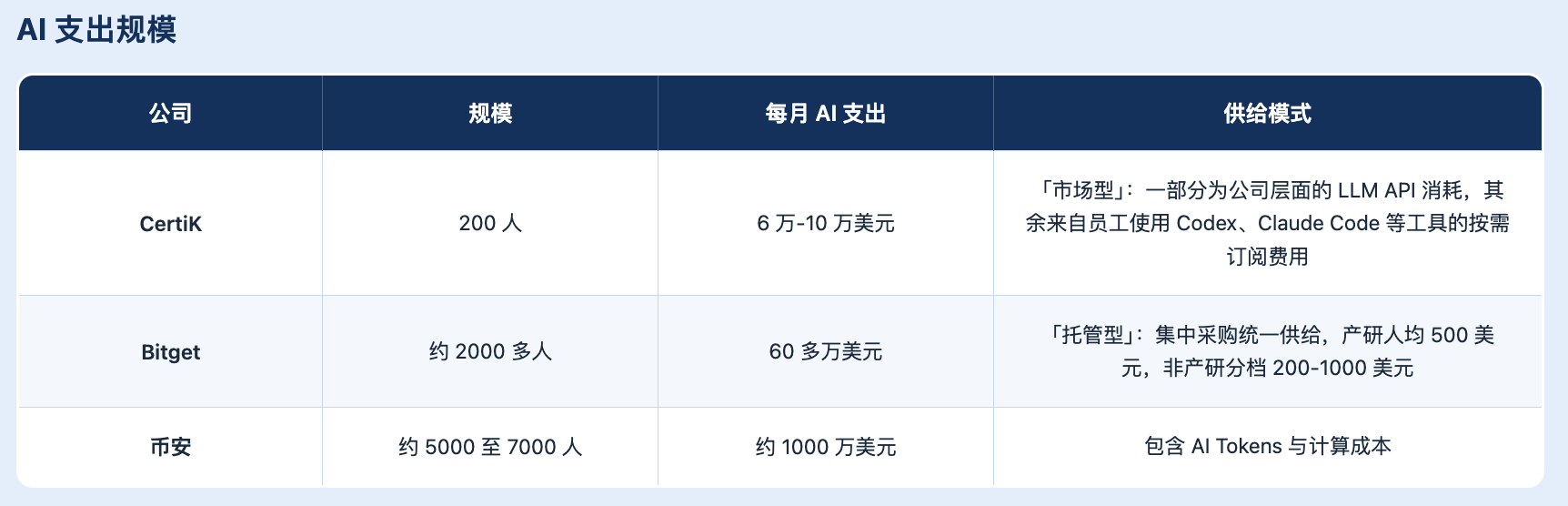
CertiK, a security company with about 200 employees, said its total monthly AI spending falls between $60,000 and $100,000. Part of that comes from LLM API usage tied to external services such as AI Auditor. Another part comes from on-demand employee subscriptions to tools such as Codex and Claude Code. The report describes this as a layered, flexible model.
Bitget, which has more than 2,000 employees, spent more than $600,000 on large models last month, according to Will, who said he personally approved the cost. On a per-person basis, that works out to around $500 for product and R&D staff, with non-product teams falling into brackets from $200 to $1,000. The model there is more centralized, with company-wide procurement and unified provisioning.
An OKX employee told Foresight News that the company has also equipped staff with enterprise versions of Claude and ChatGPT, though total spending was not disclosed.
Coinbase platform lead Rob Witoff said in a recent interview that 95% to 100% of the company’s code is now written or assisted by large language models, and that nearly all employees use AI every day. In February this year, that figure stood at 40%, meaning it has more than doubled in less than half a year. Coinbase did not disclose total spending.
For Binance, the figure cited in the report comes from founder Changpeng Zhao’s comments on the PBD Podcast in May. Zhao said he had heard that Binance was spending about $10 million a month on AI-related costs, mainly AI tokens and computing costs, but he also said the number had not been verified by him personally.
The report notes that the distance between a $200 personal AI bill and Binance’s reported $10 million monthly outlay is 160,000-fold. Two years ago, those numbers were not on the books. Now they are showing up every month like utilities.
Work cycles are shrinking, but not evenly
Once the money is spent, the next question is whether the gains are visible.
Inside Bitget, the clearest example is BG Agent, an internal AI system built by Will and his team. It went live on May 18, 2026. In less than two months, more than 800 employees were using it. Its purpose is simple: take workflows that used to require repeated manual handoffs across operations, product and marketing, and let agents handle them instead.
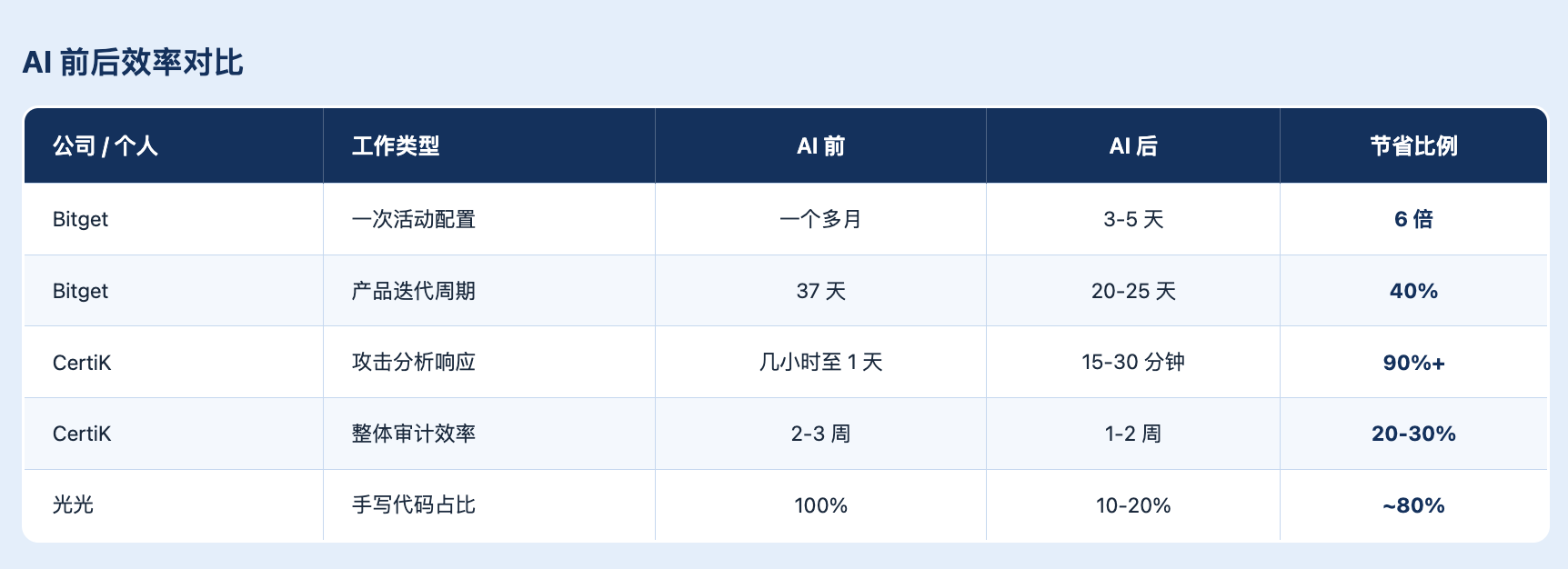
Bitget said its internal product iteration cycle has dropped from an average of 37 days last year to 20-25 days, with a target of less than 10 days. For operations teams, event configuration has moved even faster, falling from more than a month to three to five days, a sixfold improvement.
Will said a campaign used to take more than a month from the initial idea to launch. Competitive research, concept development, setup, translation into 23 languages, design, launch and data analysis all had to be stitched together manually.
After BG Agent went live, that stack compressed. Research agents can generate tables from a few prompts. Configuration automatically produces approval forms. Translation has dropped from seven days to one day, and in some cases to five minutes. Data analysis has gone from two weeks to two days.
The release schedule for AI-related products at major exchanges has also tightened. The report lists several examples from the first half of 2026. Binance launched AI Pro beta at the end of March, bringing agentic trading onto the main platform, then added 13 Agent Skills in April. In mid-May, Bitget said its AI trading ecosystem had surpassed 1 million users and that cumulative AI agent trading volume had reached $1.2 billion. On June 17, Bitget officially launched its AI strategy product Playbook. In early July, OKX took a different route and launched a marketplace where AI agents can hire each other and settle autonomously; CertiK was among the first 50 service providers.
Security has a different shape, but the direction is similar.
At CertiK, AI has cut attack analysis response times from a day or several hours to within 15 to 30 minutes, reducing response times by more than 90%. More than 90% of attack incidents now go through AI for initial analysis.
Even so, Xue Yue said CertiK’s overall efficiency gain averages only about 20% to 30%. He explained why. Audit work has a very high accuracy requirement. For smart contracts with 3,000 to 5,000 lines of code, auditors previously needed one to two weeks to find vulnerabilities, plus three to four days to understand the code and another one to two days to write the report. With AI in the process, report drafting is now almost fully delegated to AI, and code comprehension is much faster. But the actual work of finding vulnerabilities still needs people to backstop, review and guarantee quality.
The contrast is stark: more than 90% improvement in threat analysis response times, but only 20%-30% average improvement overall. In security, AI can absorb execution-heavy work, while judgment-heavy work still resists full substitution.
The same pattern shows up on the developer side. Guangguang said the share of code he writes by hand has fallen from 90% to 10%-20%, with the rest now handled by AI. The report also cites IDC data showing that 91% of developers in the United States are already using AI coding tools, while the figure in China has reached 30%.
Adoption has brought anxiety as well as speed
In the current race, almost no one wants to be completely outside AI, because the cost of staying out is marginalization. But that was not always the case.
Xue Yue said that in 2024 and 2025 many people in the industry were completely opposed to AI taking part in any Web3 security work. This year, he said, almost all of them have embraced AI, and some have become even more aggressive than early adopters.
Inside companies, though, resistance has not disappeared. It has changed form.
Bitget has taken an aggressive internal stance. According to the report, one line circulated internally: in the future there will be two kinds of people, those who use AI and those who do not, and those who use AI will eliminate those who do not. Bitget began pushing AI coding heavily in August 2025, and by March 2026 even non-product teams were expected to embrace AI across the board.
The rollout was not smooth at first. Bitget wanted to build a comprehensive AI efficiency system that also protected user data, which meant steering staff toward BG Agent. Will said many employees were reluctant to use the in-house system because it required retraining. Their view was straightforward: there were already plenty of AI tools outside the company, and if those could get the job done, why switch? At root, he said, it was resistance to changing established work habits.
Some employees repeatedly said they could not learn the tools and kept doing work the slow way instead of exploring how the system actually worked. Will said he had to demonstrate it again and again. “What we can provide is the method for catching fish, but we can’t deliver fish to the door every day,” he said.
Once people started feeling the efficiency gains, a different reaction took hold. Acceptance came with anxiety.
After one company-wide sharing session, a colleague told Will that AI made him deeply anxious: what should I do next, do I still have value at the company, and will I be optimized out? The stronger AI becomes, the more directly some employees feel the risk of replacement.
The report does not claim that AI can already fully replace workers, but it says job structures are changing. Translation and customer service roles now face lower entry barriers because of AI, and the number of those jobs is shrinking, while new roles are appearing.
It cites a report showing that of the more than 380 global roles Binance is hiring for in 2026, 20% are directed toward AI technology and product. Internally, Binance has also introduced 28 AI training courses across eight categories. In a broader tech sector that has been contracting, the report says this amounts to expansion in the opposite direction. The total number of jobs has not fallen, but the content of those jobs is changing: AI trainers and prompt engineers are being added, while translation and customer service are seeing lower barriers.
CertiK is seeing something similar. Xue Yue said the company has not carried out large-scale layoffs because of AI. Instead, since coding agents went live last year, many ordinary users who previously lacked the ability to take part in auditing have entered the vulnerability-finding and bug bounty space. Submission counts on audit bounty platforms have risen from dozens to hundreds and even thousands. But researchers still need to manually screen those submissions to judge whether they are valid, which is mentally draining. Rather than focusing on whether AI will replace people, Xue Yue said the more practical question is how to raise hit rates in a much noisier environment.
The line firms still do not want to hand over
After cost, speed and internal reaction, one question remains: what can be delegated to AI, and what must stay with humans?
Guangguang, who is also an experienced meme coin trader, said AI has little real advantage in trading, especially meme trading. “In meme trading, AI doesn’t have much of an edge. People are competing on information sources and reaction speed. Messages in WeChat groups move faster than Twitter. By the time someone is calling a trade on Twitter, you’re usually the exit liquidity,” he said.
He built his own monitoring tool for highly speculative tokens. AI watches selected Twitter accounts for him and filters posts based on prompts tied to project progress or crypto topics. That means he no longer needs to scan an entire timeline and can focus only on the posts AI surfaces. Information gathering has become easier, he said.
But he has drawn a clear boundary in trading: AI can help him watch, but it cannot pull the trigger. Meme assets carry too much risk, he said, and even a person watching the screen around the clock may not make money. Handing that job to AI is harder, not easier.
Bitget has turned a similar logic into product design.
Asked how he sees the boundary between people and AI-driven automated trading, Will compared it to flying a kite. People are naturally anxious about money they put in. No one is likely to start by giving an AI system $100,000 to trade automatically, because the risk of loss is immediate. A person needs to keep hold of the string. If the string is still in your hand, you have confidence. If it is gone, the kite can drift away and not come back.
That thinking shaped Bitget’s AI trading product Playbook, which launched this year. At the start, each user was limited to using a $2,000 sub-account for AI automated trading. The line was deliberately short.
Will said he has already seen that boundary move. After using AI trading themselves, some users have asked to raise the cap into the tens of thousands of dollars. The boundary is not fixed; it gets redrawn after experience.
Outside trading, the decision layer is kept tighter still.
At Bitget, final approvals still come from employees, not AI. Will said AI’s advantage in decision-making is not obvious enough at this stage. It can offer suggestions, but the final decision is made by people.
Xue Yue put it in similar terms. Judgment is the scarcest resource, he said. Finding a problem is harder than solving one. When AI gives you a solution, the hardest part is deciding whether the answer is accurate and whether it contains hallucinations.
He gave one example: the hardest part is not verifying a vulnerability, but noticing in the first place that a vulnerability may exist. It is like a math problem, where the hardest step is not calculating the answer but recognizing that there is a method to use. Before anyone can make a decision, they first have to know that a decision exists to be made. In his view, AI still cannot do that.
Across very different settings, developers writing code, exchanges shipping products, security companies auditing contracts, and investors making investment choices, the report says the same element is being held back by humans: decision-making.
That is where the article places the crypto industry’s current AI transition. Execution is being handed to machines more and more often. Judgment is becoming rarer, more valuable and harder to replace.
At the end of the interview, Xue Yue said people should not face only the AI of today, but the AI of the future. What it can do now matters less than the fact that it is getting stronger every day.
For that reason, he said, the line still has to stay in human hands.