
The crypto industry spent more than $13 million on lobbying in the first half of 2026, and roughly $8 million of that was tied to efforts to push the Digital Asset Market Clarity Act. The bill still failed to clear the U.S. Senate.
The report, written by Jesse Hamilton and translated by TechFlow, cites CoinDesk’s review of federal lobbying disclosures. It says the industry poured millions into Washington during the first six months of the year, with market structure legislation at the center of that campaign, yet the main objective was not achieved.
$8 million tied to the market structure push
Crypto had already drawn attention for election spending and for funding advocacy groups. This year, the industry also tried to use nearly $8 million in direct lobbying to back what the report describes as its core goal: a law to regulate U.S. digital asset markets.
As the Senate worked on the Digital Asset Market Clarity Act in the first half of 2026, lobbyists hired by the industry descended on Capitol Hill. About half of the registered lobbyists came from inside crypto companies, while the rest worked for outside firms or trade associations. The effort was expensive, and it has not produced passage of the bill.
CoinDesk’s analysis of federal disclosures found that more than $13 million was spent on lobbying by the industry during the six-month period. About $8 million was linked to market structure legislation in Congress, though the filings did not spell out how much of the same spending may also have gone to other issues moving at the same time.
The report draws a line between this spending and other political activity. It says this was not part of the crypto sector’s more than $100 million in election spending aimed at helping friendly candidates reach Congress, and it was separate from the tens of millions that go each year to advocacy groups such as the Digital Chamber, Blockchain Association and the Crypto Council for Innovation, even if some membership dues support the same policy agenda. This was direct federal lobbying by professional lobbyists meeting with officials involved in writing legislation and policy.
Where the money went
In the push for Clarity, the industry spent about $2.4 million on outside lobbying firms. Another roughly $2.1 million supported lobbyists working for trade associations. The rest of the $8 million funded in-house influence and policy teams at crypto companies.
Lobbying filings do not always describe the target in precise terms. Still, CoinDesk said the disclosures it reviewed in connection with this $8 million campaign at least partly referred to congressional efforts to build a crypto regulatory framework in the United States.
Another roughly $5.4 million in lobbying spending was not explicitly tied to Clarity in the filings. The report says some of that money may also have gone toward the same goal, but under broader descriptions such as issues related to cryptocurrency or financial services. Other dollars were more clearly aimed at tax law, digital mining matters, or at presenting industry views to U.S. regulators writing crypto rules.
The Crypto Council for Innovation, or CCI, offers one example. Its $610,000 in lobbying work was described as covering tax, implementation of the GENIUS Act, illicit finance, anti-money-laundering requirements and market structure.
Blockchain Association Chief Policy Officer Lindsay Fraser said in a statement that the group’s lobbying included more than 380 meetings with congressional staff and federal officials. Members also joined five fly-ins and 15 staff briefings on market structure, DeFi, tax policy and national security.
Coinbase led company spending
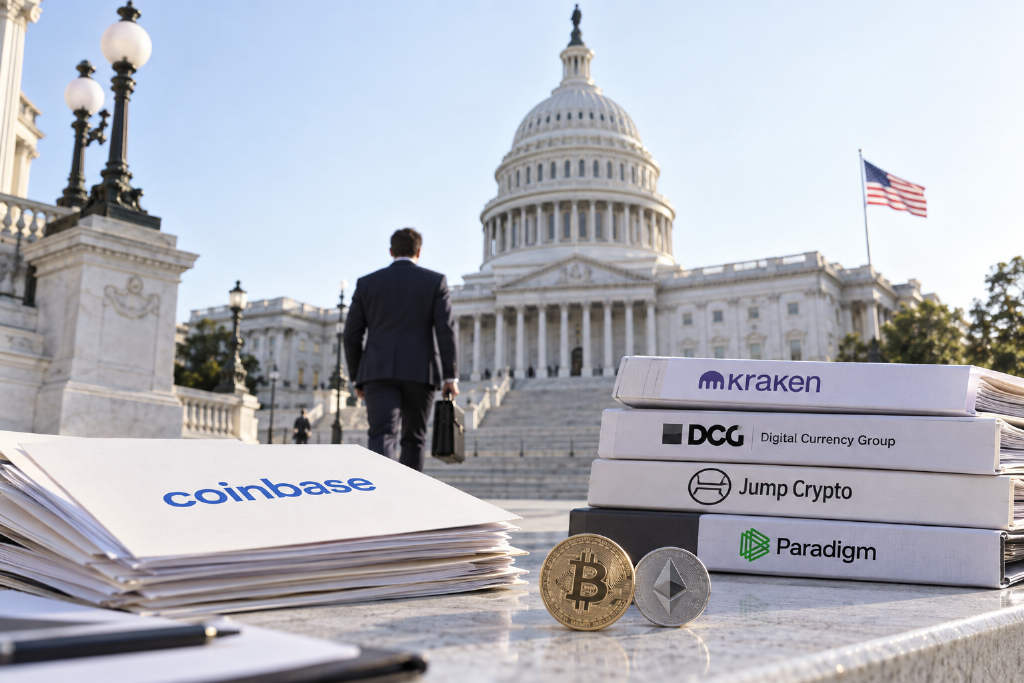
Coinbase spent about $2.2 million on lobbying that included advocacy for Clarity, according to its own disclosures. That made it the biggest single spender tied to the bill. Kraken spent close to $1 million. Digital Currency Group, Jump Crypto and Paradigm were also listed as major spenders on the legislation.
Julia Krieger, a spokesperson for Coinbase, said, 「We are proud of what our internal team and external advisors accomplished.」 She added that, as the largest single lobbying spender in crypto, the company 「helped get comprehensive, bipartisan market structure legislation to the brink of passage and laid the foundation for regulatory action」 now being pursued by the Securities and Exchange Commission and the Commodity Futures Trading Commission.
Using data from OpenSecrets.org, the report says Coinbase’s spending would place it among the top 10 lobbying spenders in the broader securities and investment category, ahead of Goldman Sachs and Andreessen Horowitz.
U.S. law requires lobbying activity to be registered through federal disclosures, though informal lobbying in social settings still happens on a large scale. CoinDesk’s review covered only the first two quarters of 2026, which are the latest disclosures currently available, and did not include the equally active 2025 crypto policy fight.
Broader crypto lobbying was also large
Beyond spending explicitly tied to Clarity, four digital asset companies spent more than $1 million each on crypto-related lobbying issues in the first half of 2026.
- Coinbase led the group.
- Andreessen Horowitz, or a16z, spent $1.5 million.
- Binance spent $1.4 million, all of it paid to outside lobbyists.
- Crypto.com spent $1.2 million.
The report says companies and trade groups usually direct most of their individual spending to in-house lobbyists. When they do pay outside firms, the money is spread widely. At least 42 different lobbying shops received crypto-related payments, though a smaller group captured a larger share.
Firms that drew the most crypto lobbying revenue
Checkmate Government Relations took in about $1.8 million in crypto-related money during the first six months of 2026, most of it from Binance. The North Carolina firm is described as a relatively new player in lobbying, but its client list stretches across health care, technology, finance, tobacco and large gun manufacturers, and it has close ties to Republican interests and the Trump administration.
Another firm favored by the industry was Sternhell Group, led by Capitol Hill veteran Alex Sternhell. Disclosure documents show it received $660,000 from digital asset clients over the two quarters, and three of its four most lucrative lobbying clients came from crypto.
Neither Sternhell nor Checkmate responded to requests for comment on this year’s crypto lobbying.
Among outside firms explicitly tied to the legislative push, Michael Best Strategies, Goldstein Policy Solutions, which has merged with Federal Hall Policy Advisors, and Phronesis DC each received at least $200,000 in the first half of 2026.
Internal divisions surfaced during the push
During the Clarity negotiations, meetings with executive branch officials and lawmakers may have been crowded with lobbyists. The report says some people familiar with the talks worried that the industry struggled to move in one direction.
Corey Frayer, a former SEC official who now serves as director of investor protection at the Consumer Federation of America, said he saw 「very severe internal infighting, and a lack of unity in the industry on major policy decisions in the bill.」
Frayer added, 「Crypto companies often ignore the advice of the experienced compliance professionals they hire; they ignore the advice of outside law firms; and even if they spend a lot on internal and external lobbyists, it would not surprise me if they ignore those people’s advice too.」
The bill stalled, but the lobbying did not stop
The report says lobbying outcomes are not always all or nothing. The industry did not persuade the Senate to pass Clarity, and even the most optimistic observers were not sure whether the bill would get another chance during the brief lame-duck session at the end of the year. Even so, the campaign produced progress that supporters still consider meaningful.
According to the report, the bill had never advanced this far before. Areas of bipartisan agreement that were won this time may support the next round, and more lawmakers now know more about crypto than they did a year ago.
As U.S. market regulators continue to work on crypto policy, including new complex rules, the lobbying load is continuing as well. Crypto lobbyists are still moving through agency offices, much as they moved in and out of Senate rooms during the Clarity negotiations.
Fraser said, 「After the Senate voted on Clarity this month, we are taking stock of the landscape and making sure time and resources line up with member priorities.」 One of those priorities, she said, will be 「deepening our work with the SEC and CFTC.」
Krieger put it this way: 「Washington is a long game.」