
The crypto industry spent more than $13 million on lobbying in the first half of 2026, and roughly $8 million of that was tied to efforts to push the Digital Asset Market Clarity Act through Congress, according to a CoinDesk review of federal lobbying disclosures. The legislation did not advance in the U.S. Senate.
CoinDesk said the $8 million represented the largest identifiable share of the sector’s lobbying work during the six-month period. The filings do not fully break down how attention was divided across issues, but the records reviewed by the outlet repeatedly referenced congressional work to build a U.S. regulatory framework for digital assets.
$8 million of lobbying was linked to market structure legislation
CoinDesk distinguished these expenditures from the industry’s more than $100 million in campaign funding and from the tens of millions spent each year on advocacy organizations such as the Digital Chamber, Blockchain Association and Crypto Council for Innovation. The review focused on direct lobbying, the legally defined activity in which specialists represent client interests in meetings with federal officials writing legislation and policy.
As the Senate worked on the Clarity bill in the first half of 2026, paid crypto advocates flooded Capitol Hill. About half of the registered lobbyists came from crypto companies themselves, while the rest worked for outside firms or trade groups. The central mission, however, remains unfinished.
Of the roughly $8 million tied to the legislative push, about $2.4 million went to third-party lobbying firms, around $2.1 million supported lobbyists employed by trade associations, and the rest funded the influence operations run by crypto companies themselves.
The lobbying goals were not described consistently in the filings. Still, disclosures reviewed by CoinDesk in connection with the $8 million push made at least some mention of Congress’ effort to establish a U.S. crypto oversight regime. Another $5.4 million in sector lobbying spending was not explicitly linked to the Clarity Act, though some of it may have supported the same cause under broader descriptions such as “issues relating to cryptocurrency” or “financial services.” Other funds were more clearly identified as targeting tax legislation, digital mining issues or the case the industry was making to U.S. regulators writing crypto rules.
Crypto Council for Innovation said its $610,000 in lobbying covered “across a range of topic areas including tax, GENIUS Act implementation, counter illicit finance, anti-money-laundering requirements and market structure.”
Blockchain Association Chief Policy Officer Lindsay Fraser said in a statement that the group’s lobbying included more than 380 meetings with congressional staff and federal officials. Its members “joined us for five fly-ins and 15 staff briefings on market structure, DeFi, tax policy, national security and more,” she said.
Coinbase led the spending tied to the bill
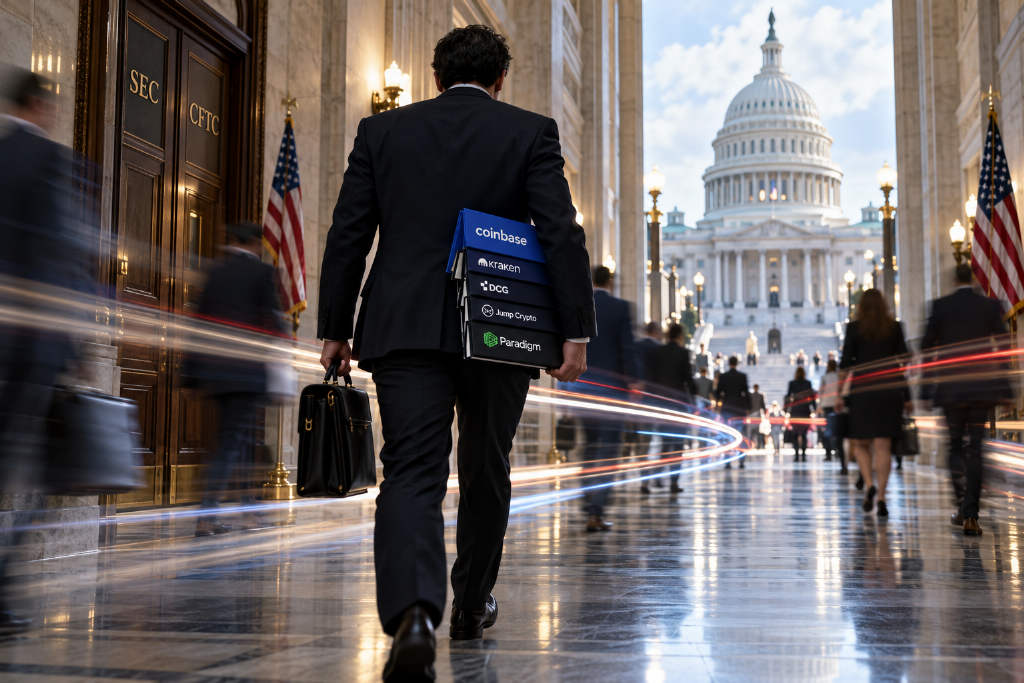
In disclosures related to the effort to get the Clarity Act over the finish line, Coinbase spent about $2.2 million on lobbying that included advocacy for the measure, while Kraken spent nearly $1 million. Other major spenders linked to the bill included Digital Currency Group, Jump Crypto and Paradigm.
“We’re proud of what Coinbase’s in-house team and outside advisers achieved,” Coinbase spokesperson Julia Krieger said. She added that the company’s effort, the largest single lobbying spend in crypto, “helped bring comprehensive, bipartisan market structure legislation to the brink of passage, and laid the groundwork for regulatory action,” which she said is now progressing at the Securities and Exchange Commission and the Commodity Futures Trading Commission.
According to OpenSecrets.org, Coinbase spent enough to rank in the top 10 overall for securities and investment lobbying, ahead of Goldman Sachs Group Inc. and Andreessen Horowitz.
CoinDesk noted that U.S. law requires lobbying to be disclosed in federal filings, though softer influence work also happens around parties and events and is not captured the same way. Its review covered only the first two quarters of 2026, the most recent filings available, and did not include 2025.
At least four firms spent more than $1 million on broader crypto lobbying
Looking beyond disclosures that explicitly named the Clarity Act, four digital asset firms crossed the $1 million mark on crypto-related lobbying topics. Coinbase was the leader, followed by $1.5 million from Andreessen Horowitz, $1.4 million from Binance, all of it on outside lobbyists, and $1.2 million from Crypto.com.
Companies and trade groups usually devoted the bulk of their spending to their own lobbying employees. But when they hired outside influence shops, the money spread across at least 42 separate firms, with some collecting much larger sums than others.
Checkmate Government Relations brought in about $1.8 million in crypto-related revenue in the first six months of 2026, most of it from Binance. CoinDesk described the North Carolina firm as a relatively recent entrant to lobbying, with a client roster spanning healthcare, technology, financial firms, tobacco companies and a major firearms manufacturer. The outlet also said the firm is closely associated with Republican interests and the administration of President Donald Trump.
Another favored shop was Sternhell Group, run by Capitol Hill veteran Alex Sternhell. The firm took in $660,000 from digital asset clients during the two quarters, and three of its four most lucrative lobbying clients came from crypto, according to the filings.
Neither Sternhell nor Checkmate responded to requests for comment on this year’s crypto lobbying, CoinDesk reported.
Among the outside firms specifically tied to the legislative campaign, Michael Best Strategies, Goldstein Policy Solutions, which later merged with Federal Hall Policy Advisors, and Phronesis DC each received at least $200,000 for work in the first half of 2026.
Coordination concerns surfaced during negotiations
During negotiations over the Clarity Act, meetings with administration officials and lawmakers could include a long list of lobbyists. Some people involved in the talks had raised concerns that the industry struggled to keep its efforts pointed in the same direction.
Critics of the sector said they saw that division. Corey Frayer, a former Securities and Exchange Commission official who is now director of investor protection at the Consumer Federation of America, said he saw “very big internal infighting and a lack of unification among the industry on significant policy decisions in the bill.”
“Crypto companies tend to ignore the advice of experienced compliance people that they hire; they ignore the advice of outside law firms; and I would not be surprised if they spent a lot of money on lobbyists, both internal and external, whose advice they ignore,” Frayer said.
The bill stalled, but the lobbying campaign continues
CoinDesk also argued that lobbying does not produce a simple yes-or-no outcome. The industry failed to persuade the Senate to pass the Clarity Act, and even optimistic participants are unsure whether it can get another chance in the lame duck period at the end of the year. Still, the effort did move farther than previous crypto legislation, and the reporting said it may provide a foundation for whatever comes next, especially where bipartisan agreement was won after hard negotiations. More lawmakers also know more about crypto now than they did a year ago.
The lobbying work is still going on as U.S. market regulators continue to shape crypto policy and propose complex new rules. Crypto lobbyists are now working agency offices much as they had worked Senate meeting rooms during the Clarity negotiations.
“Following this month’s Senate vote on Clarity, we’re taking stock of where things stand and making sure our time and resources line up with our members’ priorities,” Fraser said, adding that part of that work will be “deepening our work with the SEC and CFTC.”
As Krieger put it, “Washington is a long game.”