

TechFlowPost has published a commentary arguing that it is intellectually lazy to attribute the current bleakness of the crypto market solely to the rise of AI. In the article’s framing, crypto has not disappeared. Instead, it has entered a more brutal K-shaped divergence, where winners consolidate faster, while ordinary participants and middle-tier projects find it increasingly difficult to survive or wait for a slow, broad-based bull market.
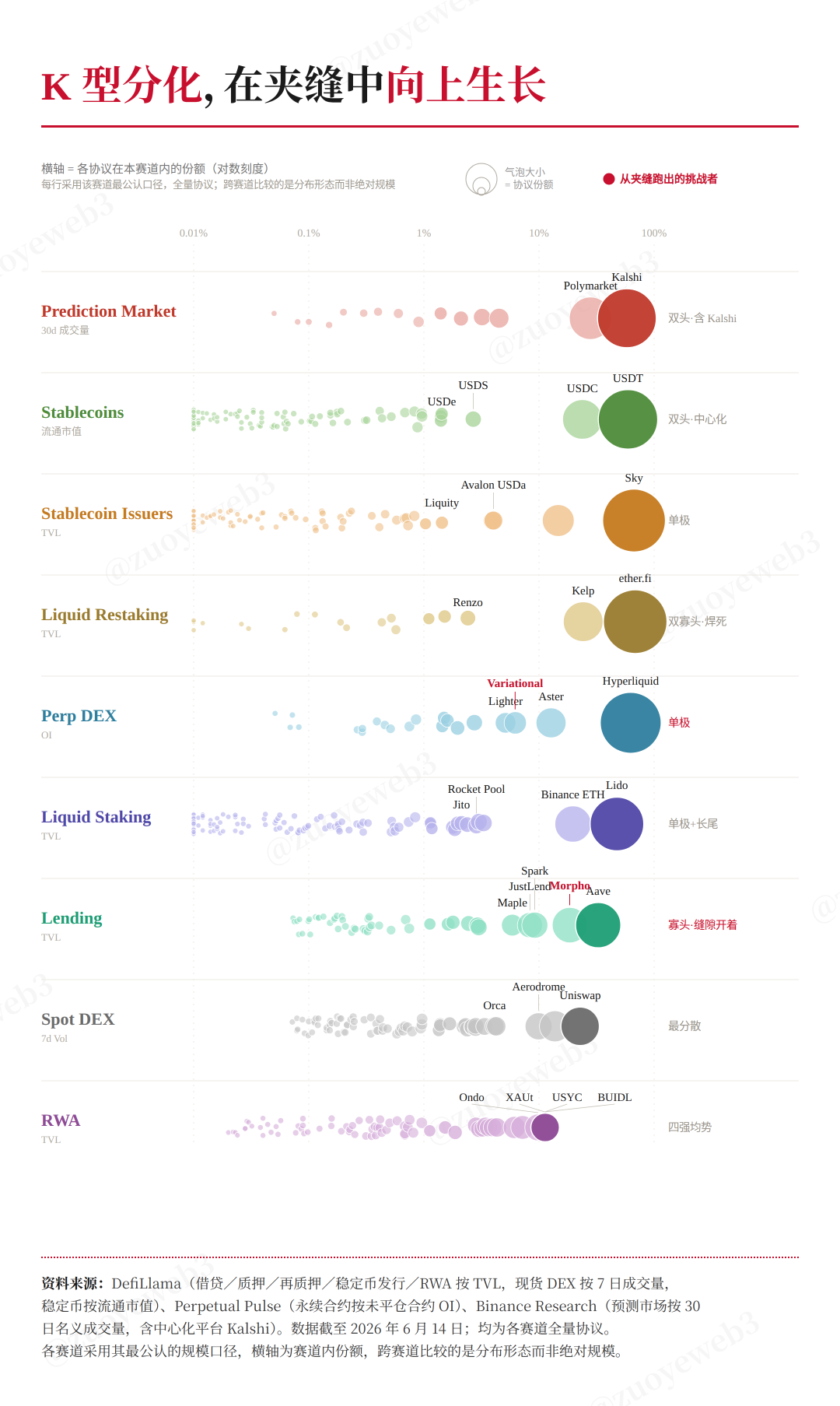
The article says blockchain still has a real long-term role in finance, especially as RWA adoption expands and stablecoins continue moving toward payment use cases. However, that does not mean token markets currently possess a healthy valuation foundation. Global attention has shifted toward a wider technology race, with AI, fusion, commercial space, and biotech competing for capital and narrative dominance. In that setting, crypto is no longer the default frontier asset class it once appeared to be.
Fundamentals remain, but token valuation logic is breaking down
According to the piece, the central contradiction in crypto is that the sector still has a meaningful technological and financial future, yet lacks the ability to absorb sovereign-scale assets in a way that could stabilize its pricing framework. In the author’s view, existing markets are not realistically carrying assets such as a digital yuan, tokenized sovereign bonds, or Chinese A-shares on-chain. Without that level of integration, crypto markets are more likely to devolve into token dumping venues or meme-driven abstraction rather than mature valuation systems.
The article therefore describes crypto as something closer to a giant “Alt Pre-IPO system.” In that interpretation, projects may not have a direct route to a market like Nasdaq, but they can still use token markets as an early price-discovery layer. The author cites a comparison to show the sector’s ceiling: only 55 crypto projects have reached a $1 billion valuation, versus 1,603 unicorns globally across the broader startup economy. That gap, the article argues, highlights how constrained crypto’s upper bound still is.
Another structural issue, the piece says, is that crypto innovation is being captured by giants more quickly than before. Binance, framed as a kind of transaction bank, took about five years from 2017 to 2022 to become the industry leader. The author doubts the next generation of products will have that much time to mature. Across old and new verticals alike, from stablecoins, exchanges, and lending to Perp DEXs, HIP-3, and prediction markets, many sectors now appear to produce one or two dominant players very quickly, closing off room for prolonged experimentation and retail speculation.
AI did not simply drain crypto liquidity; it intensified pressure on the middle layer
The article rejects the idea that AI has merely stolen all speculative capital from crypto. Instead, it argues that the rise of hard tech is creating new speculative objects of its own, not just cannibalizing digital assets. The more important change is that AI has accelerated concentration in both capital and execution, squeezing the “middle class” of the innovation economy: the projects, workers, and investors who used to benefit from slower, more forgiving development cycles.
To make that point, the author lists three pressures. First, white-collar office skills are gradually being replaced by agents. Second, the abstraction layer once defended by SaaS is being eroded by large models. Third, companies have less patience to cultivate talent in the broad middle between junior and elite contributors. In that context, the gap between a startup and the Mag7 is shrinking in time but not in difficulty. The article contrasts long-cycle examples like SpaceX with the much faster ascent of AI firms such as Anthropic, arguing that success windows are compressing dramatically.
For crypto, the same logic applies. If a new team wants to enter the small club of billion-dollar projects, it must not only identify the right sector but also resolve competition quickly. The author says the breakdown of tokenomics as a persuasive standalone story has accelerated crypto’s slide from “technical idealism” toward a more straightforward financial services industry. In that environment, the side that can gather more capital gains the ability to displace incumbents much faster.
Buybacks are not working, and the market is losing reliable signals
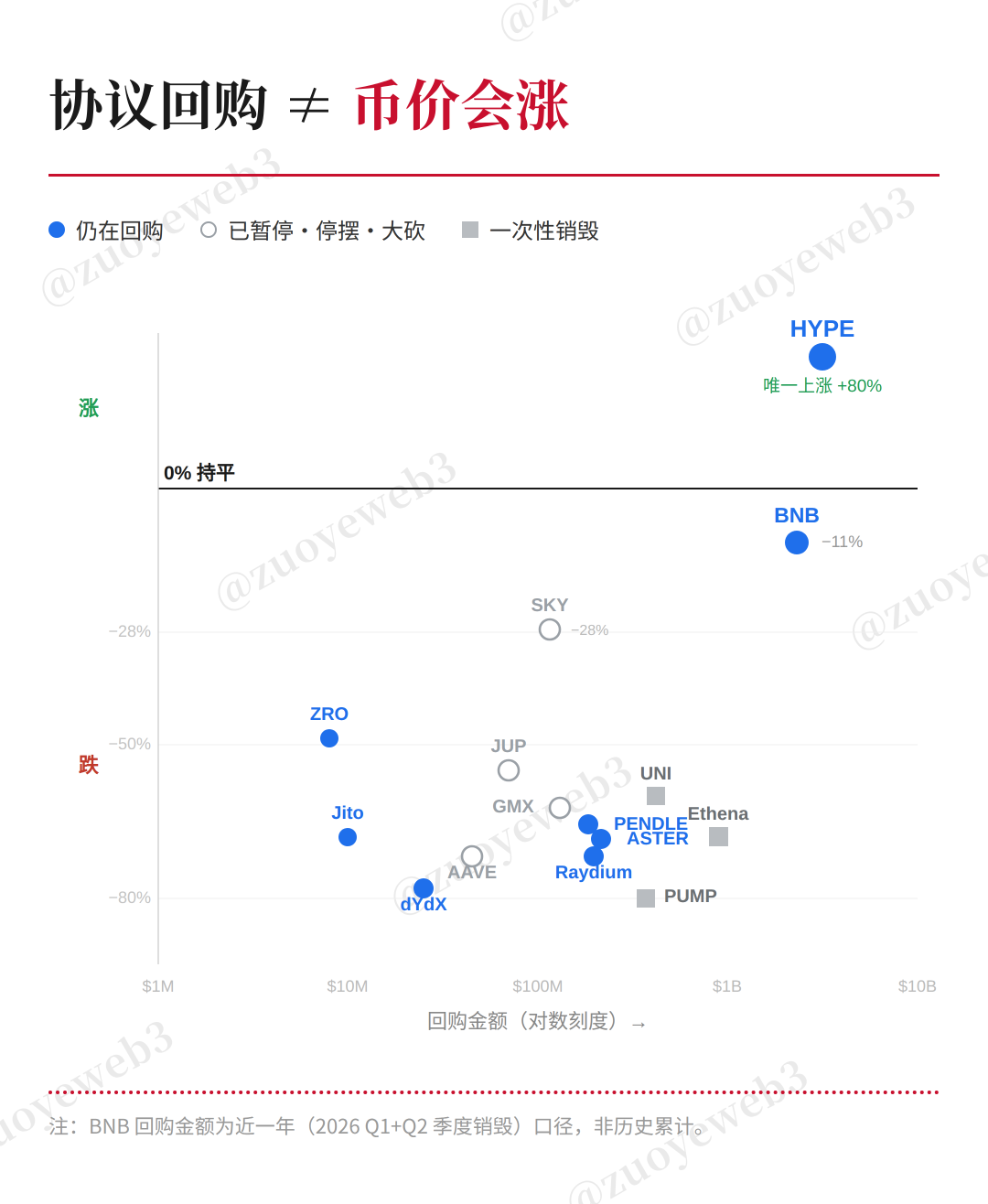
The commentary also focuses on market mechanics. It notes that over the past year, token buybacks have failed to stop the broad decline across the token sector. That stands in contrast to U.S. equities, where buybacks have long been treated as a major driver of multi-decade support. In the author’s reading, if even explicit, visible buying cannot persuade others to hold an asset, the market’s underlying engine is due for a deeper reset.
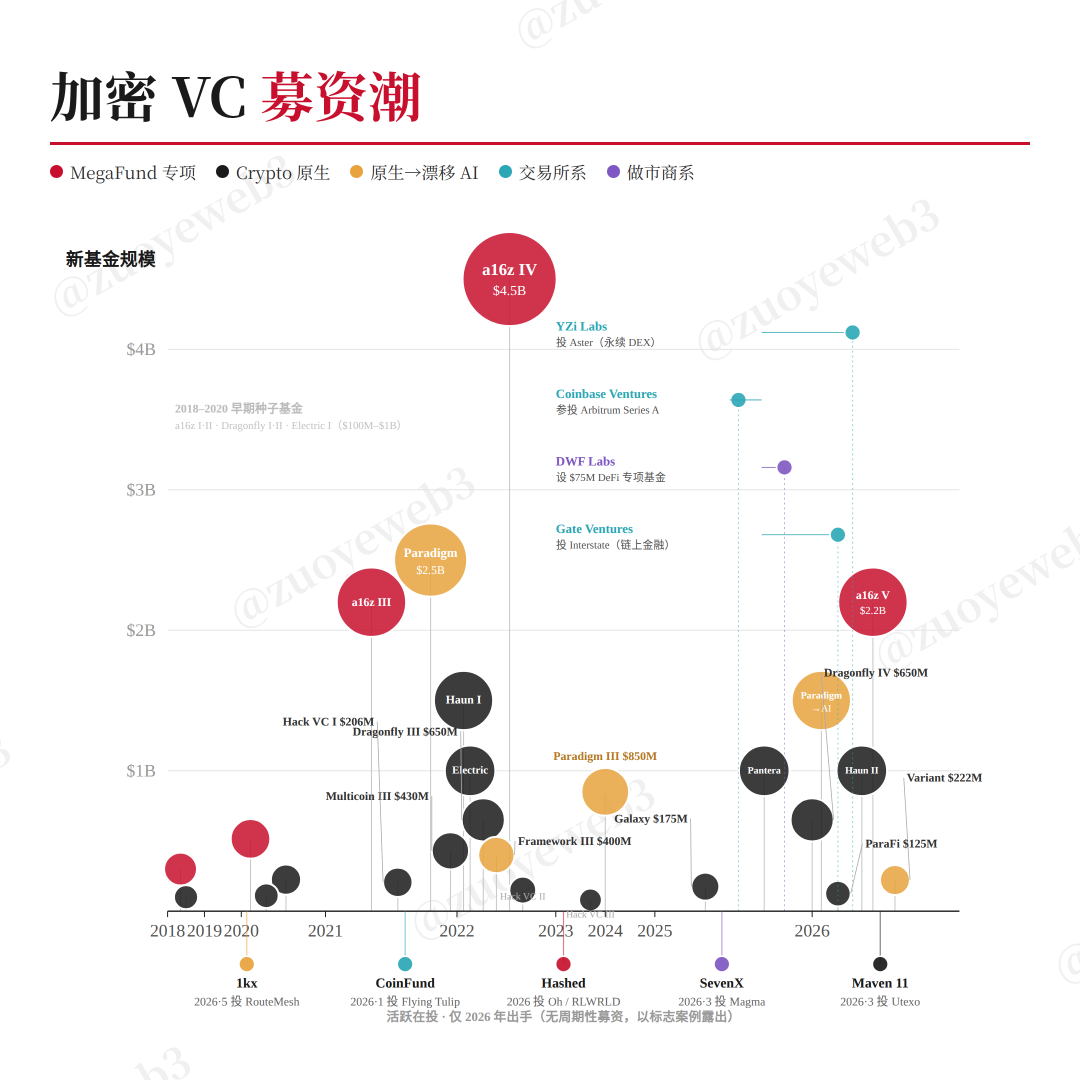
From a venture perspective, the article argues that the same K-shaped pattern is obvious. It says that in the first quarter of 2026, the top six U.S. VC firms captured nearly 80% of all fundraising, while the top five startups, representing just 0.1% of companies, took 73% of capital, totaling $195.6 billion. Venture capital, in this depiction, is no longer mainly about small, experimental bets on early technology. Under firms such as a16z, it has become a scale game in which failure is increasingly unaffordable.
The piece goes further, arguing that in such an extreme funding environment, successful VCs begin to resemble operators of a quasi-Ponzi capital loop. Returns need to satisfy multiple audiences at once: DPI for old LPs, IRR support for existing holdings, and APY optics for new fundraising. As a result, the author says crypto has entered an “uninvestable era of missing signals,” where external observers cannot easily tell how much of a published raise was actually funded, nor infer the next major opportunity from deal databases alone.
Chinese VCs are losing position as pricing power shifts elsewhere
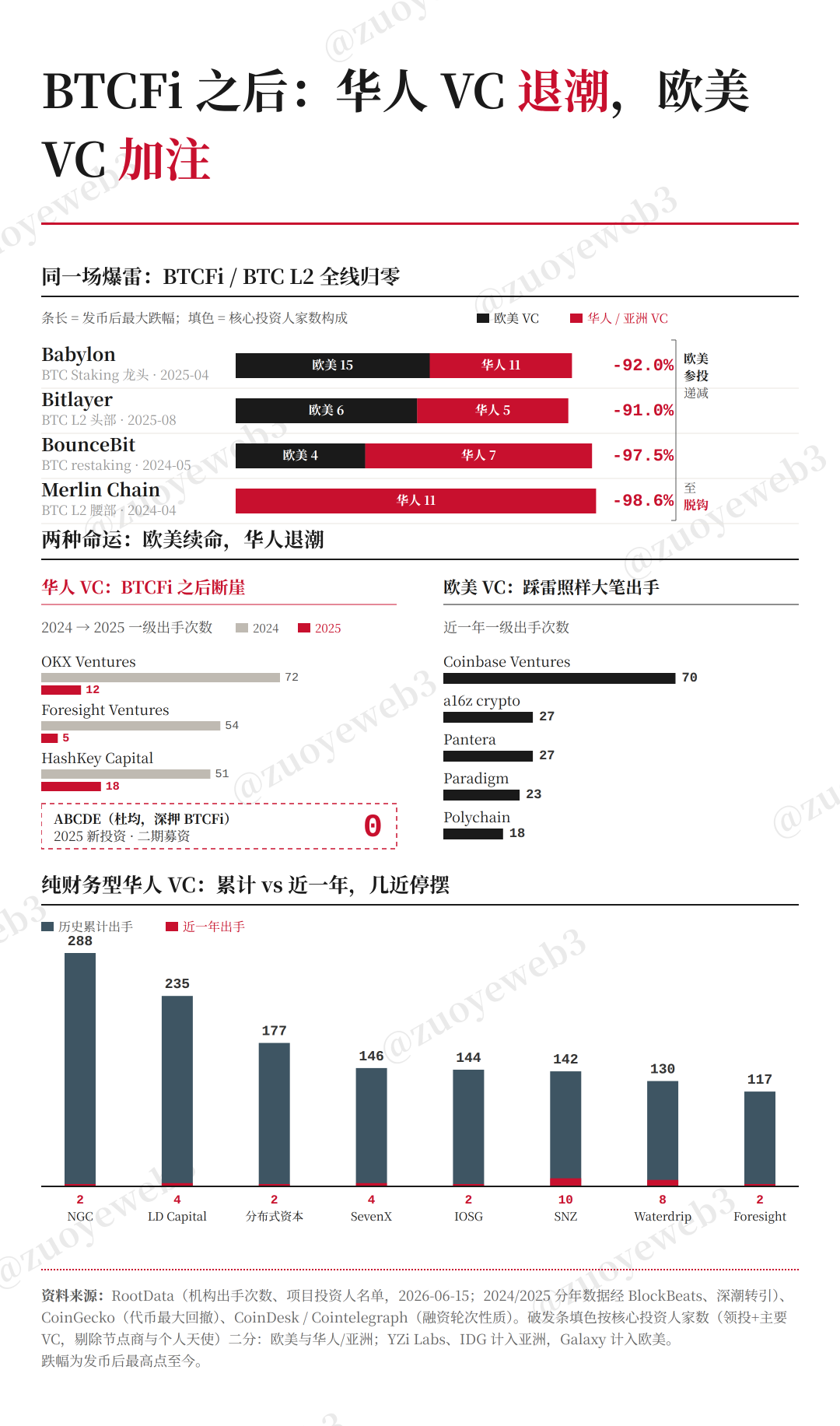
The article places special emphasis on Chinese founders and capital. It argues that after the BTCFi wave at the end of 2024, many Chinese VCs effectively lost their ability to exit and, with it, a large part of their function in project discovery and initial pricing. Previously, a project could earn validation from Chinese investors and then move into the field of view of larger U.S. funds at a higher valuation tier. The author suggests that pipeline has weakened significantly.
By contrast, U.S. VCs, even after taking hits in areas such as ETH L2 and BTC L2, still retain enough capital strength to hold pricing power in upcoming sectors like stablecoins and RWA. The article says Chinese capital is now largely absent from the new round of competition around Perp DEXs, with only some exchange-affiliated investors still able to participate meaningfully. In broader financial services, especially payments and RWA, Chinese founders and investors are described as facing dual access constraints.
This matters because, in the author’s view, crypto is not de-capitalizing. It is capitalizing faster, just in a more concentrated way. The market feels cold not because money has left entirely, but because consumption is weak and most platforms increasingly push users toward leverage instead of creating reasons for long-term spot holding. That creates a structurally fragile environment in which participation depends on constant action rather than durable conviction.
The article’s conclusion: crypto is colder, more concentrated, and still waiting for the next clear signal
In its conclusion, the piece says this may be the hardest period for founders in years. Teams either move as solo or ultra-lean operators, or they face giant incumbents that close off the room for gradual growth. Time itself has become the harshest constraint. Yet the author also argues that giantization is not purely negative: mature structures may reduce speculative whitespace, but they can still create new openings when a fresh application pattern appears.
The broader conclusion is that political change and the AI wave have not erased crypto. What they have done is expose a deeper mismatch between aspiration and market structure. The industry feels increasingly unable to justify its place through existing token valuation mechanisms, even as capital concentration and financialization continue. The article closes by asking whether crypto can still generate another tightly concentrated mania strong enough to attract billion-dollar-scale capital at high speed once the next genuine signal arrives.