
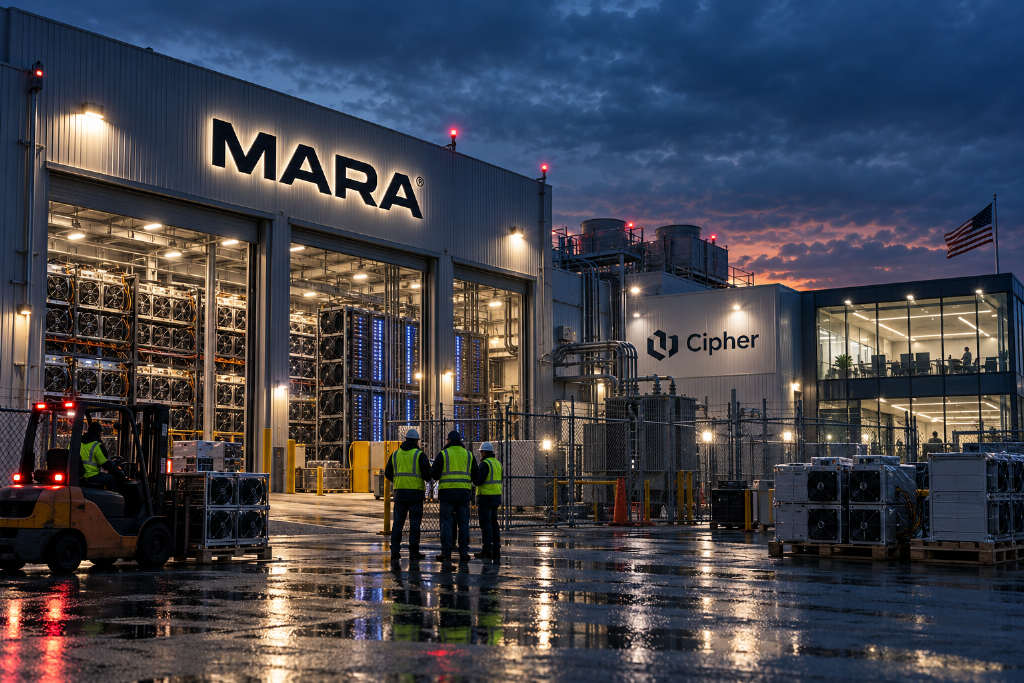
U.S.-listed crypto miners have been hit by a sharp reset as investors take a harder look at the financing behind their AI buildouts. On Oct. 14, 2026, MARA Holdings closed at $8.23, down 9.66% on the day. Over the past four weeks, the stock has fallen 26.78%. Over one year, it is down 63.97%.
Pressure has spread across the group. On Oct. 13, Cipher Digital announced an $850 million zero-coupon convertible note offering, yet the move failed to calm the market and its shares dropped as much as 15% intraday the same day. A few days earlier, on Oct. 9, Morgan Stanley cut price targets on MARA, Riot, Galaxy, and Cipher, saying borrowing conditions for miners moving into AI had tightened.
Cipher’s fundraising drew an immediate sell-off
Cipher’s financing terms were sizable. The company proposed on Oct. 13 to issue $850 million in zero-coupon convertible notes due in November 2032, with an additional $150 million option, bringing the total potential deal size to $1 billion. Pricing was completed on Oct. 14, with the conversion price set at $15.31, 35% above the prior day’s closing price of $11.34.
At first glance, the structure looked attractive: no regular interest payments and a large pool of cash raised upfront. But the company’s investor presentation filed with the U.S. Securities and Exchange Commission on Oct. 13 showed why the market reacted so negatively. Cipher’s core AI data center project, Barber Lake, has gone over budget.
The project was originally budgeted at $2.157 billion. That figure has now been revised to a range of $2.941 billion to $2.966 billion, an increase of more than 36%. Cipher said the higher cost reflects new design change requests from tenant Fluidstack.
The funding burden is also front-loaded. Cipher must first cover the initial $359.3 million of the overrun. Beyond that level, the tenant will reimburse half of the additional cost over a 20-year lease term. The financing need, in other words, lands on Cipher before reimbursement catches up.
The sector faces both a funding gap and slow delivery
Cipher’s situation reflects a broader problem among miners trying to turn power assets into AI infrastructure. In a June report, VanEck estimated that the industry faces a short-term funding gap of about $50 billion if it wants to complete previously announced AI infrastructure plans. Long-term capital needs were put at nearly $221 billion.
BlocksBridge Consulting, using VanEck’s data, also published company-level estimates. IREN faces a funding gap of $21.1 billion. Riot is short $7.2 billion. HIVE faces a $4.6 billion gap.
At the same time, the cost of borrowing is rising. IREN was still able to secure $3.65 billion in GPU financing in June at a blended interest rate of 6%. Just two months later, a separate $2.4 billion transaction carried a fixed rate of 9%.
Lenders are also using a different checklist now. Last year, the market focused on how much power capacity miners controlled and how many memorandums of understanding they had signed. This year, attention has shifted to actual construction progress. VanEck’s midyear data showed that only about 25% of the industry’s contracted leased capacity had been physically delivered.
Mining economics remain under strain
The shift into AI is happening while the legacy business has struggled to generate profits. On Oct. 13, 2026, Binance, the world’s largest crypto exchange, said it would shut down its mining pool business from Nov. 10, including related services such as Pool Savings, cloud mining, and the transaction accelerator. After that date, miners submitting hash power will no longer receive rewards.
Binance Pool launched in April 2020 and had operated for more than six years. The company said the shutdown followed a routine product review.
Data from CoinShares showed that the weighted average cash cost for listed miners to produce one bitcoin was about $80,000 in the fourth quarter of 2025, falling to roughly $75,500 in the second quarter of 2026. When bitcoin dropped to $69,000 in March this year, miners were losing about $19,000 per coin based on a production cost of roughly $88,000 at the time.
Only recently, with bitcoin back above $80,000 and hashprice recovering to around $40, has the sector moved back near break-even.
MARA and Bitdeer have taken different approaches
Against that backdrop, miners have responded in very different ways.
MARA has chosen to keep its bitcoin position. The company pledged 54% of its bitcoin holdings as collateral and added $600 million of new borrowing, pushing debt to 70.8% of its total market capitalization. In Morgan Stanley’s Oct. 9 note, MARA’s new price target was set at $10, leaving implied upside of just 2.4%, the lowest among the companies under coverage.
Bitdeer took another route. Since receiving an equity investment from Tether in 2024, the company has also used convertible notes to add funding. By the end of the first quarter this year, total borrowings stood at about $1.9 billion, which raised concerns in the capital market over the size of its debt load.
But Bitdeer made a rarer decision than most of its peers. In February this year, it sold all of its self-held bitcoin, bringing holdings to zero on Feb. 20. After that, newly mined bitcoin was also sold immediately for cash.
That move was designed to preserve liquidity while pushing AI infrastructure ahead. At its Tydal site in Norway, Bitdeer’s 180-megawatt AI data center project has continued on schedule, with the first phase targeted for delivery in December this year. Another figure in the report stands out: by April, Bitdeer’s AI cloud business had reached about $69 million in annual recurring revenue.
Bitdeer shares still fell with the broader mining sector and pulled back to $8.40 on Oct. 15. But the figures in the report suggest a different operating profile from peers still burdened by legacy mining exposure.
Investors are now demanding proof of delivery
The valuation framework around crypto miners has changed. Earlier, investors rewarded access to power and large AI-related agreements on paper. As projects moved from announcements to construction, attention shifted to engineering progress, leverage, and interest expense.
With a sector-wide short-term funding gap of about $50 billion, a legacy mining business that struggled through the first half of the year, and capital-intensive AI projects still under construction, the market is no longer pricing the transition on promise alone. It is looking for delivered capacity and visible cash support.