
By Shao Jiadian
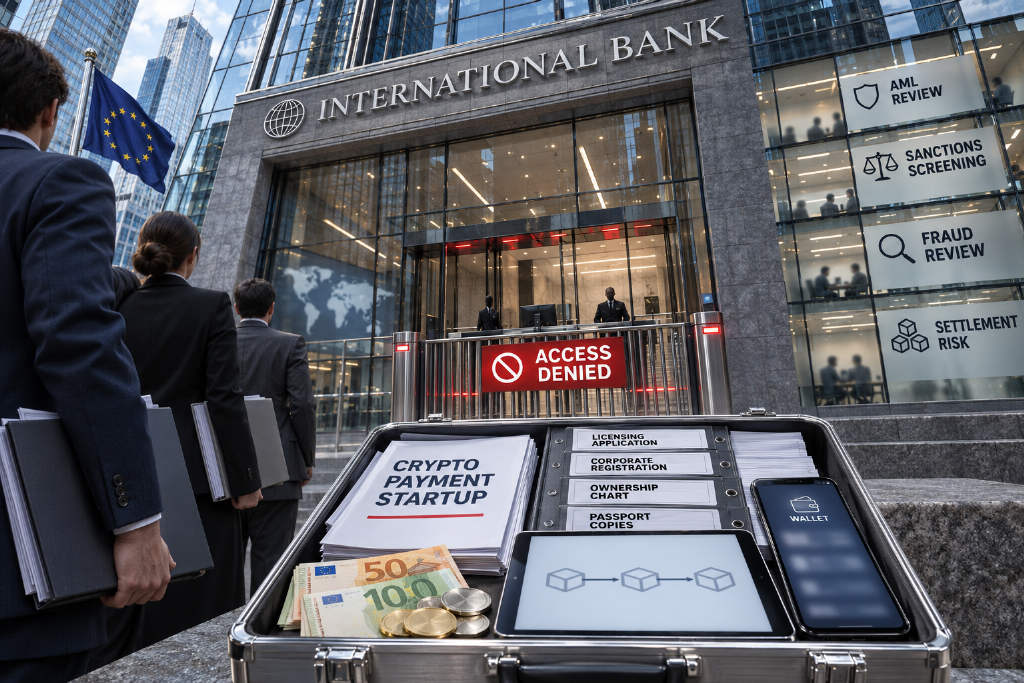
A crypto payments company finally gets its license. The next step looks straightforward: connect to a bank, open a corporate account, receive client fiat and start settlement between stablecoins and traditional currencies.
The license file is ready. So are the company registration documents and materials on directors and shareholders. The business plan does not appear to have obvious flaws. Then the bank’s due diligence process reaches a different layer of questions: Which countries do the customers mainly come from? Where do the stablecoins first enter the platform? Who controls the customer wallets? Who ultimately receives the euros after conversion? If third-party wallets are involved, how does the company prove source of funds and handle suspicious transactions?
That is when many teams realize a basic point: a regulator may allow a company to operate, but a bank may still decide not to let that business into its account system.
This is not unique to crypto payments. The issue becomes more pronounced, though, when a business combines on-chain assets, cross-border money movement and several service providers. A license answers whether a company may lawfully provide a certain financial service. Bank onboarding answers whether a bank is willing, and able on a compliance basis, to take on that company and the risks tied to its transactions. The two are related. They are not the same approval.
For crypto payment projects trying to build for the long term, getting licensed is only the first step. Whether they can form stable and durable banking and payment relationships is what determines if the business can actually run.
Why banks can still say no after a regulator says yes
The most common misunderstanding is simple: if a regulator has already reviewed the company, why does the bank need to review it again?
The answer lies in different responsibilities.
In a licensing process, regulators mainly assess whether a firm meets the market-entry conditions for a given financial activity. A Crypto-Asset Service Provider, or CASP, may need to show governance, prudential resources, client asset protection and ongoing compliance capacity for the services it wants to provide. A payment institution must meet the relevant payment-services rules.
A bank is dealing with a separate business relationship. When it opens an account for a crypto payments company, receives funds, executes payments or provides settlement, it has to make its own judgment on anti-money laundering exposure, sanctions risk, fraud risk, operational risk and other risks arising from that customer and the related transactions. It also has to decide whether those risks can be managed with its own systems, controls and risk appetite.
Put differently, the regulator asks whether the company is qualified to conduct the business. The bank asks whether the risks created once that business enters its account and payment rails can be identified, controlled and monitored on an ongoing basis.
This distinction is especially visible in the U.S. Money Services Business, or MSB, registration framework. FinCEN has made clear that MSB registration is not a government certification or endorsement of a firm’s legality, business capability or compliance standard. FinCEN also does not issue a nationwide operating license through MSB registration, and some activities may still require state-level licenses.
That means an MSB registration certificate is, at most, one part of a bank’s review of regulatory status. It does not replace the bank’s judgment on the actual business. Even where a company has obtained a fuller CASP, payment institution or other formal license, the bank still has to complete its own customer due diligence.
What banks really worry about is not the use of blockchain itself
Take a traditional cross-border payments company that receives payments from corporate clients each day and settles with overseas suppliers. A bank can usually build its due diligence logic around the payer, the payee, the contract, the goods or services involved and the related money flow.
Add stablecoins to the same business and the path may look different. An offshore customer pays USDC from an on-chain wallet. The platform receives the assets, aggregates and converts them, and another financial institution then pays euros to the merchant.
At that point, the bank may only see a fiat credit coming from a conversion provider or payment partner. The real payer and the earlier on-chain asset path sit outside the bank account. The bank then has to ask who the funds actually came from, what transaction they correspond to, whether the on-chain assets touched high-risk addresses and whether the company can identify and explain unusual flows.
In 2024, the European Banking Authority, or EBA, issued guidance on money laundering and terrorist financing risk factors for crypto-assets. It specifically called on CASPs to identify potential risks across customers, products, service channels and geographic exposure, and to apply mitigating measures that include on-chain analytics. The guidance also touches other financial institutions that have business relationships with CASPs.
The Financial Action Task Force, or FATF, had earlier published virtual asset risk indicators that focus on unusual transaction patterns, amounts and frequencies lacking a reasonable business explanation, source of funds, highly anonymous transaction tools and high-risk jurisdictions.
So the issue is not that banks automatically treat every on-chain transaction as a problem. What often makes a bank uncomfortable is a company that can execute the transaction but cannot provide enough information to show who is behind it, where the money came from and what commercial purpose it serves.
If the project itself cannot clearly explain where upstream customers come from, which wallets the funds moved through and why conversion and cross-border settlement are needed, the bank is even less likely to take that risk on its behalf.
Account purpose can be a bigger blind spot than source of funds
Many projects approach a bank with a single request: we need a corporate bank account. For a bank, that description is nowhere near enough.
The same label can cover very different uses.
- The first type is a proprietary operating account used to receive shareholder investment and pay salaries, office rent and other operating expenses.
- The second is a business receipts-and-payments account used to receive genuine business income and pay counterparties under contract.
- The third involves client money, merchant settlement or pooled funds from multiple customers. The legal relationship, ownership of funds, client asset protection requirements and payment-service characteristics can differ sharply from an ordinary operating account.
A CASP opening an account to pay staff is one risk profile. A crypto payments platform that wants to receive euros from multiple customers into one account and then pay merchants around the world is another.
In the latter case, a bank may look closely at third-party collection and disbursement, commingling of client funds, unclear control over the account or payment services that were not fully disclosed.
Some projects assume they can simplify settlement by first routing client funds into an account held by a group company and then passing the money to a payment partner. From a bank’s perspective, that can increase the risk that the account purpose does not match the real business if the arrangement does not explain the underlying transaction relationship.
The bank needs more than the name of the account holder. It needs to know who the money belongs to and why the company has the right to receive and pay it.
That is why a crypto payments project should define before onboarding whether it is applying for an operating account, a business account or a specific client-money or settlement arrangement. Different needs may point to different banks or payment institutions, and may require different regulatory permissions and client asset protection structures.
Regulators are opening room for compliant crypto business, but banks are not required to onboard everyone
Viewed through international regulatory developments, it is no longer accurate to treat bank refusals of crypto firms as a universal and fixed regulatory ban.
In March 2025, the Federal Deposit Insurance Corporation, or FDIC, removed its prior requirement that supervised banks give special advance notice before engaging in crypto-related activities. The agency said banks may engage in permissible crypto-asset activities without obtaining special FDIC approval first, as long as they comply with applicable law and manage risk effectively.
In April that year, the FDIC and the Federal Reserve withdrew two earlier joint statements on risks related to crypto-asset activities. They said banks may provide related services if they meet safety-and-soundness standards and applicable legal requirements.
That shift does not mean every bank must accept crypto payment companies. It also does not mean banks can lower anti-money laundering or account-management standards.
The EBA has also opposed unjustified over-de-risking. In guidance published in 2023, it said financial institutions should use a risk-based approach and should not deny service to a category of customers without reasonable analysis simply because that category may carry potential risk.
In 2023, the Hong Kong Monetary Authority issued a circular on banking services for enterprises that also stressed customer due diligence proportionate to risk at onboarding and promoted reasonable access to banking services.
Taken together, these positions point to one conclusion. Crypto business should not be treated as automatically unacceptable risk. Banks still remain responsible for identifying and managing the risks of specific customers and transactions.
So when a project is rejected, it should not immediately conclude that the jurisdiction bans crypto business. It should not assume the opposite either, that regulatory support for crypto leaves a bank with no basis to refuse. A more practical approach is to determine whether the problem lies in business scope, customer and fund transparency, the bank’s internal risk policy or the inability of the current materials to support due diligence.
Which crypto payment projects are more likely to get stuck at the bank stage
The article highlights several structures that deserve early review.
The first is a platform serving large numbers of third-party customers without a clear customer and funds look-through mechanism. A company may say it only handles stablecoin settlement, while its actual customers include multiple layers of agents, channel partners or other payment service providers. In that setup, the bank may struggle to identify the ultimate payer, the ultimate payee and the real purpose of the transaction.
The second is a project with complex on-chain asset sources. Where the model involves large volumes of self-hosted wallets, over-the-counter trades, multiple liquidity providers or cross-chain transfers, a bank may ask the company to show effective Know Your Transaction, or KYT, screening, risk filtering and suspicious transaction handling rather than a generic AML policy alone.
The third is a mismatch between group entities and account purpose. The licensed entity may sit in the European Union, customer contracts may be signed by an offshore company, stablecoins may be controlled by another affiliate, and yet the bank is asked to let a company with no direct customer relationship receive all settlement proceeds.
These structures do not automatically mean illegality or an impossible onboarding case. But without a reasonable explanation supported by contracts, authorizations and fund-flow logic, a bank will struggle to determine what business the account is actually carrying and what risks come with it.
Another often overlooked case appears when a project was licensed for stablecoin conversion only, but by the time it applies for a bank account it is preparing to add wallet custody, merchant acquiring, cross-border remittance or other functions. If the current business plan differs from the original authorization scope, customer agreements or application materials, the bank’s review becomes harder.
A bank’s biggest concern is not always complexity by itself. It is whether the business has become more complex than the company can manage and explain.
Before approaching a bank, at least six questions should be answered clearly
The article says projects are better off reviewing themselves from a bank’s perspective before formal outreach instead of waiting for repeated requests for more documents.
Those six questions do not mean every bank will ask for the same checklist. The exact review still depends on local regulation, bank policy and the functions of the account. But for a crypto payments project, if those six points cannot be answered clearly, repeated follow-up requests are likely.
One item stands out: the on-chain and off-chain fund-flow map. It should accurately reconstruct the relationships among customers, wallets, CASPs, trading and conversion providers, payment institutions or electronic money institutions, banks and merchants.
If assets move multiple times on-chain, the company should also explain which wallets it controls, which belong to customers, which are managed by licensed partners and at what point stablecoins are converted into fiat.
What should a project change first after a bank rejection
After a rejection, many teams first try another bank or another intermediary that can provide an account. If the underlying problem is unclear fund flows, customer types outside the bank’s risk tolerance or a mismatch in account purpose, switching banks alone may not solve it.
The more sensible sequence is to identify the reason for the refusal first.
- If the bank clearly says it does not take on a certain type of business, the project can reassess whether other institutions have the service capability and risk appetite for it.
- If the issue is insufficient documentation, the company should add business evidence, customer structure details, fund-flow explanations, licensed partnership materials and risk-control documents.
- If the bank finds that the actual business does not match the license or cooperation agreements, the priority is to adjust the business arrangement rather than relabel it in the onboarding package.
The article warns against trying to win an account by hiding the crypto-asset source, borrowing an unrelated company’s account, using a personal account to receive client money or packaging real customer payment activity as ordinary trade receipts and payments.
Those moves can turn an onboarding problem that might have been solved through business adjustments into broader account-use, anti-money laundering or other legal risks.
If a project is not yet suitable to build direct bank settlement capability, it may lawfully assess cooperation with a payment institution, an electronic money institution or another financial institution. Even then, the premise remains the same: the partner must have the relevant permissions and must genuinely assume the corresponding business and regulatory responsibilities. A licensed partnership is a structural choice, not a shortcut around bank due diligence.
How the article says such projects are usually supported
For projects that already hold a CASP, MSB, VASP or another regulatory status but still face obstacles in bank onboarding and settlement, the article says the first step is usually not to contact more banks right away. It is to recheck whether the business model matches the intended account use.
The review would focus on regulatory status, actual customer regions, product functions, group structure, control over on-chain assets and fiat settlement arrangements. The goal is to determine whether the issue lies in licensing scope, customer structure, fund flows or the bank’s own risk policy.
For stablecoin payments, PayFi and corporate cross-border settlement projects, the work can extend to mapping on-chain and off-chain fund flows, analyzing account purpose and ownership of funds, and building a matrix of group functions and regulatory responsibilities. That is meant to clarify why each flow enters a given account and what legal relationship exists between the account holder and the real customer.
Once the project reaches the stage of engaging institutions, it needs to prepare due diligence materials for banks and payment partners based on their specific requirements. That package may include product and business descriptions, licensing scope, AML, Know Your Customer and KYT frameworks, on-chain transaction monitoring, sanctions screening and mechanisms for handling unusual transactions.
Where several licensed institutions are involved, the project also needs to verify which parts of the business are covered by the CASP, the payment institution or electronic money institution, the bank and other partners, and whether the contracts match the actual flow of funds.
A license lets a project operate. A bank account determines whether the business can run
The article closes with a straightforward point. For crypto payment projects, the license, the bank account and the fund-flow structure are not separate issues. The license shows that the company has the regulatory qualification for a specific business. The bank account carries the real fiat receipts, payments and settlement function. The fund-flow path connects customers, digital assets, licensed institutions and the final recipient. A problem in any one of those links can affect the business in practice.
Regulation is moving toward a clearer path for compliant digital-asset business. That does not mean banks can ignore customer due diligence, source of funds or ongoing risk management.
So projects should not wait until the license is in hand before they start looking for a bank, designing account structures and explaining fund flows. The better approach is to answer those questions when planning the first license: who will open the account, how funds will enter the banking system and how the payment chain can be understood and accepted by financial institutions.
That brings the article back to its headline question. Why can a crypto payments project get licensed and still fail to open a bank account? Because the bank is not only checking whether the company is allowed to do the business. It is checking whether every flow of money generated by that business can be seen clearly, controlled and monitored while the bank continues to bear the related risk.



