
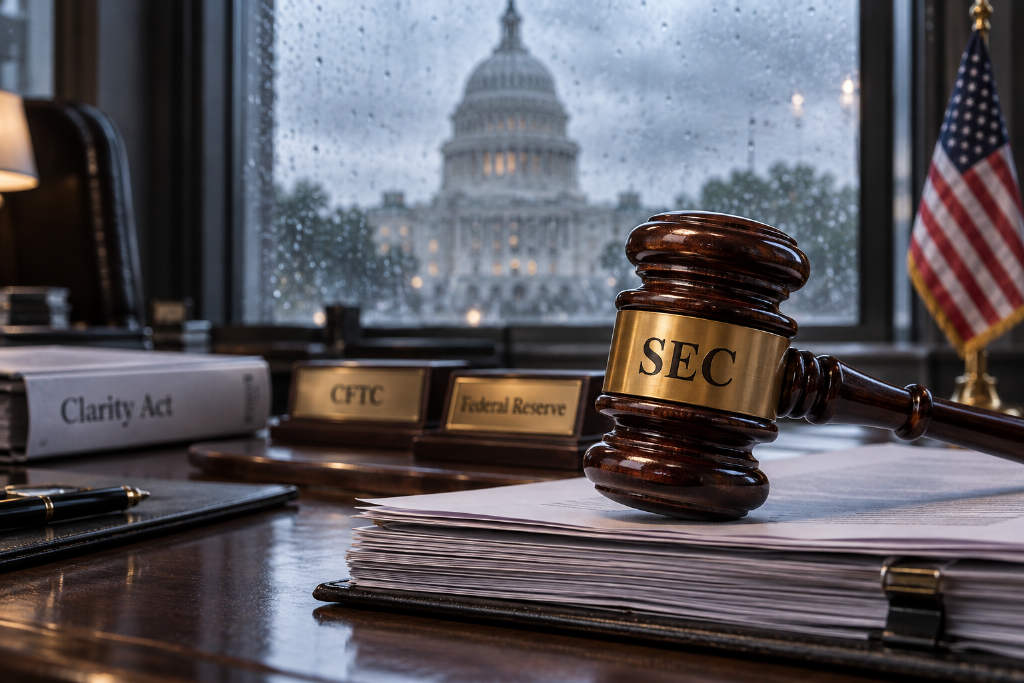
For nearly two years, the crypto industry’s strategy in Washington revolved around one word: clarity. The assumption was simple. Pass a market-structure law, and the rest of the regulatory framework would follow.
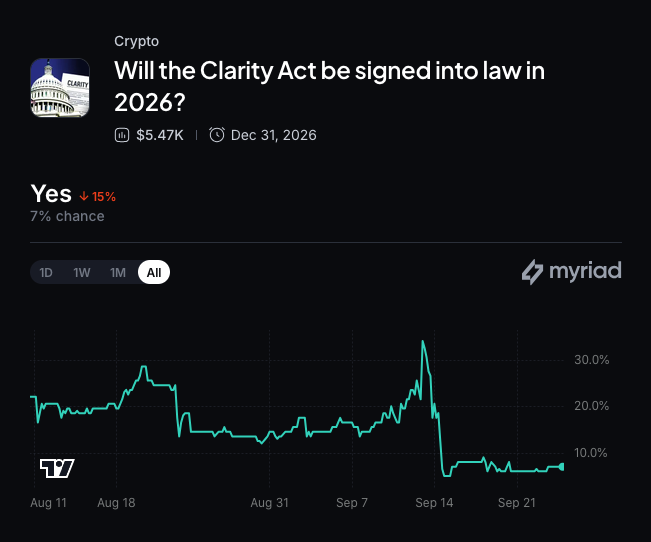
That plan has now run into a wall. With Congress stalled, the industry’s attention is shifting toward federal regulators.
Last week, the Senate failed to move the Clarity Act forward. The market-structure bill, more than a year in the making, fell in a 49-50 procedural vote, well short of the 60 votes needed to advance. Democrats voted against it, and three Republicans joined them after months of talks broke down over ethics provisions tied to President Donald Trump’s crypto ventures. Senator Cynthia Lummis, the bill’s lead architect, said the effort was all but finished for the year.
The bill’s collapse did not stop rulemaking. It changed where the action would happen. Within 48 hours, federal agencies began moving to fill the gap themselves.
SEC moves first with digital asset innovation exemption
The Securities and Exchange Commission took the clearest step. SEC Chairman Paul Atkins directly referenced the Clarity Act’s failure when he introduced a new “innovation exemption” for digital assets. Under that framework, qualifying trading venues would be allowed to trade tokenized U.S. stocks on-chain without registering as national securities exchanges.
The move signaled that the SEC intends to shape crypto policy through its own authority instead of waiting for Congress.
CFTC advances on a parallel track
The Commodity Futures Trading Commission has also been active. CFTC staff issued a no-action position allowing passive software providers, including crypto wallet apps, to give users access to regulated derivatives without registering as introducing brokers.
The agency also sent a broader crypto-markets rulemaking package to the White House for review, though the text has not been made public.
Federal Reserve and OCC push stablecoin rules ahead
The Federal Reserve followed on Thursday with a proposed rule that would require the stablecoin issuers under its supervision to fully back their tokens with safe, liquid assets and to hold capital against operational risks.
That proposal is part of the multi-agency rollout of the GENIUS Act, the stablecoin law signed by President Donald Trump in 2025. The rollout also includes the Office of the Comptroller of the Currency, which has been working to finalize its own stablecoin rules by November ahead of a statutory deadline in January.
Industry turns to regulators for guidance
The result is a regulatory framework being assembled rule by rule rather than through a single act of Congress. Much of the industry appears to have accepted that reality.
Kristin Smith, president of the Solana Policy Institute, said the sector is “now looking to regulators for guidance,” and called that “the more viable path forward right now.”
There is a tradeoff. Agency rulemaking can take longer to write. It is also easier to challenge in court and easier for a future administration to unwind than a law passed by Congress.
From hostility to reluctant acceptance
The shift is striking given how recently the SEC was seen as crypto’s chief adversary. Under former Chairman Gary Gensler during the Joe Biden administration, the agency pursued what the article described as a “regulation by enforcement” approach. That climate rattled crypto executives across the sector. A market-structure law was supposed to make sure those conditions did not return.
For now, though, the industry is taking what it can get. What it has in front of it are rules written by regulators once viewed as hostile, rather than a single statute passed by what the article describes as arguably the most industry-friendly Congress yet.
Whether those rules endure will be a defining question in the months ahead, and possibly for years.