
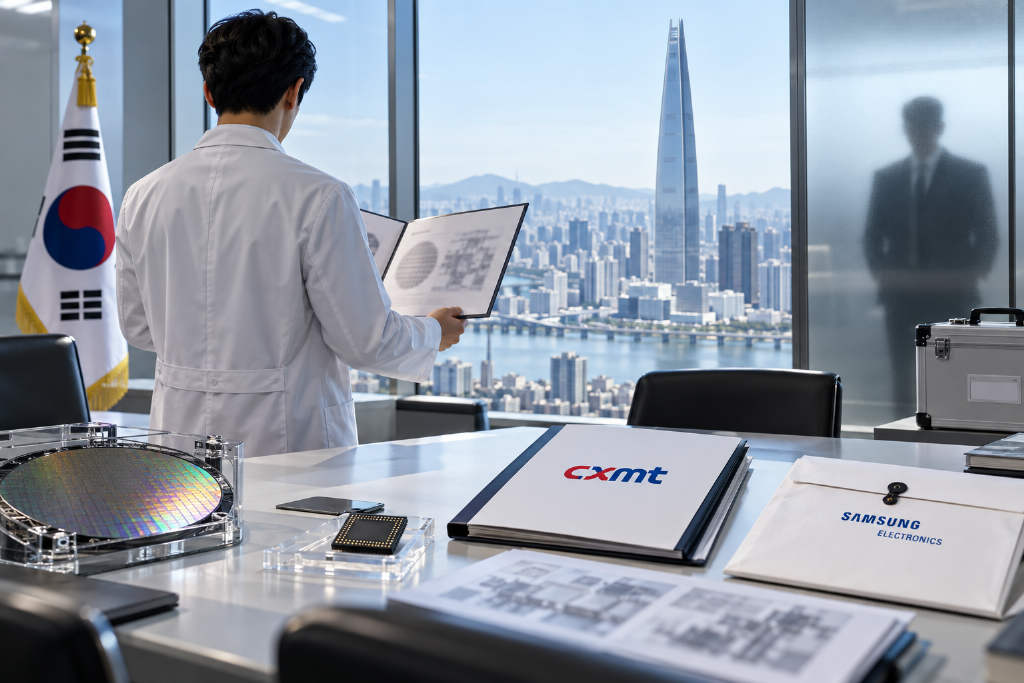
South Korea’s JoongAng Ilbo said on Sept. 29 that David Wang, the former chief executive of ChangXin Memory Technologies (CXMT), allegedly told Korean engineers at the company who had come from Samsung Electronics to bring over Samsung’s 18nm DRAM process recipe (PRP) and equipment data in late 2016. The paper, citing investigation records, said the case exposed a chain of pressure: investment promises from the Chinese government, pressure on the company, then pressure on employees.
Investigation records describe threats made to Korean engineers
Based on records cited by the report, a former Samsung Electronics department head surnamed Jeon — who spent 28 years at Samsung before joining CXMT to manage equipment investment — said Wang repeatedly called in the Korean technical team between October and December 2016 and told them: “Bring all of Samsung’s PRP and equipment information that you have. If you do not bring it, I will report you to the South Korean government.”
The report said Wang also warned that he had people who could check whether the material was real, and told the team not to try passing off fake documents. And one more detail: CXMT executives allegedly used “Huangshan” as an internal code name for Samsung Electronics. A current prosecutor quoted in the article said those legal threats suggested the executive knew the conduct was illegal.
The article said Jeon was indicted last year and, in a first ruling in April this year, was sentenced to seven years in prison. The case is still on appeal.
The 18nm PRP reportedly covered about 600 manufacturing steps
The report said the Samsung 18nm PRP Wang wanted was the full road map for the process, covering roughly 600 steps in DRAM manufacturing. Everything. The sequence of each step, the names and models of the equipment involved, and exact process-condition parameters were all included.
At the time, 18nm meant semiconductor circuit widths of just 18 nanometers. Back in 2016, the industry viewed that node as a hard barrier, and Samsung Electronics was the first company to mass-produce at that level. The report said Samsung had spent more than KRW 1.6 trillion on related research and development.
It also said the material was eventually copied out by a former Samsung process design engineer surnamed Park, who wrote it by hand into a 12-page notebook in September 2016. According to the article, Park is now the subject of an Interpol red notice.
Testimony said funding was tied to 18nm mass production
Jeon said in September this year that CXMT was itself under pressure tied to Chinese government investment. He was quoted as saying: “At the time, the Chinese government said that if CXMT could not mass-produce 18nm, it would not provide investment funds, and CXMT had no intention of developing the technology on its own from the start.”
The report said the timing of Wang’s pressure campaign lined up with the period just before CXMT was due to seek investment funding from the Chinese government. In the paper’s telling, that timing pointed to a simple model: the government set the technical goals, and the company had to find a way to hit them.
CXMT’s funding history and hiring practices were also detailed
CXMT was established in 2016 with direct backing of RMB 14.4 billion from Hefei Industry Investment, a Hefei city government entity, the report said. It also said the company stayed in the red for nearly a decade and posted its first annual profit only last year, when net profit reached RMB 7.1 billion.
On hiring, Jeon said CXMT would take any “current Samsung A-grade employee,” and sometimes even a contact detail alone was enough to get that person hired.
A report from the Taiwan-based Research Institute for Democracy, Society and Emerging Technology also said CXMT tapped ties through senior Taiwanese executives linked to Nanya Technology and Inotera, which has since been acquired, to poach hundreds of engineers in groups by offering two to three times their earlier salaries. The article said that helped CXMT become the world’s fourth-largest DRAM maker within a decade.
Court findings could shape later international litigation
The article said people in legal circles believe that if a court formally determines CXMT executives were involved in technology theft, Samsung Electronics would have more leverage in later international trade litigation.
For comparison, the report pointed to the OLED trade-secret fight between Chinese display maker BOE and Samsung Display. In that case, the U.S. International Trade Commission found infringement and recommended a U.S. import ban lasting 14 years and eight months. The dispute was later reportedly settled with a licensing payment of about KRW 1 trillion.
The report said the outcome of the CXMT case could shape not just the legal battle between Samsung and CXMT, but also serve as a judicial reference for how the global technology industry responds to state-led efforts to obtain technology.