
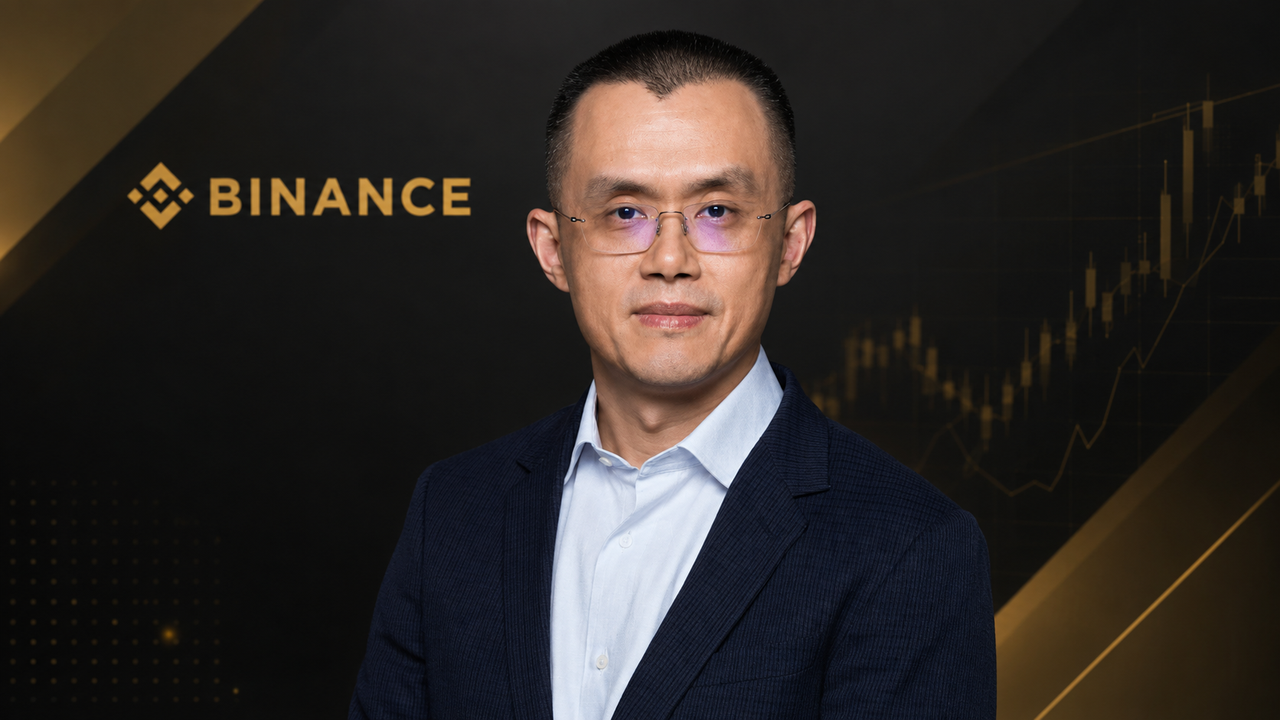
Binance founder Changpeng Zhao, better known as CZ, said crypto’s next growth phase could come from AI-driven payments, tokenized real-world assets and a deeper merger between traditional finance and on-chain finance, according to remarks in a Talking Tokens Podcast interview.
In the discussion, Zhao looked back at Binance’s launch in 2017, said the exchange became the world’s largest within five months, and reflected on what he would change if he were starting over. He said he would learn law, compliance and politics earlier, and he would also move faster on product launches.
The interview was translated by Wu Blockchain. The original text said the guest’s comments do not represent Wu Blockchain’s views and do not constitute investment advice. It also noted that the audio transcription and translation were completed by GPT and may contain errors.
Why Zhao thought exchanges could be built better in 2017
Asked what problem he wanted to solve before launching Binance, Zhao said most of his career before 2017 had been tied to order execution and exchange systems. From that vantage point, he believed the exchange business still had obvious weaknesses.
He said products could be better, technology could be stronger, matching engines could be much faster, security could be tighter and customer service could improve materially. In his view, exchanges at the time were not truly putting users first. That gap, paired with the market cycle then underway, created an opening for Binance.
When asked what advice he would give his 2017 self, Zhao said a lot had happened over the past nine years and that he had grown older through those challenges. Looking back with what he knows now, he said he would tell himself to spend more time learning legal and compliance matters, and to study politics as well.
Zhao said that before 2017 he was essentially a technologist, focused on building better products and protecting users. He said he underestimated the importance of legal issues, which was also an area where he was weak. He added that he did not understand international law well enough at the time, including how different countries apply their own laws and how some U.S. laws can reach globally and carry long look-back periods.
His second lesson was speed. Zhao said founders are usually better off bringing products to market earlier and then adjusting based on user feedback. He pointed to Binance futures as an example, saying the product launched two years after the company was founded. If he had another chance, he said, he would likely launch futures earlier.
Binance reached No. 1 in five months, Zhao says
Zhao said Binance became the world’s largest exchange around five months after it was founded and stayed there every day afterward.
He attributed that outcome to several factors. A company needs a strong product and strong customer service, he said, but it also needs a mission. For Binance, that mission was to increase the freedom of money, while one of its most important values was protecting users.
According to Zhao, user protection helped Binance hold its leading position after it got there and also supported growth. He also said timing mattered. In 2017, many exchanges were still mainly Bitcoin exchanges. Some U.S. platforms listed only four tokens, and one of the biggest U.S. exchanges at the time had not yet listed Ethereum, he said.
At the same time, he stressed that the market was not empty of competition. Bittrex and Poloniex were both major players globally. Binance, in his telling, caught an industry turning point and the momentum around altcoins while also competing on product quality, service and user protection.
Crypto wealth penetration is still below 1%
On what makes a product sticky in the current market, Zhao said there is always room to improve products in any era and in any industry. Nothing is perfect.
He first pointed to fiat on- and off-ramps, saying they still carry high friction today. A product that lowers that friction across more regions and reduces costs would answer a need many users still have.
He then turned to stablecoins. Zhao said some of the most widely used stablecoins do not pay yield to users. Others may offer interest, but are difficult to trade with. A stablecoin that can provide attractive yield while also remaining easy to transact with would be another area where the market can still improve.
On real-world assets, or RWA, Zhao said the sector is only getting started. He said only a small number of stocks have truly been tokenized so far, and the market remains heavily centered on the U.S. He asked why other countries would not want to tokenize their stock markets and let global investors participate more broadly.
That feeds into his wider point: crypto is not saturated. Zhao said many people think the market is already full, but from a wealth penetration standpoint, crypto asset penetration is probably still under 1%, and definitely below 1%.
Zhao says many still see crypto as only an investment asset
The conversation then moved to mainstream adoption. The host noted that the industry has spent years talking about onboarding the next billion users, while the first billion has not actually arrived.
Zhao said the biggest misconception is that many people still treat crypto as an investment asset rather than foundational technology. People buy Bitcoin and ask when they should exit, he said, but nobody talks about exiting the internet or exiting AI. Those are technologies people use.
In Zhao’s view, crypto and blockchain are here for the long run and belong in the same category of foundational technologies. He said they are one of the three foundational technologies he has encountered in his lifetime, alongside the internet and AI.
He acknowledged that crypto has investment characteristics. Even so, he said people should look through that surface layer and examine a project’s long-term prospects before investing, rather than treating the entire sector as a short-term speculative trade.
AI agents could become direct users of crypto payments
On the overlap between AI and crypto, Zhao said there are many ideas in circulation and that he cannot guarantee his own view is right. Still, he said one of the clearest directions is payments handled by AI on behalf of users.
He said AI can already help search for the best hotels and flights, but cannot yet fully complete bookings. In his view, that could change within months, not years. Once AI starts completing transactions directly, it will need a natively digital form of money.
AI could use a user’s credit card to book a hotel or flight online, he said, but that would be cumbersome. Crypto would be a much cleaner fit. For that reason, Zhao said payments may become the biggest breakthrough point between AI and crypto.
As more people use AI to make payments, they will indirectly or directly use cryptocurrency, he said. He added that traditional fiat payment systems do not handle global payments particularly well. They may work inside one country, but the problems become clearer in cross-border settings.
Zhao said he expects more global citizens and more global transactions over time. Whether someone is paying another person on the other side of the world or booking travel in another region, crypto payments would be easier to use in those settings, he said.
He also mentioned other possible areas of overlap, such as using blockchain to verify training data, but said those applications are farther from real deployment. Most AI companies today are still centralized, large, profitable and highly valued, which means decentralization may not be a priority for them right now.
When asked how soon crypto payments could gain real traction, Zhao said his guess is one to two years, or at least that is the timeline he hopes to see. He added that the earliest users are likely to come from the crypto community and from early adopters of AI-based tools.
Companies should use AI aggressively, but not blindly
Zhao said he sees AI in much the same way he sees the internet. In practical terms, that means nearly every company and every individual should use as much AI as they reasonably can. But there is a limit. He said companies should not overuse it because AI is still new and still weak at some tasks.
He framed AI as a productivity tool. If it increases productivity, companies should use it. Zhao said AI is especially good at helping people write code. It cannot independently build a huge and complex system yet, but it can help write code snippets, check bugs and analyze code.
He added that people who know how to work with AI can also use it effectively in design, graphics and video work. Even so, Zhao warned against handing everything over to AI, from all writing to all video production.
His reasoning was simple. The world is still made up of people, and people still need human participation and human warmth. AI has become fairly capable on the creative side, he said, but it is still not good at the kind of originality humans can produce. That leaves a major role for people.
AI could reshape crypto security and speed up blockchain development
Looking five years out, Zhao said AI could have a profound effect on security, especially technical security. AI is very good at finding vulnerabilities, he said, and that ability can be used for good or for bad.
Developers can use AI to identify weaknesses in their own systems, which should make today’s systems much safer because issues can be found much more quickly. Zhao added that, based on what he has heard, Anthropic’s latest model is very powerful. He said he hopes tools like that become available to developers in some form to help improve their systems. In the short term, though, he said hacking incidents could still appear here and there.
Zhao also tied AI to blockchain performance. He said blockchains still face limits in efficiency and throughput, and the industry needs chains that are faster and can handle more capacity. If that happens, the cost of using blockchains should fall as well. AI, in his view, will play an important role in accelerating that kind of technical development.
He broadened the point from there. If the internet brought people into the digital world, AI could push that process 10 times or even 100 times further, he said. The more digital the world becomes, the greater the need for digital money.
Zhao said paper cash is already an outdated concept. While most money no longer exists physically in paper form, he argued that the financial system still inherits thinking from the paper-money era. He said the world ultimately needs to move past that model, and AI could help push it beyond that threshold.
Lending, debt and RWA remain open fields for crypto platforms
Asked what product or use case Binance might not have today but could have millions of users by its 18th anniversary, Zhao said it is hard to picture that far ahead, especially because Binance already offers many products.
Even so, he said Binance and other crypto platforms still have room to enter new areas. One is lending and debt. Binance already offers related products to some degree, but lending and debt remain a small share of crypto overall, while debt is an enormous market in traditional finance.
The other clear area is tokenization and RWA, which he said everyone is talking about now. As for a category nobody has thought of yet and nobody has built yet, Zhao said he could not name one on the spot and added that he is not particularly good at inventing completely new ideas out of thin air.
Stepping down from the CEO role changed his vantage point
Zhao said leaving the CEO role gave him a very different perspective on the industry. When he was running Binance, he said, almost every question became: what does this mean for Binance?
That naturally narrowed his field of view. He said he used to attend 20 to 25 meetings a day, with issues constantly coming up. Because Binance was such a large and influential platform, many other things in the industry looked smaller by comparison.
Now that he has been forced to step back, Zhao said he has more room to look at the industry as a whole. He also has time to study new subjects such as AI and biotech, as well as new directions inside crypto.
He said there is a common misunderstanding that because he was CEO of Binance, he must have known every new thing happening in crypto at the time. In reality, he was so busy operating the company that he did not have enough time to properly study many new developments across the industry.
Zhao said that broader perspective has helped him learn faster. He used stablecoins as an example, saying he missed them to some extent when he was running Binance because he did not expect them to become as large as they are today. At the time, he saw stablecoins more as a temporary patch used to connect exchanges and facilitate some transactions. That judgment, he said, turned out to be wrong.
Now he spends a lot of time studying RWA, or asset tokenization, and said he is advising some governments in that area. He said that is one result of having more time to observe and research new things after stepping back.
If he had to start from zero today, Zhao says he would still build an exchange
Near the end of the interview, Zhao was asked what he would build if he were starting from zero today, with no Binance and no existing reputation, but with the experience he has accumulated.
His answer was straightforward: he would still have to choose something he knows how to do, and his experience would largely take him back to building an exchange.
Zhao said he often tells people to look for the intersection of three things: what they are good at, what they are interested in and what creates value for other people. In his own case, the skills he knows best and most of his experience come from building trading systems. Leading an AI team, he said, would probably be a disaster for him. So he would stick to what he understands best.
Traditional and on-chain finance will end up as one system
On the long-term relationship between traditional finance and on-chain finance, Zhao said he does not believe the two should remain separate. He rejected the idea that there should be a lasting opposition between crypto finance and mainstream or traditional finance.
To explain the point, he used communication as an analogy. There used to be physical mail and now there is email, but when people send messages today, most of them do not think in terms of two separate communication systems. Finance, he said, should be viewed the same way.
In Zhao’s framing, crypto and blockchain are simply new technologies adopted by the financial system. Because the technology is still relatively new, it has produced a distinct vertical around itself for now. Over time, that vertical will merge into the broader financial system.
He said signs of that merger are already visible. Stocks are being tokenized and moved on-chain, while banks and traditional financial institutions are also using blockchain. His conclusion was blunt: there should not be two financial industries or two parallel financial systems. In the end, there will be only one.
The source article also carried a risk reminder stating that markets involve risk and that the content does not constitute investment advice.