
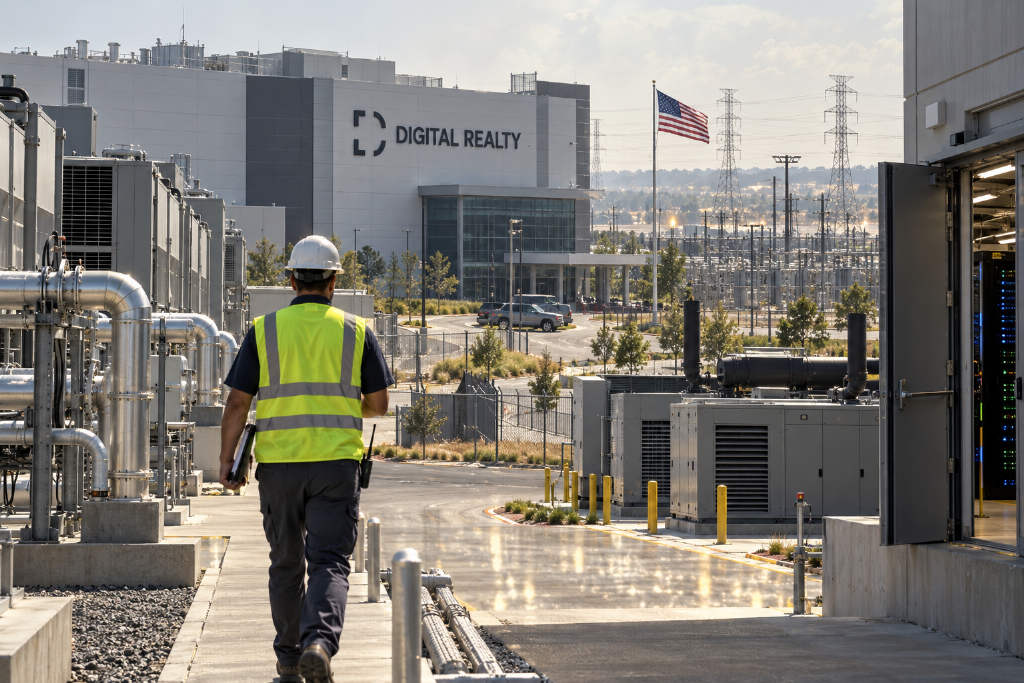
AI infrastructure spending is often discussed in terms of chips, electricity, land and financing. Inside the buildings where that compute actually runs, the work looks different. It is physical, repetitive and built around preventing things from going wrong.
At a more than 90,000-square-meter data center in Ashburn, Virginia, Digital Realty chief engineer James Waddy walks about 30,000 steps a day. He checks air handling equipment, server rooms, pipes, cables and rooftop condensers. At times he smells for signs of burning, touches pipes for abnormalities and looks for bird damage on equipment. None of that sounds like AI development, but it is part of the infrastructure that keeps AI systems online.
30,000 steps a day to keep the site stable
Over the past year, discussion around AI infrastructure has focused heavily on GPUs, power plants, transformers, land, financing and hundreds of billions of dollars in capital spending. A data center on the ground is also something else: a large physical system that has to operate 24 hours a day.
The US currently has about 2,700 operational data centers. As AI-driven demand for compute grows, more facilities are being built, and the requirements on power, cooling and networks keep rising. Behind those systems are workers who may not train large models or write AI software, but whose job is to make sure the buildings housing the servers do not fail because of overheating, power loss, equipment breakdowns or a problem with a single fiber line.
In that sense, they function as the caretakers of the AI era.
Waddy has worked at the Digital Realty data center in Ashburn for three years. He has a business degree and previously worked in sales at an HVAC company. He started on night shifts, moved up through the ranks, and now manages dozens of engineers, describing himself as the team’s “general.” His core responsibility is to keep critical infrastructure running.
His daily rounds begin in the air handling room, where large cooling systems feed cold air into the data center. Farther up, the data hall resembles an oversized locker room. Rows of servers sit in racks or cages leased by different companies. There are no customer logos on display, and it is often impossible to tell who owns which machines. Competitors’ systems may be running just one row apart. The closer workers get to the servers, the louder it becomes, and ear protection is required.
Above that is the roof. Waddy checks lines of condensers, looking for faults and for damage caused by birds. From there, he can see cranes in the distance at another company’s construction site.
“It’s nice up here,” Waddy said. “I like this kind of inspection.”
The facility has been operating for nine years. Its hallways are long enough that some technicians use scooters to get around. Inside are tall cable cages, along with cots and showers for staff who may need to stay on site during extreme weather. At times as many as 120 people may be in the building, including about 50 full-time employees, with the rest made up of contract security workers and customer-assigned staff. Even so, many rooms remain empty on workdays.
A “human sensor” in a facility where small issues matter
While Waddy’s title is engineer, the work is not the same as research or design engineering.
Technology analyst Winston Smith said the role is closer to that of a critical facilities technician, or CFT, or a data center operations technician, or DCO technician. The work centers on site inspections, infrastructure maintenance and emergency response.
Smith said Waddy’s use of hearing, smell and touch to detect problems effectively makes him a “human sensor” for the facility. He is looking for signs of trouble in mechanical, electrical and cooling systems before monitoring software sends an alert, or before equipment actually fails.
The tasks may look mundane. They are not trivial. Data centers are built to avoid surprises, and even a seemingly minor anomaly can disrupt redundancy planning or maintenance schedules. An unexpected delivery of large equipment, a fault in a secondary system, or a small irregularity can all affect operations.
For Waddy, a good day is not one in which he solved dramatic failures. It is one in which nothing happened. He walks across raised floors while air circulates below to cool servers. No unusual sound. No odd smell. Everything normal. That is the outcome operations staff want.
Chasing six nines of uptime, one fiber at a time
Data centers aim for reliability so high it can seem almost dull. Digital Realty estimates its facilities operate at 99.999% uptime and wants to push that to 99.9999%. That extra nine looks small, but it cuts annual downtime from about six minutes to roughly 30 seconds.
To win back those seconds, every part of the system has to be dependable. For Jeff Hansen, a data center technician at CC&N, that means working on one of the smallest components in the chain: fiber.
The core of a single-mode fiber is only 8 to 9 microns in diameter. A human hair is about 75 microns thick. To join two fibers, a fusion splicer aligns the cores at 1,000x magnification and then uses an electric arc to melt the glass together. Hansen calls it “microscopic welding.”
“Working with fiber is like playing with lasers,” he said. “A strand of fiber is a microscopic glass filament carrying an incredible amount of information. That fascinates me.”
A room in a hyperscale data center may contain thousands of these connections. Each fiber has to be routed, terminated and tested individually. If a test fails, the root cause can be one of countless possibilities, and technicians work through the problem with process and experience.
That is why improvisation is rare in a data center. Hansen said his team meets before each site visit to confirm the work scope, tools and project details. Team leads prepare briefings and review what has changed since the last visit.
These facilities change fast. A site that was still under construction six months ago may already be fully operational. Access permissions, operating protocols and risk levels may all be different.
“You can’t freestyle data center work,” Hansen said. “It takes a lot of planning to do it right, and that starts before we ever set foot on site.”
Access controls reflect that environment. Entering a hyperscale facility may require badge checks, identity verification and even iris scans. Cardboard and paper may be banned because they create dust. USB drives and other storage devices may also be prohibited.
Even a task that appears to take only five minutes cannot simply be done on the spot. Replacing equipment, adding systems, moving cables or carrying out maintenance requires advance requests, risk assessment, scheduling and coordination with other teams. Small incidents are documented too: minor power fluctuations, flickering lights, unusual sounds from cooling equipment, even a small puddle on the floor can trigger a report.
For cabling technicians, safety has three layers at once: do not injure yourself, do not injure coworkers, and do not damage equipment. In a live data center, moving a fiber that is carrying traffic can have direct consequences.
What the industry needs is not heroics. It is a process designed to work without them.
AI has made an obscure industry visible, and hiring is tightening
Data centers used to be easy to overlook. AI has pulled them into public view.
According to industry data provider Data Center Map, the US has about 2,700 operational data centers, nearly 400 under construction and at least 1,500 in planning. Ashburn, where Waddy works, sits about an hour outside Washington, DC, in what is widely known as Data Center Alley.
Data centers are not labor-intensive in the traditional sense. A single facility may need only dozens to a few hundred workers for ongoing operations. But when thousands of sites are being built and run at the same time, demand rises quickly for engineers, technicians, maintenance workers and project managers.
Job site Indeed said more than 1 million people searched for data center positions this year. In August, search volume was eight times higher than it was at the start of 2022. Indeed also found that hourly workers in maintenance and installation roles earn about 42% more in data centers than workers in comparable jobs in other industries. Data center project managers make about $115,000 a year.
Digital Realty said entry-level engineers earn about $66,000 annually, while experienced engineers average more than $120,000.
Technology commentator Evan Kirstel said on social media that data center construction is lifting wages for electricians, technicians, HVAC workers and security staff, turning AI infrastructure investment into concrete blue-collar employment opportunities.
The real shortage, though, is people who can handle complex infrastructure. Brandi Galvin Morandi, chief human resources officer at digital infrastructure company Equinix, said demand is strong for talent with expertise in electrical systems, network engineering and cooling systems.
At the Ashburn facility, white-collar and blue-collar roles sit side by side. Some workers handle security, some manage customer cabling, some handle procurement, and engineers monitor the overall facility. The mix is broadly similar at data centers across the US.
The problem is speed. Hiring and training are not keeping pace with construction. Cindy Fiedelman, chief human resources officer at Digital Realty, said these sites run around the clock, so workers need technical training, safety discipline and hands-on experience. The supply of that talent is expanding more slowly than the industry itself.
Community colleges have started offering data center-related courses, and large technology companies are funding training programs. In Virginia, Northern Virginia Community College has launched data center workforce programs with private-sector support. Companies including Meta are also involved in skilled labor development.
Michael E. Webber, a professor at the University of Texas and author at Energy 101, said AI data centers are creating blue-collar jobs and may put pressure on some white-collar work, though white-collar workers may find it easier to move into other occupations.
Digital Realty now operates more than 300 data centers across six continents. In facilities like the one in Ashburn, it leases space to large technology companies that need compute capacity. Customers include Oracle, Meta and IBM. The servers may come from different vendors and the engineers may work for different teams, but the requirement is the same: keep the systems running.
Expansion is bringing public scrutiny as well
The building surge tied to AI has changed how data centers are seen. They are no longer just back-end infrastructure.
Don Atkinson, 53, has worked at Digital Realty for about 14 years and has also handled backup power system maintenance. He now manages younger engineers. What feels unfamiliar to him is the shift in public attention. He said he does not use AI much himself and added, “It’s a weird time right now.”
Another employee, Malcolm Mosely, put it more plainly: “I’m just here to do my job.”
The industry is finding it harder to stay outside broader debates. In Atlanta, Digital Realty is seeking an exemption from a local construction moratorium that limits data center development near transportation hubs. The company wants to build a $500 million data center there. Local residents oppose the project, and it is currently stalled.
Similar disputes are emerging as data center expansion continues. In the past, few people paid attention to what happened inside these buildings. Now power consumption, water use and community impact are part of public discussion.
The industry is being recast. It is no longer only the back room of the internet. It is also infrastructure for the AI era. Higher wages, heavy hiring, community opposition and energy pressure are all arriving at once. Behind that noise are engineers who keep walking their rounds, day after day, making sure the digital world does not stop.