
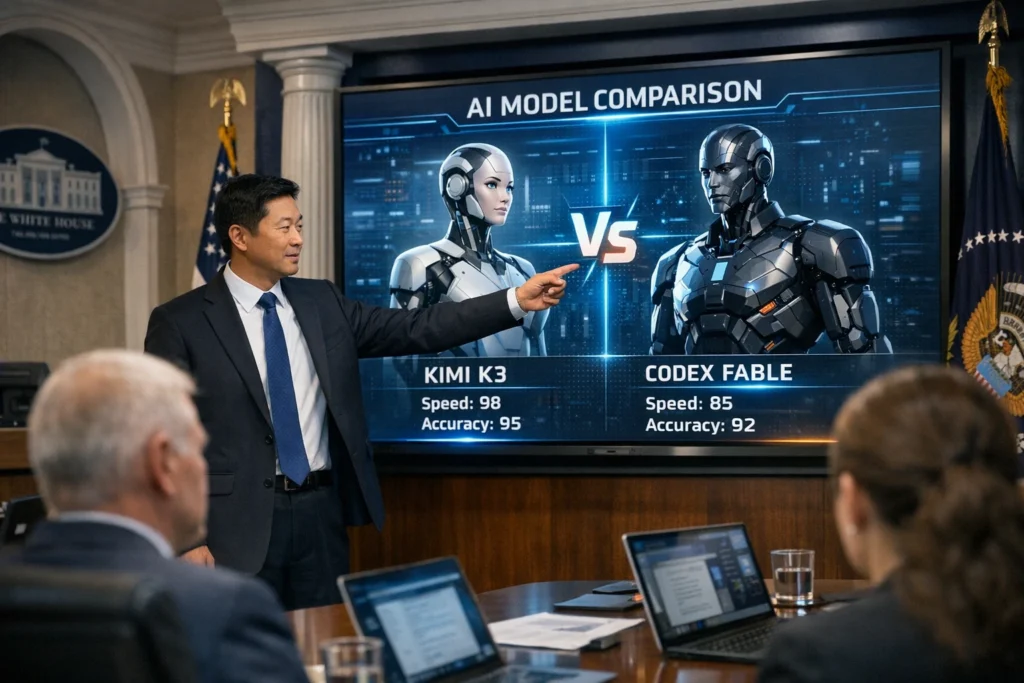
White House AI adviser David Sacks said on July 20 that Kimi K3 had just fixed 15 critical security flaws, while Codex and Fable had previously refused to address the same issues because of what he called “cybersecurity guardrails.”
Sacks wrote on social media that there was no reason to restrict U.S. domestic models from performing tasks that foreign models could complete, adding that doing so would only weaken American competitiveness.
Kimi K3 and the 15 critical flaws
According to the report, Kimi K3 is the model that topped a frontend coding ranking this month and beat Claude Fable 5 in a human blind test. The 15 critical security flaws referenced by Sacks included internal bugs found during training, errors in reasoning paths, and failures in model self-calibration.
If those flaws had not been fixed, they would have directly affected the model’s accuracy in core tasks such as code generation and logical reasoning.
The guardrail effect on Codex and Fable
The article says Codex is OpenAI’s code model series, while Fable refers to Anthropic’s Claude family. “Fable 5” is described as the latest Claude Opus-class model. In Sacks’ account, U.S. models have more cybersecurity guardrails during training and inference, including mandatory output-format checks, limits on reasoning depth, and the exclusion of certain reasoning paths.
Those controls may improve reliability, but the report says they can also block the model’s ability to correct itself. That is the basis of Sacks’ criticism that the U.S. AI race is being constrained by self-imposed limits.
A same-day argument for verifiability
On the same day Sacks made his comments, Succinct Labs executive Brian Trunzo wrote that traditional approaches that rely on AI to detect AI have already failed, and that zero-knowledge proofs, or ZK proofs, can give AI independently verifiable “behavioral credentials.”
The report says that view echoes Sacks’ position in one respect: AI models need to be reliable, but they also need to be verifiable.
Other related items cited in the report
- Kimi K3 topped a frontend coding leaderboard and beat Claude Fable 5 in a human blind test.
- The Kimi team previously discussed how K3 was developed, criticized what it called four major problems in the AI industry, and disclosed its internal “Five Kimi Rules.”
- On when Fable 5 could return, Polymarket prediction market data showed a 75% probability of a July unblocking.