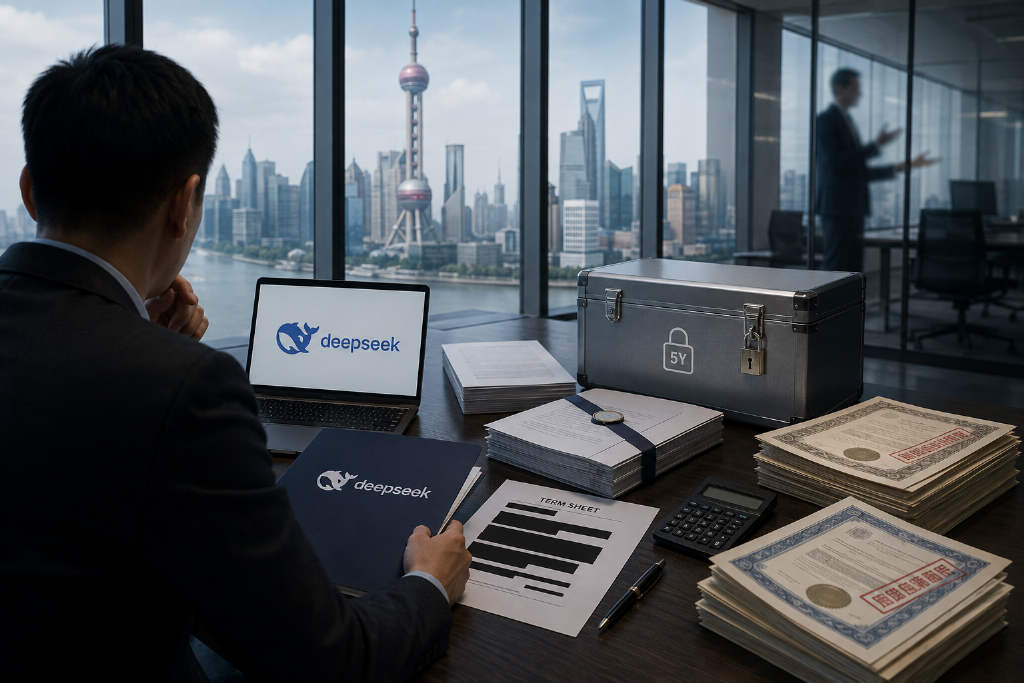
A Caijing report said some intermediaries marketing access to DeepSeek investment allocations were asking for unusually high fees, with terms described as "18% upfront and 35% on the back end." Under that structure, an investor committing 100 million yuan would first pay 18 million yuan, then give up 35% of any future returns. The report added that even investors willing to accept those terms still had no guarantee of receiving an allocation.
According to the report, DeepSeek conducts look-through identity checks on participating investors and on the limited partners behind investment funds. The investment also carries a five-year lock-up period, during which transfers are not allowed. Aside from the National Artificial Intelligence Industry Investment Fund, most outside investors do not receive voting rights or board seats and only share in financial returns based on their contribution.
The report also described a broader wave of fake allocation claims and intermediary disorder around the fundraising. Some institutions claimed to control large allocations but did not make the final investor list. In another case, an investor reportedly paid a 5 million yuan "meeting fee" in an attempt to reach Liang Wenfeng, but the effort did not succeed.
ChainCatcher, citing Caijing, reported that some intermediaries offering access to DeepSeek investment allocations were quoting fees of "18% upfront and 35% on the back end." That means an investor putting in 100 million yuan would first need to pay 18 million yuan in upfront fees, then hand over 35% of future gains.
Caijing said paying those charges still does not guarantee an allocation. The report added that DeepSeek carries out look-through identity checks on investors joining the fundraising, as well as on the limited partners behind participating funds. The investment comes with a five-year lock-up and cannot be transferred during that period.
Except for the National Artificial Intelligence Industry Investment Fund, most outside investors do not get voting rights or board seats. They only receive financial returns in proportion to their capital contribution.
The report also said the fundraising has been surrounded by fake allocation claims and chaotic intermediary activity. Some institutions said they controlled large investment quotas but did not end up on the final investor list. Caijing also reported that one investor paid a 5 million yuan "meeting fee" in an effort to contact Liang Wenfeng, but did not succeed.
This article was originally published by Bit.Fan. For more cryptocurrency news and market insights, visit www.bit.fan. Disclaimer:
The market information, project data, and third-party content displayed on this platform are for industry information sharing only and do not constitute any form of investment advice or return commitment.
Cryptocurrency trading carries high risks. Users should fully assess their risk tolerance and make independent decisions. All profits, losses, and legal responsibilities are borne by the users themselves.