
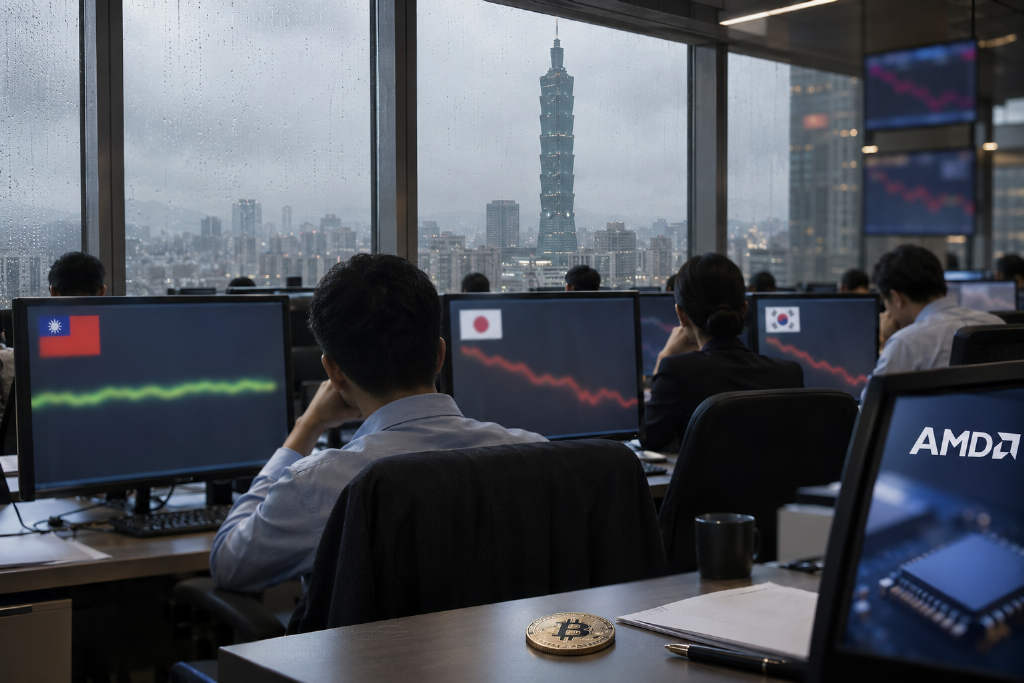
Asian technology shares fell in early trading on Nov. 4 after initial vote counts in the U.S. midterm elections showed Democrats ahead in both the Senate and the House, according to Reuters. U.S. stock futures also weakened during Asian hours.
CNBC data showed Nasdaq 100 futures at 27,887 at around 10 a.m. Taipei time, down 1.48%. S&P 500 futures were down 0.68% at the same time, leaving the tech-heavy Nasdaq contract falling by more than twice the pace of the broader benchmark.
CNBC-TV18 reported that Nasdaq futures had earlier been lifted by Advanced Micro Devices (AMD) earnings and were up by about 200 points. As vote trends began to point to a Democratic sweep of Congress, the contracts reversed and at one point fell by more than 500 points. In the previous U.S. session, the Philadelphia Semiconductor Index had closed up 2.63%, while AMD’s post-market earnings release and its 2027 growth forecast both came in ahead of expectations.
Early election results put focus on Senate control
Reuters said Democratic Senator Jon Ossoff won re-election in Georgia, making it one of the first major races to be called that night. Democrat Roy Cooper also won in North Carolina, flipping one Senate seat from Republican control.
Before the vote count began, Republicans held 53 Senate seats and Democrats held 47. Democrats needed a net gain of four seats to take a majority. In the House, they needed a net gain of three seats.
As of 9 p.m. Eastern Time on Nov. 3, Senate races in Ohio, Maine, Michigan, Iowa, Texas, and Alaska had not yet been decided. Final Senate control was still pending those results.
Japanese and South Korean chip names lead the decline
Japan’s market reopened on Wednesday after a one-day holiday on Tuesday. Reuters said the Nikkei 225 initially fell 1.5% after trading resumed, and CNBC data later showed the decline widening. At 10:57 a.m. Tokyo time, the Nikkei stood at 61,125.75, down 3.10%.
Semiconductor equipment stocks posted the steepest losses. Advantest fell 8.55%, while Tokyo Electron dropped 6.09%. The report noted that the two companies make chip testing systems and wafer fabrication equipment, placing them upstream in the AI chip supply chain.
South Korea’s market opened higher and then turned lower. Reuters had earlier reported that AMD earnings helped lift Korean stocks by more than 2% in early trade. The KOSPI opened at 5,786.13, up 2.4% from the previous close, and reached an intraday high of 5,828.13.
By 11:11 a.m. Korea time, the KOSPI had fallen to 5,588.49, down 1.07%. That was 10:11 a.m. in Taipei. The gap between the session high and low was about 300 points, for a swing of more than 5%. At the same time, SK Hynix was down 2.65% and Samsung Electronics had fallen 1.48%.
Taiwan stocks hold near flat while TSMC steadies
Taiwan’s market was more resilient than Japan and South Korea. Real-time data from the Taiwan Stock Exchange showed the benchmark index opening at 43,449.45. It later reached a high of 43,741.54 and a low of 42,955.57, a spread of nearly 800 points.
At 10:12 a.m., the weighted index stood at 43,295.56, down just 12 points from the previous close. That left the decline much smaller than those seen in Japan and South Korea. The report’s opening also said the index was down about 500 points before publication.
TSMC opened at NT$2,320 and fell as low as NT$2,280 during the session. At 10:09 a.m., it was trading at NT$2,295, unchanged from the previous close.
Analysts watch the size of a Democratic win
CNBC-TV18 reported that analysts at Deutsche Bank and Societe Generale warned that if Democrats were to win both chambers of Congress, expansion in AI infrastructure would come under pressure.
Chris Weston, head of research at Pepperstone, told Reuters: 「For traders, the difference between a narrow Democratic win and a large one is critical.」 He added: 「A modest blue wave may already be largely priced in.」 In the report, a blue wave referred to a large Democratic victory. Weston said the bigger market reaction could come from the size of the margin and how far the result diverges from expectations.
A Bloomberg report carried by The Economic Times cited Andrew Ticehurst, senior rates strategist at Nomura Holdings in Sydney, as saying that a blue wave is generally seen as negative for the U.S. dollar and positive for Treasuries. He said the market reaction in Asia was consistent with that view. The same report said the dollar weakened against most major currencies, while the yield on the U.S. 10-year Treasury fell 4 basis points to 4.92%. Lower yields imply higher bond prices.
Bitcoin shows limited movement
Bitcoin was comparatively steady during the same period. Binance BTC/USDT data showed the token trading at about $76,912 at 10:12 a.m. Taipei time, up about 0.2% over the past 24 hours.



